 Written by Sophie Clarke
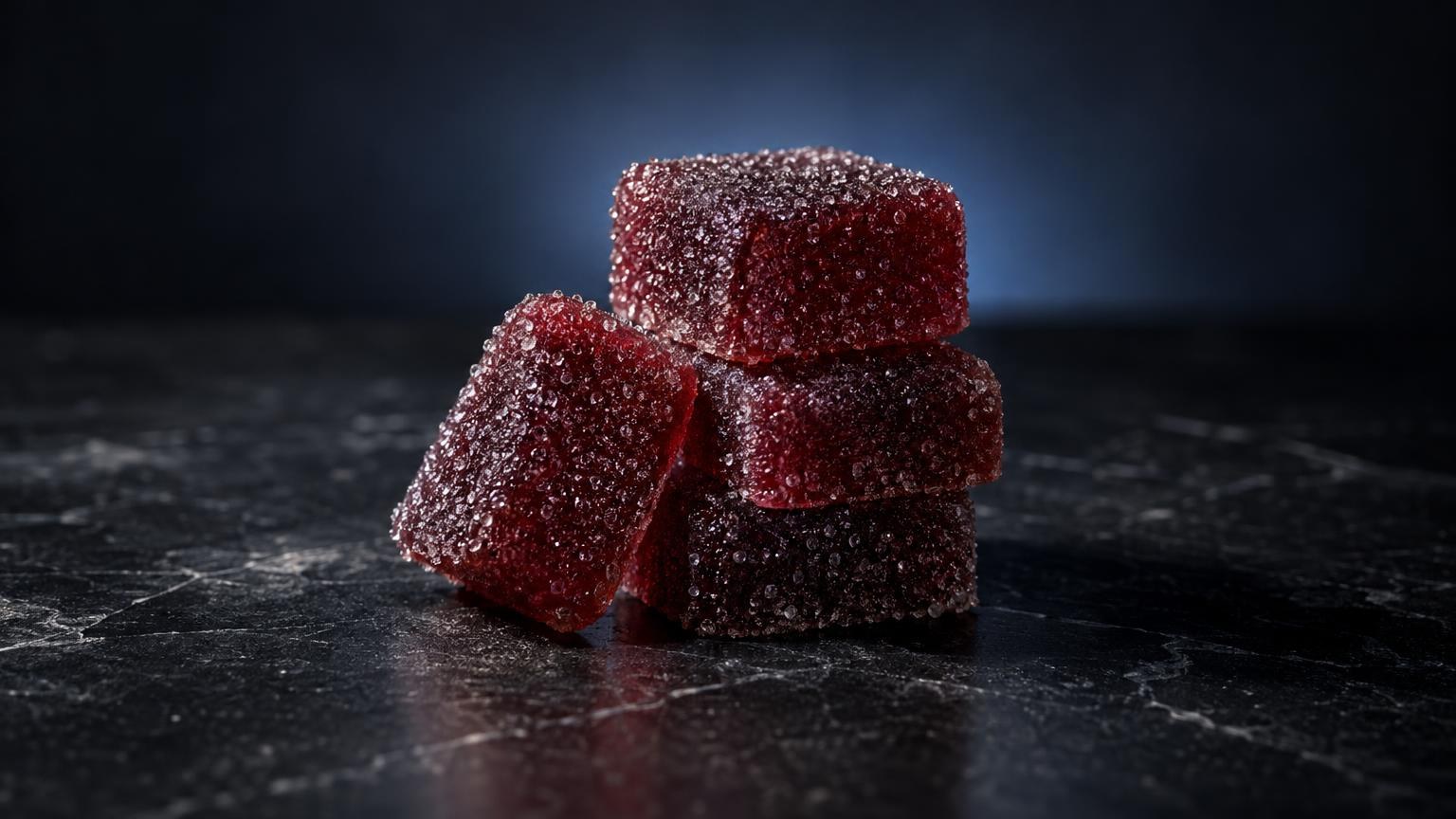
THC gummies side effects are usually temporary and dose-related, driven by how slowly edibles are absorbed; a typical intoxicating dose runs 10–30 mg of THC[4], and the delayed onset often leads people to take more than intended[5], as medically reviewed by Alex Nguyen, PharmD, RPh, CPH, referencing Centers for Disease Control and Prevention data.
Contents6 sections
THC gummies side effects refers to the unwanted reactions edible cannabis can trigger alongside the expected high. They’re usually temporary, mostly dose-related, and far more likely when you take more THC than your body is ready for.
The side effects people report most often:
- dry mouth
- red eyes
- dizziness
- a faster heartbeat
- clumsy coordination
- drowsiness
- anxiety or paranoia
Most of these aren’t a different effect from the high. They’re the same effect turned up too far, a bit like a chilli sauce that tastes great on the first bite and burns two bites later. Cannabis edibles also tend to stay with you longer than smoked cannabis use, so an uncomfortable phase can drag on for a long time.
How strongly you react depends on the balance of cannabinoids, mainly THC and CBD, in the products you pick, and on your own sensitivity. This guide sticks to side effects in recreational use: why THC gummies can hit harder than expected, where “too much” begins, what to do if it happens, and how your choice of format changes the odds. Onset times and dosing are covered in our general THC gummies guide.
Do THC gummies have side effects?
Yes. THC gummies have side effects, and the usual ones are short-lived: dry mouth, red eyes, dizziness, a faster heartbeat, clumsy coordination, drowsiness and, when the dose overshoots, anxiety or paranoia. They’re mostly dose-related, so the trouble rarely comes from the edible itself. It comes from taking more THC than your body expects.
Think of that list as the high turned up too loud rather than a separate set of problems. The body heaviness you might be after and the couch-locked drowsiness nobody wants sit on the same dial.
The effect and the side effect are often the same thing at different volumes. That’s why one gummy can feel pleasant at one amount and overwhelming at double.
Edible cannabis products also differ from smoked marijuana in how the effects build and how long they linger, which is why THC gummies side effects can feel stronger and last longer than the size of a sweet suggests. For the timing itself, our THC gummies guide on onset and dosage covers it in detail.
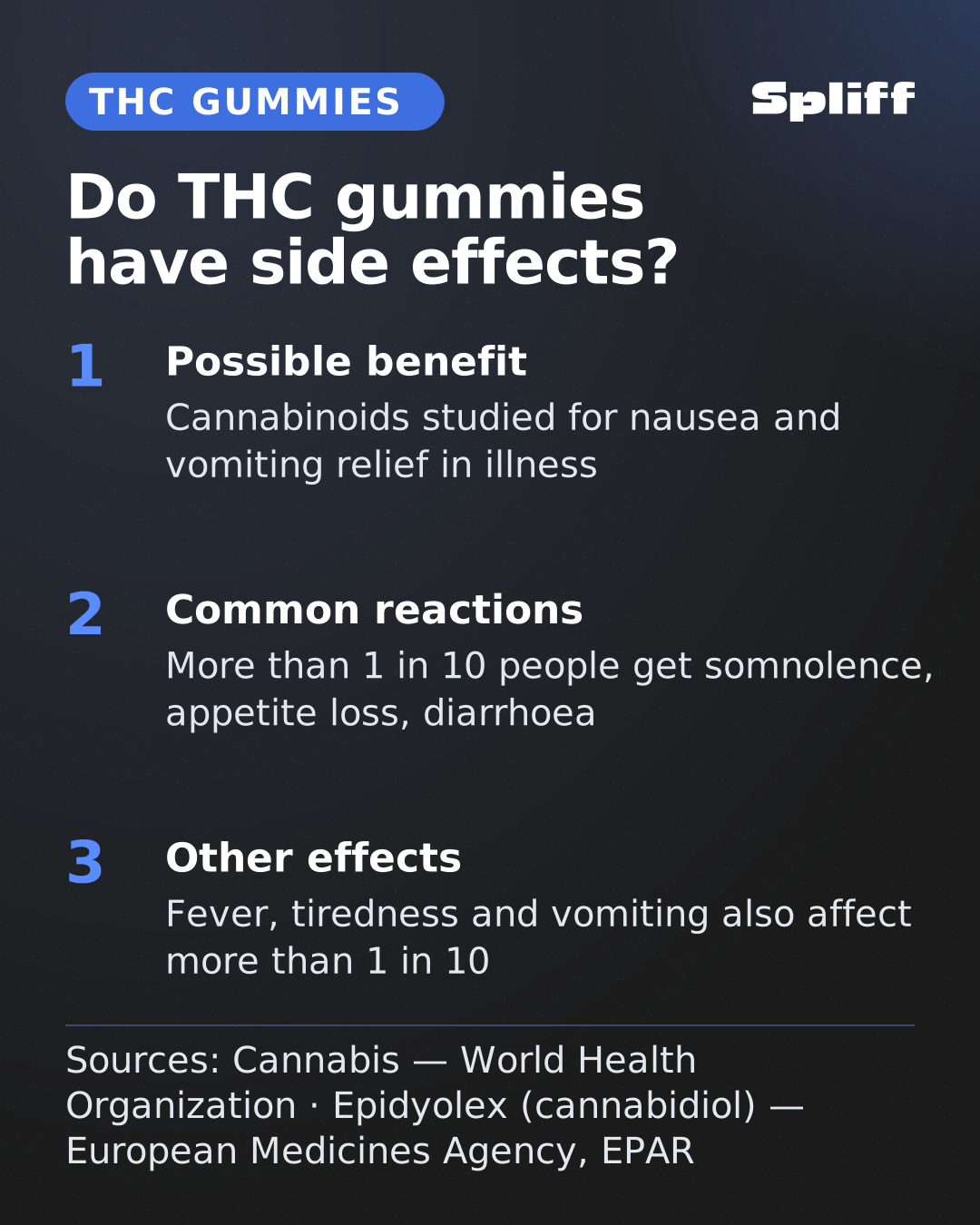
CBD edibles aren’t side-effect-free either. Epidyolex, a CBD medicine reviewed by the European Medicines Agency, lists somnolence, decreased appetite, diarrhoea, fever, tiredness and vomiting as its most common side effects, which may affect more than 1 in 10 people[3]. Those figures come from a medicinal product, not a sweet, but show that any cannabinoid acts on the body.
According to the World Health Organization, cannabinoids have been studied for nausea and vomiting in advanced stages of illnesses such as cancer and AIDS[2], which tells you these compounds are active, not that a gummy belongs in your medicine cabinet.
Why do edibles hit harder than smoking cannabis?
Edibles hit harder because the THC takes a slower, longer route: it’s swallowed, digested and processed by the liver before it reaches your bloodstream. The effect arrives late and lasts longer than with smoking cannabis, and that delay tempts people to take more too soon, which is where most unpleasant surprises start.
This depends a lot on how people use cannabis. With smoking, vaping or any inhaled route, THC reaches the blood through the lungs and you feel it fast, so you can stop as soon as it’s enough. Cannabis infused edibles work differently, because the digestive system and the liver handle THC and the other cannabinoids first, reshaping both timing and feel.
Think of a dish where the chilli builds after the first few bites. You taste, notice little, add another spoonful, and the heat lands all at once. Infused edibles follow the same curve, and the classic mistake is taking a second piece before the first one has shown its full strength.
How hard it lands also depends on factors you can’t read off the packet:
- An empty or full stomach, which can change how quickly and how sharply the effect builds
- Your tolerance: regular cannabis users and occasional ones won’t feel the same piece the same way
A review of edible cannabis published on PMC notes that psychiatric and cardiovascular complications are more likely with edibles than with inhaled cannabis[4]. That slow, sneaky curve deserves real respect, not a shrug.
Onset timings and dose guidance are reviewed in detail in our THC gummies guide. Most THC gummies side effects trace back to that delayed curve and the urge to top up early, far more than to the gummy itself.
What are the negative side effects of taking too much?
Taking too much THC from gummies usually shows up as nausea or vomiting, intense anxiety or panic, confusion, a racing heart and heavy unsteadiness. It’s unpleasant but typically passes as the THC wears off. Chest pain, fainting, or vomiting that won’t stop are the signs to get medical help straight away.
That late, stacked-up effect is where ordinary THC gummies side effects tip into overconsumption. Research on edible cannabis puts a typical intoxicating dose at 10–30 mg of THC[4]. A second helping taken out of impatience can push you well past that range.
The line between “too high” and “too much” is about control. The negative side effects below mean your body is struggling to keep up:
- nausea that builds into vomiting
- panic, dread or paranoia you can’t talk yourself out of
- confusion: losing the thread of a conversation, or not quite knowing where you are
- a pounding or racing heart
- being too unsteady to stand or walk safely
If that’s where you are, keep the plan simple. Move somewhere quiet and familiar, sip water, and don’t take anything more, including another gummy “to balance it out”. Ask someone you trust to stay with you while the effect fades, because time is what works here, and no CBD product is a proven off switch.
Some people shouldn’t experiment without a doctor’s input: anyone pregnant or breastfeeding, anyone with a heart or mental health condition, and anyone on regular medication. A healthcare professional can weigh up the risk to your health in a way no label can.
Frequent use is a separate concern from one rough evening. If cutting back feels harder than it should, or cannabis starts crowding out work, sleep or people, talk to your doctor or a local addiction treatment service. Asking early makes that conversation easier.
Gummies look exactly like sweets, and that’s the real hazard at home: edibles account for three-quarters of all cannabis-related exposures in children[4]. Keep them in their original packaging, in a closed cupboard or lockbox out of reach of children and pets, and never in a bowl next to ordinary sweets.
If you think a child has eaten one, don’t wait for symptoms. Call your national poison centre or emergency services, or head to the nearest children’s hospital.
Gummies, chocolate or space cake: choosing a format that keeps you in control
Knowing when it’s too much is half the job. The other half happens before you open anything: the format you pick decides how easy it is to take a small, predictable dose.
How do Magic Candy, Magic Sphere and Magic Brownie compare?
Gummies give you the most control, and the brownie gives you the least. The delayed onset of edibles is often misunderstood and leads people to consume more than they intended[5], so you want a format where a small dose is the default.
Splitting edibles into smaller portions is impractical, and that’s a common reason for overdose[4]. A low-strength gummy is already the small portion. A slice of space cake is a whole serving, and like a good dessert, you tend to finish it.
| Product | Format | THC stated in the name | Small amount? | Pack |
|---|---|---|---|---|
| Magic Candy | Sweets | Easy, separate pieces | Smaller pack | |
| Family Pack Magic Candy | Sweets | Easy, separate pieces | Bulk pack | |
| Family Pack Magic Sphere | Chocolate | Moderate, chocolate invites a second piece | Bulk pack | |
| Magic Brownie | Space cake | Hard, one cake to cut | Single cake |
“Family Pack” is a packaging size, nothing more. A bigger box doesn’t make each piece any milder, so keep it sealed and locked away.
What should you check on the label before you buy?
Check the THC content per piece first, because most THC gummies side effects trace back to a dose bigger than you meant. Then run through the rest:
- THC per piece and per pack: the pack total alone tells you nothing about one bite.
- THC CBD content: CBD edibles and THC cannabis edibles are different products, so read which cannabinoid you’re getting and how much.
- Proof of testing: dose label accuracy only means something if the batch was analysed.
- Packaging: resealable and opaque, so leftovers stay closed and out of sight.
The lab analysis of each batch is available on request from customer service. The same checklist applies to any edible.
THC edibles aren’t a medicine and aren’t a substitute for medical advice or treatment. For adults only (18+), and never drive after taking them.
Conclusion
Once the format is sorted, what’s left is how you use edibles, not the edible itself. Most THC gummies side effects come down to a few habits: too much THC at once, a second piece before the first has landed, or a pack left where someone else can reach it.
Keep these three points in mind:
- choose a format you can portion easily, whatever THC CBD balance the label shows
- treat delta-9-THC like any drug that changes how you feel: go slow, never stack pieces, and if you’re on any medicinal treatment, talk to a healthcare professional first
- keep every pack closed, labelled and out of reach, the simplest health rule in any home
Get those right and the high stays the part you notice. Spliff orders ship quickly after payment (Germany), and the edibles covered here go to 4 countries: AT, BE, DE and NL.
Frequently asked questions
Do THC gummies get you stoned?
Yes, THC gummies are edibles made to produce intoxication, with a typical intoxicating dose containing 10–30 mg of THC[4]. Because the THC is absorbed through digestion rather than inhalation, the high can feel stronger and more unpredictable than smoking, and psychiatric or cardiovascular complications are reported more often with edibles[4].
Are 5mg gummies strong?
A 5mg THC gummy sits below the typical intoxicating range of 10–30 mg of THC reported for edibles[4], so it’s usually considered a lower, more cautious dose. Still, sensitivity varies by person, and splitting an edible into smaller amounts is often difficult to judge accurately[4].
How to come down off a gummy high?
There’s no instant fix: the delayed, prolonged action of edibles means the effect has to run its course once it has set in[5]. Staying calm, resting somewhere safe, and waiting it out is the usual approach, since edibles are linked to more acute psychiatric visits than inhaled cannabis when overconsumed[4]. Seek medical help if symptoms like chest pain or fainting occur.
Sources
- Cannabis — World Health Organization — www.who.int
- Epidyolex (cannabidiol) — European Medicines Agency, EPAR — www.ema.europa.eu
- Edible cannabis – PMC – NIH — pmc.ncbi.nlm.nih.gov
- Tasty THC: Promises and Challenges of Cannabis Edibles – PMC — pmc.ncbi.nlm.nih.gov