Contents9 sections
- What a Space Cake Actually Does to You
- Onset and Duration: Why People Redose Too Early
- The Uncertainty Chain: Why a Homemade Slice Can Never Be Dosed
- From Coffeeshop Slice to Lab-Dosed Portion: What Changed
- How to Read the mg per Portion on an Edible Label
- Starting Small: Cutting a Dosed Portion Down
- Labelling, Traceability and Choosing Your Format
- Conclusion
- Frequently asked questions
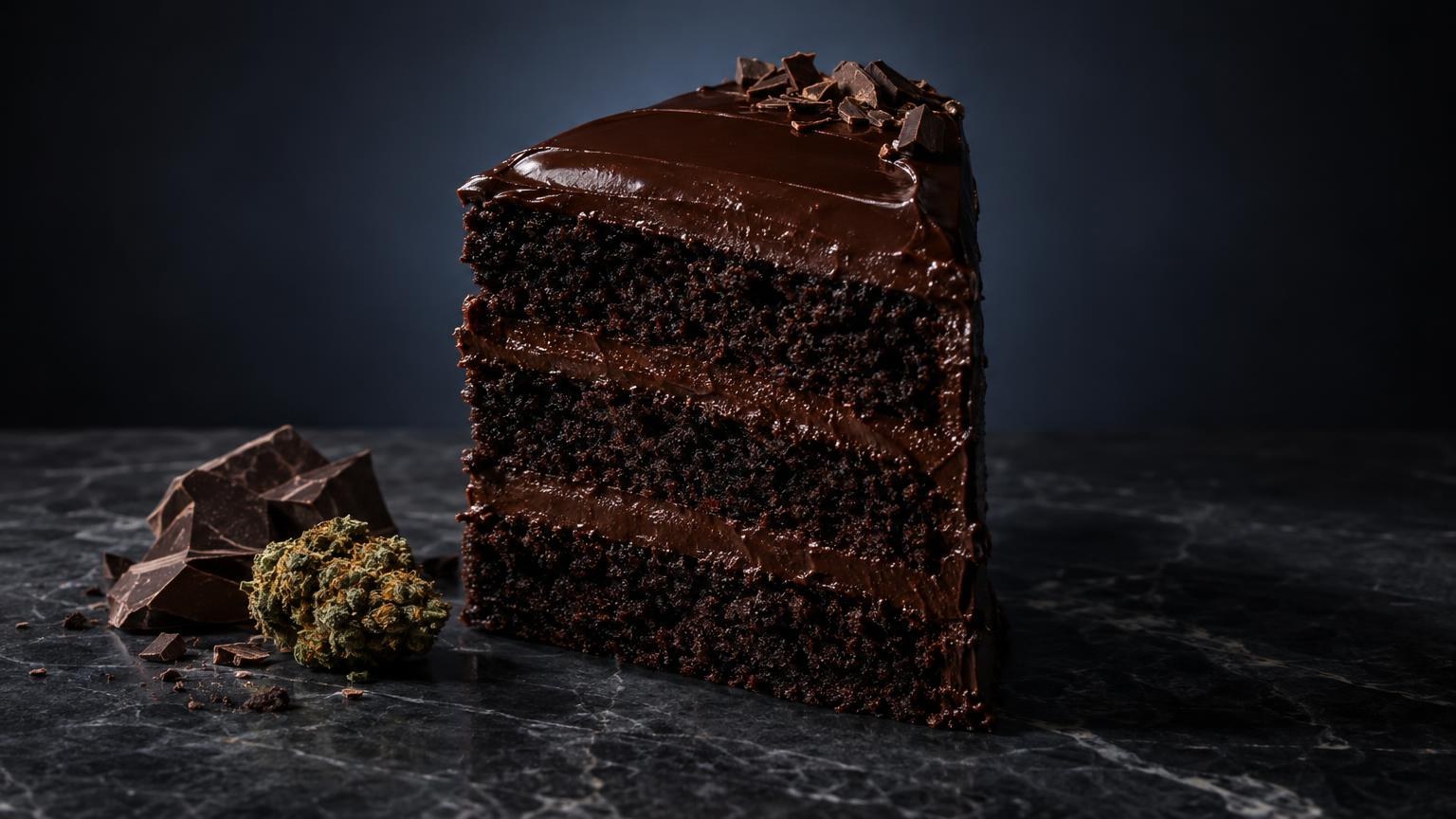
A space cake is a baked cake made with cannabis-infused fat, butter or oil loaded with cannabinoids, then sliced and served by the portion, the classic of the Amsterdam coffeeshop counter.
You will see it spelled spacecakes, space cakes, even sold as a THC cake; the object is the same, the cake that turned cannabis into something you chew instead of inhale.
Here is the part most people skip: raw flower stirred into batter would do almost nothing. The plant synthesises THCA, an acid precursor whose carboxyl group blocks meaningful activity at your cannabinoid receptors until heat strips it away. Chemists call that reaction decarboxylation, and an oven performs it on the way to a finished cake.
So the baking is not decoration. It is the chemical step that converts a largely inactive precursor into an active cannabinoid.
A second variable runs alongside it: cannabinoids are lipophilic molecules. They partition into the fat phase and travel with it through the batter, which is why the butter, not the flour, decides where the potency ends up.
That hepatic first pass converts a share of the THC into 11-hydroxy-THC, a metabolite with its own activity profile, a mechanism documented in Franjo Grotenhermen’s pharmacokinetic review in Clinical Pharmacokinetics (Grotenhermen, 2003).[3] It explains why a slice behaves structurally differently from a joint: slow climb, long plateau, a heavier body character.
And that is exactly where the trouble starts, so this guide follows one number, the milligrams in the portion, through timing, labels and law.
The essentials in 30 seconds
A space cake is a cannabis-infused baked cake, an Amsterdam counter classic, and this guide follows one number through it: the milligrams in the portion.
- Only a lab-dosed, factory-made portion gives you a figure worth trusting.
- Your personal response window depends on you as much as on the cake.
- Per-pack, per-portion and per-100 g figures are not the same line on the label.
What a Space Cake Actually Does to You
Ask ten people what spacecakes did to them and you will get ten different answers. That spread is not folklore, it is pharmacokinetics plus arithmetic, and the arithmetic half is the harder one to explain.
Eating removes the feedback loop that inhalation gives you: no puff-wait-decide rhythm, just a slice already swallowed.
That gap between swallowing and knowing is where the classic mistake happens. You eat a slice, the room stays boringly normal, so you eat a second one. Both slices then land together. Researchers Barrus and colleagues, in the RTI Press review “Tasty THC”, identify precisely this delayed onset as a key driver of accidental overconsumption with edibles.[4]
When that overconsumption happens, notice what the failure is not. Not the baking, not the strain that went into the butter, and not some mystery about how cannabis infused edibles work. What failed is the label that never existed.
And here is the part most people find genuinely counter-intuitive: the recipe details people obsess over change almost nothing on that curve. Whether it is a vegan space cake or a butter-heavy one, whether the batter carries natural vanilla flavouring or cocoa, the sensory profile shifts, the milligram figure does not. Cookies, brownies and cakes made with the same infused butter carry the same milligrams: the flavour changes, the dose does not. The fat content can nudge the timing, as the next section shows, but never the amount you swallowed.
Timing is the variable you can actually learn to respect, so let’s start there.
Onset and Duration: Why People Redose Too Early
The useful question is not what a space cake does, but when it does it.
The pharmacokinetic literature gives honest ranges. In his 2003 review in Clinical Pharmacokinetics, Franjo Grotenhermen reports that after oral ingestion, psychotropic effects set in with a delay of 30 to 90 minutes, reach their maximum after 2 to 3 hours, and last for about 4 to 12 hours, depending on dose and on the specific effect measured.[3]
Treat those figures as study averages, an order of magnitude, nothing tighter. Those minutes belong to the eater, not to the cake.
Three variables move your personal onset window, and none of them are printed anywhere:
- Stomach contents. An empty stomach and a stomach holding a fatty meal do not empty at the same rate, and infused edibles ride that gastric timing.
- The lipid load of the cake itself. A rich, dense crumb carries and releases cannabinoids differently from a lean one.
- Individual metabolism. Hepatic enzyme activity, body composition and tolerance all shift both the delay and the height of the peak.
Going by what users report about dosed edibles, the sessions that go wrong are almost always timing errors, not tolerance questions. That is a pattern in feedback, not a measured statistic.
The Uncertainty Chain: Why a Homemade Slice Can Never Be Dosed
Timing you can learn. Dose is the harder half of the space cake question, the part no recipe post will tell you, and it is arithmetic rather than opinion.
A cannabis space cake is built around cannabis-infused fat, classically cannabutter. The total load of that fat is an estimate dressed up as a number.
| Unknown | What varies | Can you check it at home? |
|---|---|---|
| Starting material | Cannabinoid content of the flower and of the infused fat | No, without lab analysis |
| Distribution in the batter | Where the infused fat concentrated during mixing | No, it is invisible once baked |
| Portion size | Mass of the slice actually eaten | Only with a scale, and only for mass, not for dose |
Now stack those three unknowns, because they compound rather than politely adding up. A slice where the infused fat happened to pool, cut noticeably larger than its neighbour, can easily carry close to twice the cannabinoid load of an average portion, before you even account for the unknown potency of the butter itself.
Space cake recipes are everywhere online, and making space cakes at home is not hard; what no space cake recipe can give you is the number, whatever wheat flour, raising agents or vanilla it calls for. So no, I am not going to hand you a recipe, and not out of squeamishness. A recipe fixes ingredients and ratios; it cannot guarantee dispersion through the batter, and cannot cut the cake for you.
Precision on the wrong variables is not precision. Weighing your flour to the gram while the potency of your fat is a shrug tells you nothing useful about what lands on the plate.
From Coffeeshop Slice to Lab-Dosed Portion: What Changed
Arithmetic like that only bites when nobody measured anything, and for decades that was the entire model. The space cake belongs to the cannabis-infused edible family, and the food-culture database TasteAtlas places its cultural home behind an Amsterdam counter in the Netherlands. The spacecakes went over the counter by the slice, on a plate, with zero analytical data attached.
Treat that as context, not a verdict. The coffeeshop slice was a food product built by a baker, part of a cannabis culture that valued the ritual more than the arithmetic, and no dataset sat behind it because nobody was generating one.
Standardised manufacturing attacks the unknowns one by one:
- Assayed input. The cannabinoid-bearing material is quantified before it ever enters a batter.
- Controlled homogenisation. Mechanical dispersion, not a wooden spoon, distributes the lipid phase through the mass.
- Manufactured portion. The unit is produced at a fixed mass instead of being cut freehand.
- Lot traceability. A batch number links the finished cake back to the analysis of that specific run.
A third-party certificate of analysis is the document that gives the printed milligram figure any meaning at all. It reports cannabinoid concentration per unit and screens for contaminants such as pesticides, residual solvents and heavy metals.
That is one more reason a serious producer documents what goes into the batter.
How to Read the mg per Portion on an Edible Label
Everything above only becomes usable if you can read the number printed on the box. That skill transfers to any cannabis infused edible you will ever pick up, so give it ten minutes.
The trap: three different figures can legitimately appear on the same pack, and they are not interchangeable. EU food information rules, Regulation (EU) No 1169/2011, let values be declared per unit of sale, per portion, or per 100 g, and an edible label borrows exactly that grammar.[2] Reading the wrong line is how people eat four times what they planned.
| What the label prints | What it actually tells you | What you still have to do |
|---|---|---|
| mg per pack | The total in the whole product | Divide by the declared portions |
| mg per portion | The dose in one unit, ready to use | Nothing. This is your figure |
| mg per 100 g | A concentration, not a dose | Read the portion mass, then multiply |
A pack declaring 200 mg total across a stated number of portions is honest and workable. A pack declaring 200 mg with no portion count hands you a total you cannot convert into anything.
Beyond the headline figure, three more elements tell you whether a label was written by someone who expects to be checked:
- A full ingredient list, with the infused fat or extract named rather than hinted at. On a real brownie pack that reads like any bakery label: sugar, vegetable oil, cocoa powder, cocoa butter, skimmed milk powder, baking powder, natural vanilla flavour, and then the cannabis extract or infused butter that carries the cannabinoids. If you know how to read a chocolate or milk label, you know how to read this one
- The declared number of portions per pack
- Allergens, since these are cakes and chocolates: gluten, milk, soy, nuts. A “gluten free” or “vegan” claim is a regulated statement too, so it tells you the producer expects to be checked
Notice what a label never tells you: a strain name. A “space cake strain” or a “THC cake” badge, a Haze name on the box, is a marketing line, not an analytical value. The same logic applies to a space cake CBD version: whether the products are built on CBD or THC extract, the strain name tells you nothing about the dose. Haze, Kush or any other strains printed on a box add flavour to the story, not precision to the figure. What goes into the batter is an extract with a measured cannabinoid content, and that milligram figure is the only variable that changes your experience.
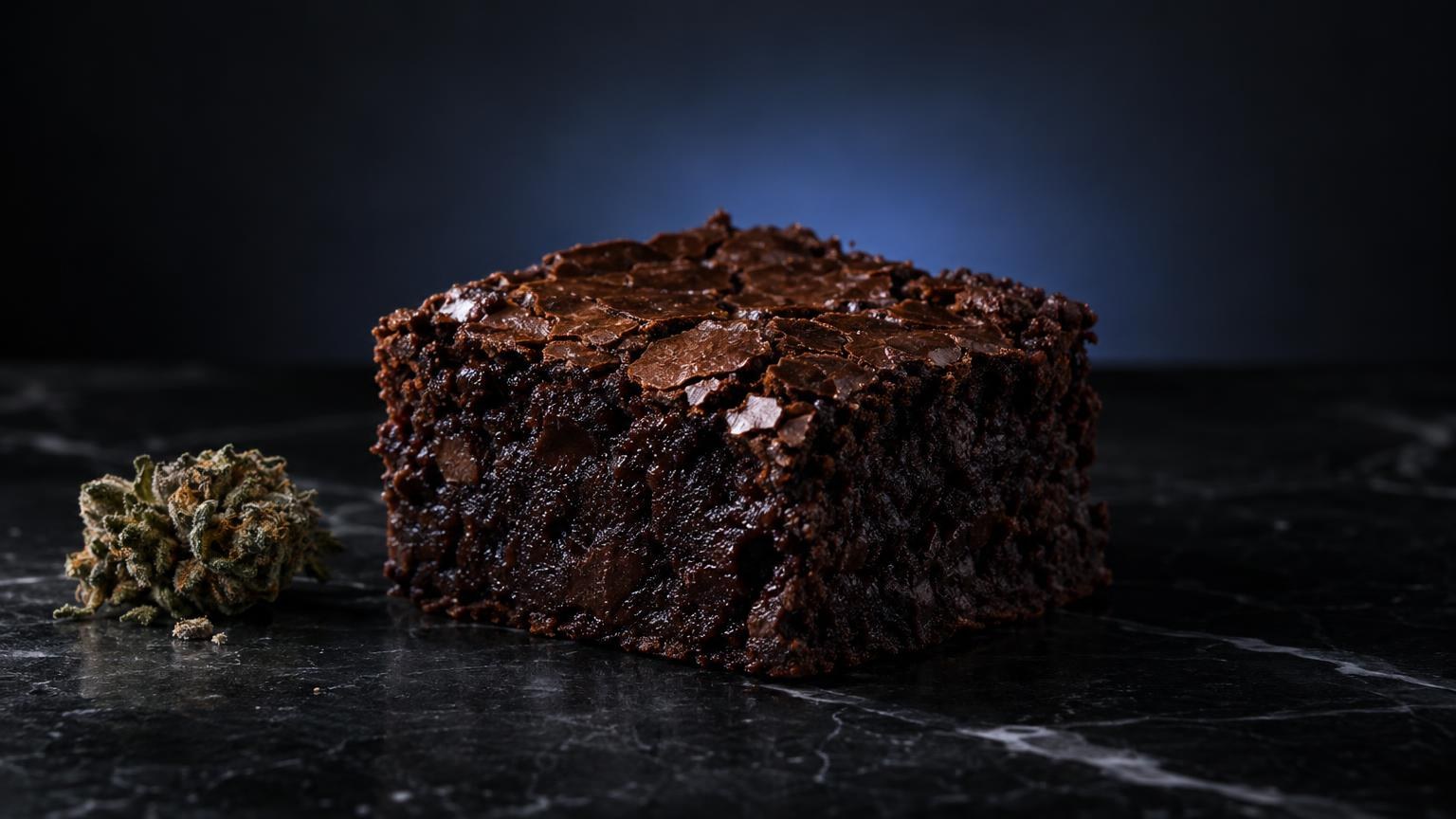
Our own Magic Brownie – Space Cake prints its total on the front, which is precisely the case where you do the arithmetic before the first bite, and it arrives in sealed delivery packaging with the printed figures intact, which is the point of checking them.
Starting Small: Cutting a Dosed Portion Down
Acting on the printed number is where most first space cake experiences actually go wrong, and the fix is unglamorous: start below it.
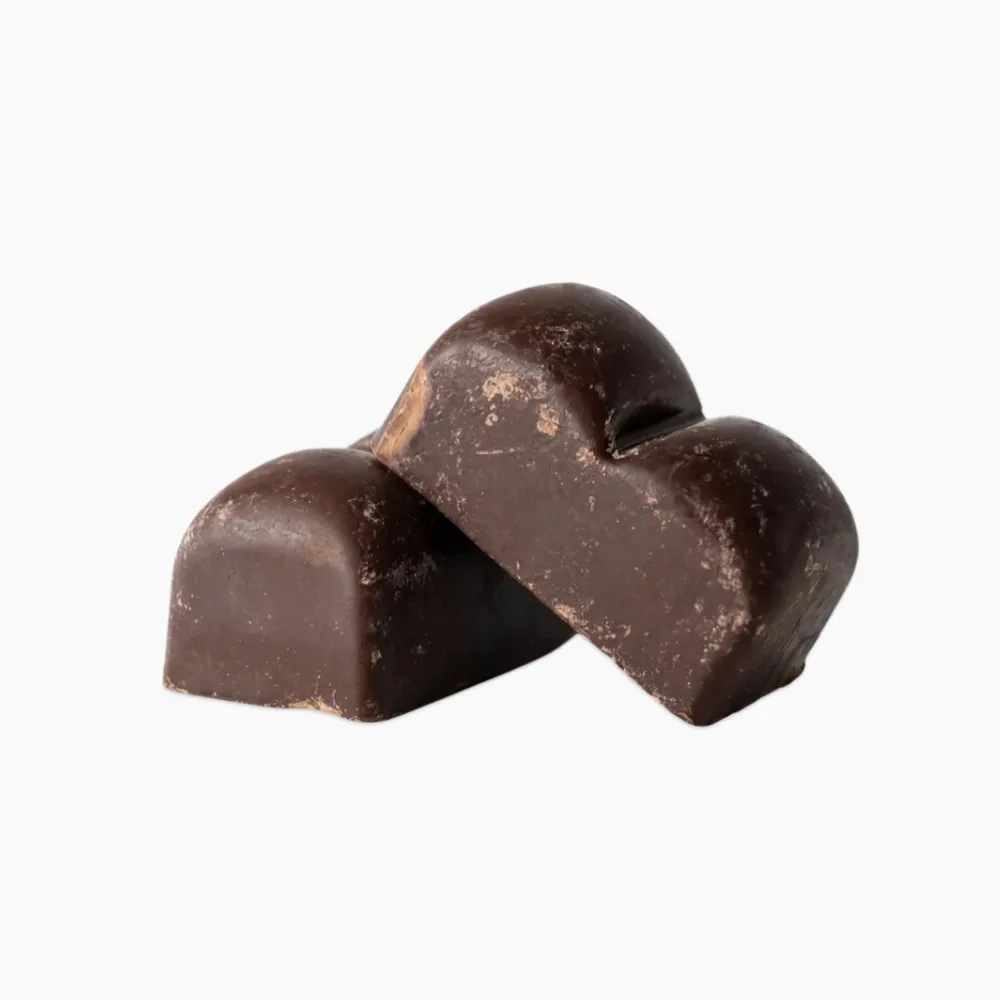
Halving a manufactured portion works for one structural reason. The matrix is homogenised before the product is formed, so the cannabinoids are spread far more evenly than in a home-baked slice. Cut that portion in two and each half carries roughly half the milligrams, an approximation rather than a measurement.
The arithmetic finally runs forward instead of backward: divide by two or four, and you have a starting figure you can write down.
- Start from the printed value, never from how big the piece looks.
- Divide physically: a scored square or a clean knife cut on a uniform product.
- Log it: quantity in mg and the time you swallowed it. Memory is unreliable once effects arrive.
- Put the rest away, out of sight and out of reach. Use the same rule for cookies and chocolate as for cake.
What that starting figure will do to you specifically is not something a label can tell you. Tolerance, body weight, and anything else you have taken all shift the response. Those variables belong to you, not to the product.
And that is the honest argument for starting low: an overshoot on an edible cannot be undone once it is swallowed. A half portion you barely feel costs you an evening of patience, and you are free to add more next time, once you know how the first one landed. The reverse, a high dose you did not plan, costs far more.
Labelling, Traceability and Choosing Your Format
A number printed on a box only means something if the box itself is accountable, and that accountability comes from food law long before it comes from cannabinoid chemistry.
Mandatory ingredient declaration, allergen flagging and portion information are the machinery that lets you compare two cannabis infused edibles honestly, whether they are vegan space cakes, sugar-heavy brownies or oil-based cookies. They are also the parts of a pack a serious producer cannot fake without leaving a documented trail.
Cannabinoid rules themselves shift from country to country, so check the legal status that applies where you are before you order anything, and use a shop that ships with the label intact.
Pick the format that matches how you actually plan to eat it. Brownies, cookies, chocolate bars and gummies all belong to the same family of infused baked goods and sweets, and the effects of a space cake and of a dosed cookie differ by milligrams, not by shape. That single choice shapes your experience more than any cultivar name printed on the front.
| Format | Best when | What it solves |
|---|---|---|
| Magic Brownie – Space Cake | You want the baked, chew-it-slowly space cake experience | No guesswork about the fat |
| Family Pack Magic Choc | You are sharing with other adults | 40 squares of 25 mg, so every piece carries the same dose |
| Magic Choc – Space Chocolate | Solo, first time, or you want to go under a full portion | Moulded, not cut |
| Family Pack Magic Choc | An evening with friends who each dose themselves | Volume without anyone sharing one unmeasured slice |
The brownie is the one I reach for when I want the cake, the crumb and the ritual that made this thing famous in the first place. The space cake Amsterdam culture gave us the ritual; the label gives us the number, and you need both to know what you just ate, whether it came from a bakery counter or a delivery box.
Conclusion
Strip away the Amsterdam mythology and the space cake story gets short: for decades, the slice on the counter was an act of faith.
Traceable batches and lot analyses, available on request from the seller, replaced that faith with something better: a decision you get to make before you eat, not a surprise you manage afterwards. Baking, flour, milk and vanilla make the cake; the measured extract makes the experience, and a labelled, traceable product is the only one that lets you make it on purpose.
Keep it away from minors, and never behind the wheel. When unsure, ask a doctor rather than the internet.
Frequently asked questions
What is a space cake?
A cannabis-infused cake, the Amsterdam coffeeshop classic, whose baking step is what activates the cannabinoids in the first place.
What do I need to make space cake?
Standard cake ingredients plus a cannabis-infused fat, butter or oil, which carries the cannabinoids into the batter and does the real work.
How does space cake compare to smoking for feeling effects?
Digestion delays everything: onset, peak and end all arrive later than with inhalation.
How do I read the milligram figure on a space cake label?
Find the mg per portion line: mg per pack has to be divided by the portion count, and mg per 100 g is a concentration, not a dose.
What is the practical way to start with a dosed space cake portion?
Start at half a portion or less, log the time, and wait the full 2 to 3 hours before deciding on more.
Is a spacecake the same as a weed brownie?
In practice, yes: spacecake, space cake and weed brownie all name a baked edible made with a cannabis-infused fat. The shape changes, but what decides the experience is the number of milligrams of THC in each portion.
How strong is a space cake?
It depends entirely on the dose per portion, which a homemade cake cannot tell you. A lab-dosed space cake prints it on the pack: the Magic Brownie carries 200 mg of THC in one brownie, meant to be cut into several portions rather than eaten at once.
Sources
- Regulation (EU) No 1169/2011 on food information to consumers — EUR-Lex — eur-lex.europa.eu
- Grotenhermen F. Pharmacokinetics and pharmacodynamics of cannabinoids — Clinical Pharmacokinetics, 2003 — pubmed.ncbi.nlm.nih.gov
- Barrus DG et al. Tasty THC: Promises and Challenges of Cannabis Edibles — Methods Rep RTI Press, 2016 — pmc.ncbi.nlm.nih.gov