 Written by Sarah Mitchell
 THC Edibles at Spliff · from €17.90 · ★ 4.9/5 (1,327 reviews)
72 h delivery in Europe · Free delivery from €99
Contents8 sections
- What Actually Happens After You Eat a THC Gummy
- Why the Gummy Became the Dominant Edible Format
- Milligrams per Gummy vs Milligrams per Pack: How to Read a Dose
- Lab-Dosed Gummies vs Homemade: The Precision Gap
- Labelling, Regulation and Responsible Use in Europe
- Buying THC Gummies Online in Europe: Your Pre-Order Checklist
- Conclusion
- Frequently asked questions
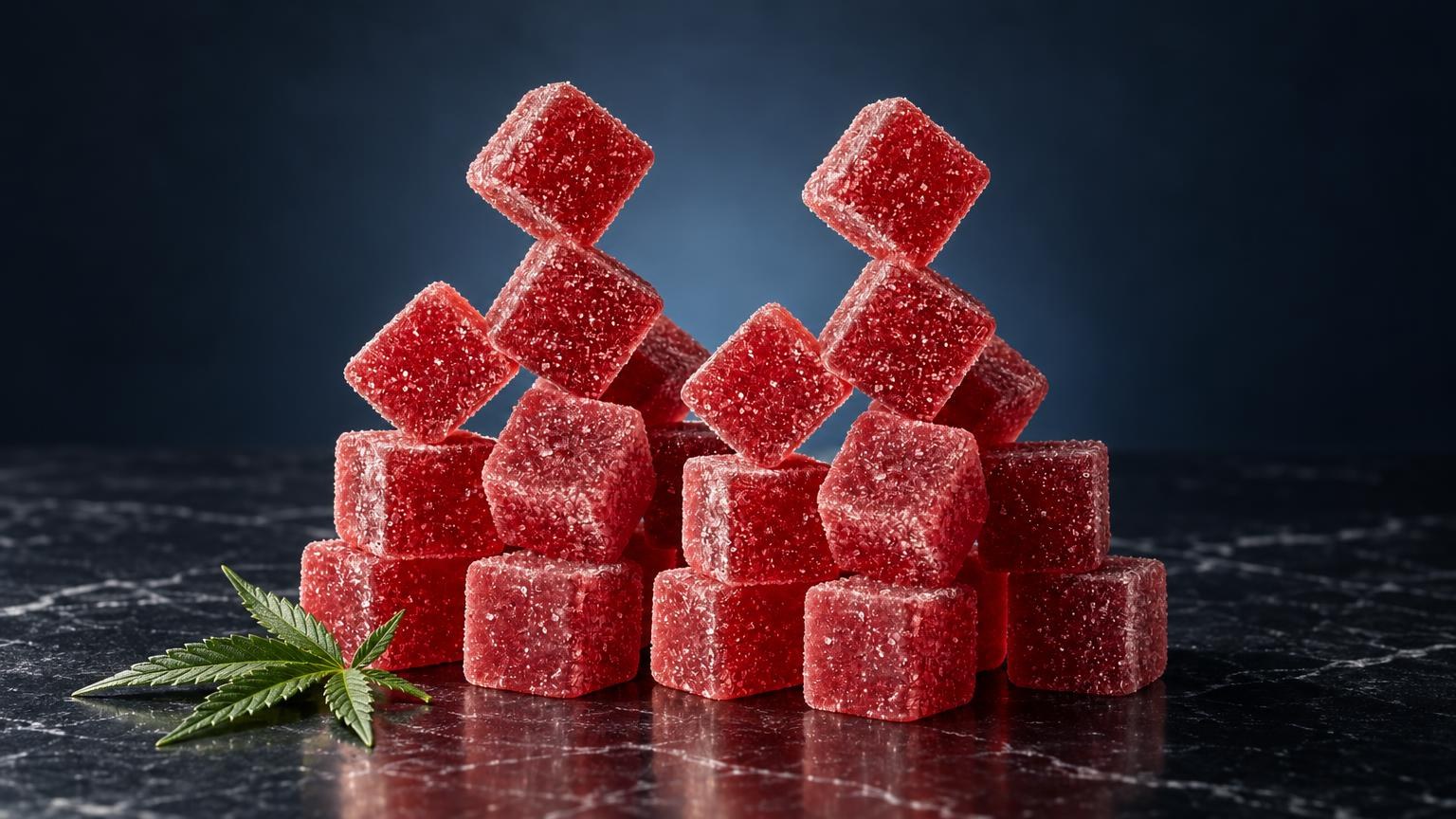
You eat a THC gummy and nothing happens. Start there, because the delay isn’t a defect: it’s the route. Inhaled cannabinoids cross the alveolar membrane and reach the brain within a few breaths, while a gummy has to clear the gut first.
Then comes the part that makes oral dosing genuinely different. Everything absorbed from the intestine passes through the liver before it reaches general circulation. According to Tasty THC: Promises and Challenges of Cannabis Edibles (RTI Press)[2], that first pass converts ingested THC into 11-hydroxy-THC, a metabolite that readily crosses into the central nervous system.
So the molecule doing the work after a gummy is not quite the one you inhale from a joint. That single metabolic detour explains most of what follows: the wait, the shape of the peak, the long tail.
First-pass metabolism is the variable I’d flag before any other. It’s the whole reason THC gummies behave differently from vapes, from flower, and from anything you inhale.
One scope note before the curve. The pharmacokinetics below describe ingested delta-9-THC, the reference molecule the published literature actually measures. The sweets in our own catalogue are sold under their own commercial names, labelled and batch-screened as such, and no figure in this guide is a measurement of those products. The reading and buying rules, on the other hand, apply to any dosed cannabinoid sweet.
Below, the curve itself, hour by hour.
The essentials in 30 seconds
THC gummies work through digestion, not inhalation: the liver turns the ingested molecule into a different active metabolite, onset is delayed, and the peak arrives hours rather than minutes after ingestion. The confectionery format allows precise dosing per unit, provided a lab-verified batch analysis backs the printed figure on the label.
- Read the label per sweet, not per pack: the unit dose is the only figure that decides what you experience.
- Wait out the full onset window before considering a second piece.
- Before buying, check for a matching batch COA, full ingredient and allergen list, lot number, best-before date, and identifiable seller details.
What Actually Happens After You Eat a THC Gummy
So what does that route feel like from the inside? Nothing, for a while. Then a vague shift: body temperature moves, sound sits slightly differently, and the first wave arrives as a slope rather than a switch.
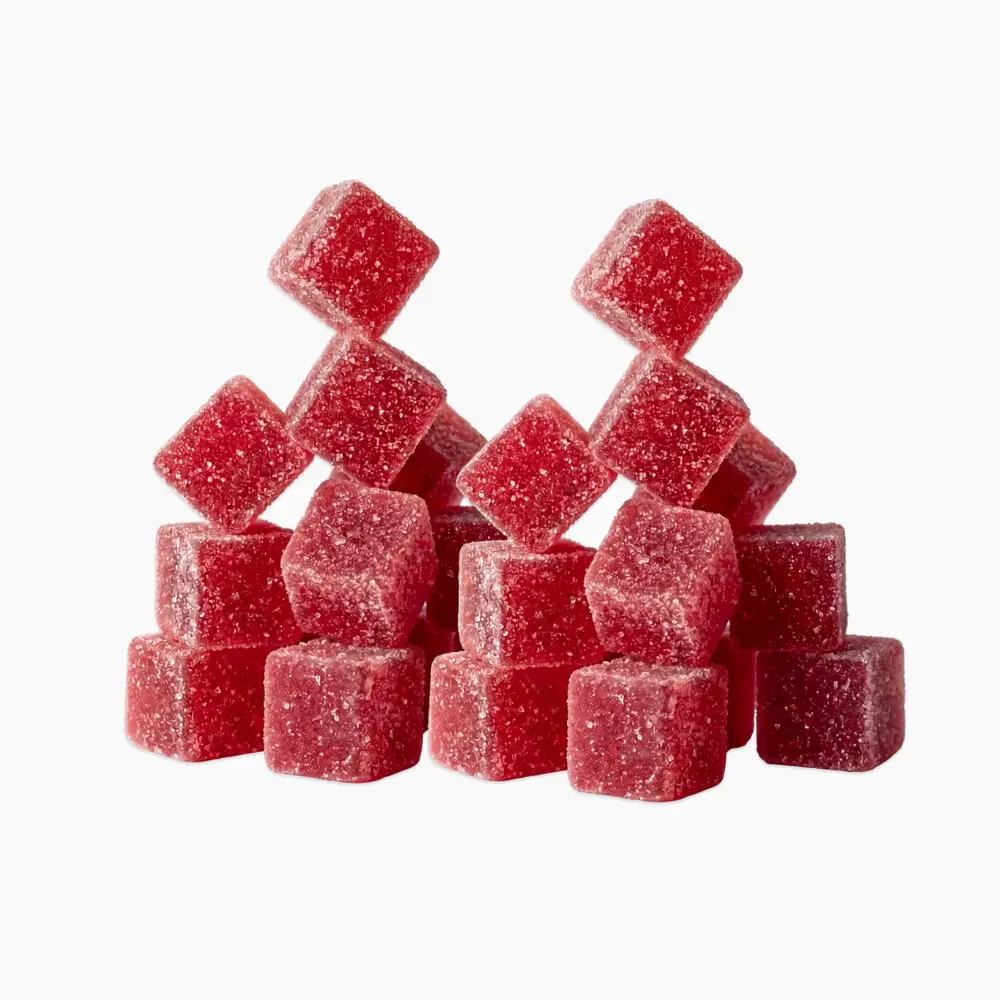
The measurable part of that slope is the peak. In the reference clinical review of cannabinoid pharmacokinetics (Grotenhermen, Clinical Pharmacokinetics, 2003)[1], psychotropic effects after oral ingestion set in after 30 to 90 minutes, reach their maximum around 2 to 3 hours and can last 4 to 12 hours, depending on dose and the effect measured. That is a wide window around the single most important moment of the experience.
Blood tells an earlier story than feelings do. A pharmacokinetic study of five commercial 10 mg edibles published in Pharmaceuticals (MDPI, 2021) measured peak plasma THC between 35 and 90 minutes, with visibly different curves from one product to another. What you feel lags what your blood shows, one more reason a single official number would mislead.
Which is why anyone quoting you one precise number for thc gummies is guessing. The variables stack:
- Fed or fasted: cannabinoids are lipophilic compounds, so a fat-containing meal changes both the fraction absorbed and the rate of absorption.
- Body mass and composition: volume of distribution differs between individuals, so an identical milligram load produces different plasma concentrations.
- Enzymatic activity: hepatic metabolism, driven largely by cytochrome P450 isoforms, varies genuinely from person to person.
- Prior use frequency: tolerance reshapes both the intensity and the duration of the felt effect.
After the peak, the decline is gradual rather than abrupt. You come down in stages, and there is usually a long, low tail, lasting longer than most people expect, where you feel functional but not neutral. The effects of an edible are shaped like a hill, not a spike. Plan the rest of your day around that tail, not around the peak.
One distinction worth nailing down now, because it confuses almost everyone I talk to: feeling normal again and testing clean are two entirely different timelines. Perceived effects fade along the curve described above. Screening assays, by contrast, detect THC metabolites rather than current intoxication, and those two things do not disappear on the same schedule.
The same digestive route applies to cbd gummies and cbd gummy bears, minus the intoxicating end point: identical absorption physics, different pharmacology once the molecule reaches circulation.
Why the Gummy Became the Dominant Edible Format
The format explains the precision, and that’s a separate piece of engineering entirely.
A gummy is a confectionery matrix: a gelling base of pectin or gelatin, glucose syrup, sugar, an acidifier such as citric or malic acid, plus flavour and colour. The cannabinoid extract disperses into that liquid mass while it’s still fluid, then a depositor drops it into moulds of fixed volume. Every cavity receives the same measured shot of the same blend.
Compare that with a baked batter. Batter is thick, uneven and cooked as one block, so lipophilic extract can pool in the fattiest zones, and portion size ends up decided by whoever holds the knife. A gummy eliminates both variables at once: the unit is the dose.
- A countable portion, not an estimated slice
- Repeatable from one piece to the next within a batch
- Physically divisible if you want a fraction
- A label figure that maps onto one object you can hold
That precision is only as good as your storage, though. Heat softens and deforms the matrix, humidity makes the surface tacky and fuses pieces together, and light plus oxygen drive oxidative degradation of cannabinoids over time.
Which is why sealed, opaque packaging matters as much in a parcel crossing Europe in July as it does in your kitchen cupboard.
CBD gummies and thc gummies share that identical matrix, as do infused chocolates, oil-based edibles and most other products in the category, so the difference lives entirely in the cannabinoid profile printed on the pack. And those cannabinoids don’t stack the way most people assume.
According to Johns Hopkins Medicine, CBD can inhibit the breakdown of THC in combined edibles. The Hopkins team frames that interaction in terms of increased adverse effects, not a softer ride. So don’t read a CBD figure on a mixed pack as a built-in brake.
Milligrams per Gummy vs Milligrams per Pack: How to Read a Dose
Which number on the packaging actually describes that unit? Two figures compete for your attention, and only one of them is pharmacologically meaningful.
Milligrams per pack is inventory. Milligrams per gummy is pharmacology. The conversion takes a single division: total cannabinoid content stated on the pack, divided by the number of sweets inside.
| Stated on pack | Units inside | Per sweet | What one sweet means |
|---|---|---|---|
| 100 mg | 10 | 10 mg | A single, modest unit |
| 1000 mg (Family Pack) | 10 | 100 mg | Ten times the density, same sweet size |
| 1000 mg (Family Pack) | 40 | 25 mg | Same pack figure, very different unit |
That third row is where people get caught out. Two packs can both advertise 1000 mg and deliver wildly different unit doses, which is why the pack figure on its own tells you almost nothing about what you are about to swallow. The confusion is well documented: the RTI Press review of cannabis edibles gives the example of a single chocolate bar carrying 100 mg, which is in fact ten servings in one object[2]. Read the stated unit count first, then divide.
In our own range the contrast is deliberate, and I use it constantly when I explain dose density to newcomers. Magic Candy at 100 mg is the low-density entry point, dosed per sweet on the label, while the Family Pack at 1000 mg is the same confection formulated for people who already know their number. Same family of thc gummies, entirely different dose density, and the label is the only place that difference shows up.
New to THC CBD edibles? The arithmetic you want gives you a fraction of a sweet, not a whole one. Halving a low-dose unit is the gentler start, and a quarter is gentler still.
Cutting by hand is honest but imprecise. A gummy is not a scored tablet: the cannabinoid disperses through the entire gelatin matrix during manufacture, so a visual quarter remains an approximate quarter.
Here is one more argument for keeping that first number small. A simulated-driving study published in the Journal of Cannabis Research (2024) reported measurable changes in driving performance after cannabis edibles while blood THC stayed comparatively modest. On the oral route, a blood figure makes a poor proxy for how you are actually functioning.
An exploitable label, whether it sits on thc gummies, cbd gummies or any other dosed oral format, gives you five things:
- The cannabinoid named, not implied
- Milligrams per unit
- The number of units in the pack
- Net weight of the contents
- A batch or lot number traceable to an analysis
Recreational sweets are not medical cannabis products, and they carry no dispensing leaflet to fall back on. That puts the arithmetic squarely on you. Keep an eye on frequency too: habitual, escalating use is how the conversation shifts towards dependence and addiction, and a label cannot flag that for you.
Miss any one of those five items and you are estimating rather than dosing. That distinction is the one I refuse to blur.
Lab-Dosed Gummies vs Homemade: The Precision Gap
A printed milligram figure only means something if someone actually measured it. That assumption is the real dividing line between a lab-dosed sweet and a batch you set in your own kitchen. The gap has nothing to do with effort or good intentions: it’s analytical control.
Homemade gummies fail first on homogeneity. Cannabinoids are lipophilic compounds, while a gelling base is mostly water and sugar syrup, so without a controlled dispersion step or an emulsifier the extract migrates instead of distributing evenly. Pour that mass into a twenty-cavity mould and the first sweet and the fifteenth can carry very different loads.
The second failure sits upstream, in the chemistry itself. Heat-driven decarboxylation of the acidic forms is never complete and never zero, and its yield shifts with temperature, time and the plant material you started from. You cannot divide a total you never quantified, so the mg-per-unit figure on a homemade batch is an estimate stacked on top of another estimate.
What commercial production adds isn’t magic. It’s metrology. A batch is formulated to a target, sampled, and assayed by HPLC, and the resulting figure is tied to a lot number that travels with the pack.
- Batch dosing: the extract is weighed into a known mass of matrix, not eyeballed.
- Sampling: several units from the same run are pulled and tested, which catches distribution problems.
- Certificate of analysis: quantified cannabinoid content per batch, expressed in mg.
- Traceability: the lot code on the pack maps back to that specific analysis.
Stay sceptical anyway. A COA is only as good as its match to the sweet in front of you, third-party issued, current, and tied to that exact lot code, not a generic sheet covering “the product” in general. That scrutiny applies to CBD gummies exactly as it applies to THC gummies.
Labelling, Regulation and Responsible Use in Europe
A certificate of analysis describes a batch. A label describes a product as a food. Those are two distinct obligations, and a serious operator meets both at once.
Read a cannabinoid sweet the way you’d read any packaged confectionery. The mandatory particulars of a food apply here exactly as they apply to a bag of wine gums:
- the full ingredient list, in descending order of weight
- declared allergens (gelatin base, glucose syrup, colourings, sulphites)
- net weight and number of units
- lot identification, so the pack can be traced back to its production run
- the name and address of the food business operator responsible for it
Here’s the distinction I want you to hold onto, because it’s the one people blur most often. “THC gummies” is what you type into a search bar; a serious European catalogue answers it with confectionery in which no classified molecule is detected, with batch analysis on file to prove it. Material rich in controlled cannabinoids is another product entirely, and it isn’t something you order from a shop.
The practical precautions are short, and I’d take them literally. Adults only. Store the pack away from children, because a dosed sweet looks exactly like a sweet, and keep it off the table before you drive or handle machinery.
One more variable worth knowing: cannabinoids can interact with each other and with medicines, and the CBD and THC interaction covered earlier in this guide is a concrete, measured example. That’s a pharmacokinetic question, not a lifestyle one, so if you take any medication, ask a pharmacist before adding a cannabinoid sweet.
Buying THC Gummies Online in Europe: Your Pre-Order Checklist
Everything above eventually collapses into one moment: you’re on a product page, not in a laboratory, deciding whether to click. So here is the filter I run before anything goes into a basket.
- A third-party batch COA you can actually open, matching the lot code printed on the pack. If the link opens on a blank PDF or a generic sample, that’s a fail.
- A full ingredient list with allergens: gelling agent, syrups, acidifier, flavours, colours.
- Best-before date and lot number on the packaging itself, not only on the invoice.
- Identifiable seller details: legal operator, contact route, address.
- A price that matches the milligrams, not just the pack. Divide cost by declared total cannabinoid content and compare like with like.
- Shipping conditions: how the parcel is packed, and what happens to it in a July delivery van.
If a listing fails two of those six, I close the tab. That isn’t purism. An unverifiable dose isn’t a dose, it’s a guess in sweet form.
Generalist marketplaces fail this filter with depressing regularity. Third-party listings rarely carry a lot-specific certificate, and the ranking logic rewards whoever bids hardest rather than whoever documents best. Their listings run on star reviews, free delivery badges and a brand new offer every week, none of which tells you anything about the batch.
A specialist shop that owns its own batches has something concrete to lose by publishing a number its laboratory can’t defend. That asymmetry is the whole argument, and it is what a premium price is supposed to buy.
Format then follows use, and that choice comes down to dose density. Cannabis edibles now account for a substantial share of overall consumption according to survey data analysed by RTI International researchers. Most of that shift is people wanting a countable portion rather than a rolling paper.
One point I want to be completely unambiguous about before I name a single product. If you typed “thc gummies”, “cbd gummies thc” or any “delta” variation into a search bar, what our catalogue holds is something else: sweets sold under their own commercial names, with the declared cannabinoid printed on the label. Searches for the strongest THC gummies land on the same shelf, and the honest answer is the label: a high declared dose per sweet is a positive only if a real batch analysis stands behind it. The lab analysis of each batch is available on request from customer service.
Read the sweets below as what they are: labelled confectionery sold under its own commercial name, not Δ9-THC edibles. Every batch is lab-tested for classified molecules and none are detected.
For a first run, Magic Candy is the sensible entry point: fruit sweets, ten to a pack, a modest declared dose per sweet, and a lot code traceable to its certificate. It’s also genuinely good candy, which matters more than people admit when you’re only eating half of one.
For regular or shared use, the Family Pack Magic Candy raises the pack total tenfold: read the per-sweet figure on its label before you portion it. The Family Pack Magic Sphere does the same in chocolate, for anyone who prefers a cocoa matrix to a pectin one. Same labelling logic, same lot-level screening.
We ship across Europe in neutral outer packaging, with the thermal reality of transit factored into how the sweets are wrapped: international delivery to 22 EU countries, the price provided as a regular price rather than a rolling promotion, and a fresh batch code on every run. If your cupboard runs warm, add a storage-friendly accessory and stop fighting your ambient temperature.
Our verdict
The right choice comes down to arithmetic, not luck: divide total pack mg by unit count, confirm that figure against a lot-specific COA from a third-party lab, and start with a low, precisely labelled dose rather than a hand-cut fraction of an unverified batch. Homemade or unlabelled sweets fail on the one thing that matters, knowing what’s actually in the piece you’re eating.
- For first-time buyers → a low mg-per-unit pack (10-15 mg) with a recent, lot-matched COA and full ingredient labelling
- For experienced users wanting flexibility → a mid-range mg-per-unit product that’s easy to divide precisely, rather than cutting a low-dose gummy by eye
- For anyone considering DIY → a commercially produced batch-tested option instead, since kitchen recipes can’t guarantee even distribution across a mould
Conclusion
Strip that checklist down and you get a single habit: read a cannabinoid sweet as a labelled food, not as a story someone told you at a party.
Get the label, the matrix and the timing straight, and thc gummies stop being a gamble and start being a measurable portion.
Swap the cannabinoid for CBD and the same reading grid applies, only the molecule, and what it does once absorbed, changes.
Frequently asked questions
How to buy THC gummies online?
Follow the pre-order checklist: an openable third-party batch COA matching the lot code, full ingredient and allergen list, best-before date and lot number on the packaging itself, identifiable seller details, a price read per milligram, and stated shipping conditions. Fail two of those six, close the tab.
How to make THC gummies?
A commercial gummy starts as a fluid confectionery mass with the extract dispersed before moulding. This guide deliberately stops short of a recipe: without analytical control you cannot state a per-sweet dose, and the lab versus homemade section above explains why that figure is the one that matters.
What affects how strong a THC gummy feels?
Strength and onset vary with whether it is eaten fed or fasted, body mass and composition, hepatic enzyme activity, and prior use frequency. The onset section above gives the full peak window from the clinical literature.
Sources
- Grotenhermen F. (2003), Pharmacokinetics and pharmacodynamics of cannabinoids, Clinical Pharmacokinetics — pubmed.ncbi.nlm.nih.gov
- Tasty THC: Promises and Challenges of Cannabis Edibles (RTI Press) — pmc.ncbi.nlm.nih.gov
- Ewell T.R. et al. (2021), Pharmacokinetic Investigation of Commercially Available Edible Marijuana Products in Humans, Pharmaceuticals — www.mdpi.com
- Johns Hopkins Medicine (2023), CBD May Increase the Adverse Effects of THC in Edible Cannabis Products — www.hopkinsmedicine.org
- Zhao S., Brands B. et al. (2024), The effect of cannabis edibles on driving and blood THC, Journal of Cannabis Research — link.springer.com
- Epidyolex (cannabidiol), European Medicines Agency, EPAR — www.ema.europa.eu
- Cannabis: health and social responses, EU Drugs Agency (EUDA) — www.euda.europa.eu