 Written by Sarah Mitchell
 THCX at Spliff · from €5.30/g · ★ 4.9/5 (1,308 reviews)
72 h delivery in Europe · Free delivery from €99
Contents10 sections
- What HHC Actually Is: Hexahydrocannabinol, Molecule by Molecule
- HHC vs THC: What the Receptor Data Really Shows
- Why HHC Vanished From European Shelves
- Does HHC Get You High? What Those Vapes and Gummies Contained
- The THCX Range at Spliff
- What It Costs in Europe: THCX Prices, September 2026
- How to Read a Cannabinoid Listing After the HHC Era
- The Loophole Is Closed: Where That Leaves You
- Conclusion
- Frequently asked questions
HHC (hexahydrocannabinol) is a hydrogenated form of THC, produced industrially from hemp-derived CBD and sold across Europe from 2022 as a “legal THC”. It binds the same cannabinoid receptors (CB1 first), generally with lower and less predictable potency, so not a more intense high. It has since been restricted in a growing number of European jurisdictions and pulled from most shops, which is why the comparison below matters more than any potency claim.
Reduce it to the molecule and hhc vs thc is a one-bond story. Take delta-9 THC, the cannabis molecule everyone means by “THC”, saturate the double bond on its ring, and you land on hexahydrocannabinol. Chemists first discovered this compound in 1940, so nothing about it is structurally new[1].
That single chemical modification is why HHC reads as structurally similar to THC without being THC.
Yes, the compound exists in the plant. Work published by Casati and colleagues in 2024 identified it as a trace phytocannabinoid in hemp pollen and seeds[6]. Nobody ever built a product from that: the quantities are microscopic.
The commercial route, documented by Ujváry in 2024, runs differently. It starts from hemp-derived CBD, cyclises it into THC, then puts that intermediate through a process called hydrogenation over a metal catalyst. The output is a semi-synthetic cannabinoid, not a plant extract, and that word carries the whole regulatory story[3].
The essentials in 30 seconds
HHC and THC differ by a single chemical step: hydrogenation adds two hydrogen atoms to the THC structure, giving a semi-synthetic cannabinoid made from hemp CBD. Users reported effects broadly similar to THC, generally weaker and less predictable. Once sold across Europe as a “legal THC”, the HHC legal status shifted sharply once regulators caught up with the chemistry.
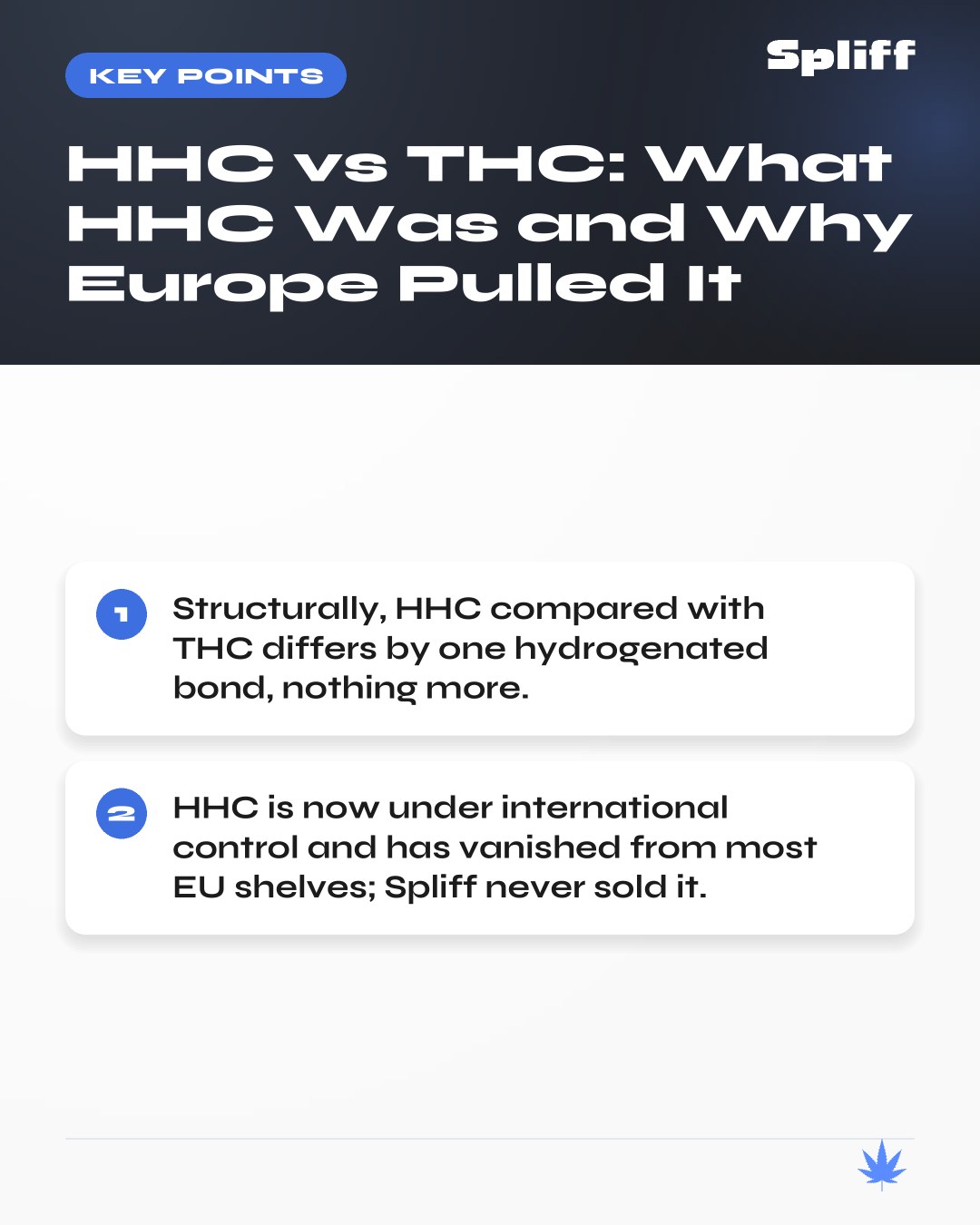
- Structurally, HHC compared with THC differs by one hydrogenated bond, nothing more.
- Potency varies with the 9R/9S epimer ratio of each batch, not with the label, according to the peer-reviewed research.
- HHC is now under international control and has vanished from most EU shelves; Spliff never sold it.
What HHC Actually Is: Hexahydrocannabinol, Molecule by Molecule
The load-bearing word in that description is semi-synthetic. Hemp supplies the feedstock, a reactor and a hydrogenation process do the rest, and that places hexahydrocannabinol in a different category from the cannabinoids a plant hands over ready-made.
The structural gap is precise: delta-9 THC carries the molecular formula C21H30O2, while HHC comes out as C21H32O2, two extra hydrogen atoms, nothing more.
“Hemp derived” was the phrase the 2022 market chose to use, and it described the starting material accurately. It described nothing else. Trace natural occurrence does not turn a hydrogenated product into a plant extract: unlike the cannabinoids a cannabis plant is known to produce, CBD or CBN among them, semi synthetic cannabinoids of this type are manufactured goods with an agricultural origin.
That distinction has regulatory teeth. Under EU food law, cannabinoid extracts and isolates from Cannabis sativa need prior authorisation, so nothing coming off that production chain enters the food supply by default.
Peer-reviewed work on this specific mixture stayed thin throughout its commercial life, even while sellers talked up supposed benefits[3]. Any hhc vs thc comparison therefore starts from a moving analytical target rather than a fixed one, and I’d want a certificate of analysis before I took any claim about it seriously.
HHC vs THC: What the Receptor Data Really Shows
That two-epimer reality is exactly why “which one is more potent” is the wrong question. Both compounds aim at the same cannabinoid receptors, CB1 first, so on paper HHC compared to THC looks like a clean one-to-one comparison. What actually lands in a product is not one molecule but a blend behaving in two different ways.
Commercial HHC is a mixture of two epimers, 9R-HHC and 9S-HHC, at an average ratio of roughly 1.4:1 according to the WHO ECDD review[1], and that ratio shifts with the catalyst, the pressure and the batch. Graziano and colleagues (2023) reported that 9R-HHC binds CB1 in a THC-like manner, while 9S-HHC is markedly weaker at the same receptor[4]. Potency therefore tracks the epimer ratio of the batch, not the label on the jar. Two vapes carrying identical “HHC” declarations can sit far apart pharmacologically.
Move past binding affinity and the picture stays cautious. Durydivka and colleagues (2024), working on receptor assays rather than on human subjects, describe overall potency as lower than delta-9-THC, with receptor activation only broadly comparable and evidence of biased signalling, meaning the downstream pathways in the body are not recruited in the same proportions[5]. So yes, users reported effects similar to THC, but “similar” is doing a lot of work in that sentence. Ujváry (2024) is blunt about the rest: human pharmacology remains poorly studied[3]. So the experience two individuals report from the same jar can differ, and the risks scale with that uncertainty.
| Criterion | HHC | Delta-9-THC | THCX range |
|---|---|---|---|
| Origin | Reactor-produced | Plant cannabinoid | Trade name, not a molecule |
| Route to market | Reactor, 2022–2025 shops | Regulated or illicit supply | Batch-tested, EU shipping |
| Receptor evidence | Epimer-dependent, incomplete | The best-documented of the three[5] | Not the subject of this page: see the THCX pillar |
| EU legal status | Under international control | Controlled substance | Not the subject of this page: see the THCX pillar |
| Sold by Spliff | No | No | Yes |
The same logic covers the neighbouring searches you probably run next: hhc vs thc vs cbd, hhc vs thcp, hhc vs delta-8. Each pair sets compounds with different receptor profiles side by side, and each carries a different potential for negative effects. None of them collapses into a simple ranking of who hits harder.
Why HHC Vanished From European Shelves
The pharmacology never settled, but the regulators stopped waiting for it. HHC surfaced on the US market in September 2021, reached Europe in May 2022, and by the end of that year the WHO ECDD recorded its presence in 70 % of EU member states[1].
That speed was the business model. Sold as a hemp derived compound that regulators had not yet listed, it lived in a regulatory gap, not under any explicit authorisation. Everyone in the supply chain knew the difference.
From 2023 onwards, several EU countries closed that gap themselves by adding hexahydrocannabinol to their national narcotics lists. That patchwork is exactly why a buyer could discover, from one month to the next, that the legal status of HHC had changed depending on where they were standing.
The international lock came later, through the body that reviews cannabinoids and advises whether they belong under the drug conventions[1]. Four dates matter:
- October 2024 : the WHO ECDD, at its 47th meeting, recommends international control[1].
- 13 March 2025 : the UN Commission on Narcotic Drugs votes at its 68th session[2].
- HHC is placed in Schedule II of the 1971 Convention on psychotropic substances.
- 6 December 2025 : the decision enters into force[2].
Here is the telling part: the stated reason was not molecular structure. The committee cited evidence of a public health and social problem, including reported hospital cases confirmed on exposure to HHC alone[1].
So the legal status question changed shape entirely. The THC legal status has sat inside the drug conventions for decades; HHC drifted for roughly three years before joining the same framework.
The practical consequence: the hhc vs thc comparison now runs between two controlled substances, not between one controlled molecule and one loophole. The legal status of HHC is no longer an open question, and the gap that carried it into Europe is closed.
Does HHC Get You High? What Those Vapes and Gummies Contained
Yes, HHC is psychoactive: it reaches CB1, so products containing HHC did get people high, and were bought for recreational use. Sellers promised euphoria and relaxation on tap; what shipped was a support sprayed with a semi-synthetic additive, not a plant. The same vape or gummy format rarely delivered the same intensity twice.
The WHO ECDD review lists the forms that circulated between 2022 and 2024, and they all follow one logic: a carrier plus an added cannabinoid[1].
- Vape cartridges and disposables, the dominant format by volume
- Gummies and other edibles
- Hemp flowers sprayed with an HHC solution
- Resins and hash-style blocks
That distinction matters more than it sounds. A sprayed flower carries whatever the sprayer applied, and however evenly the solution landed on the surface. That’s a manufacturing variable, not a genetic one.
Reports from that period describe the same unwanted reactions users associate with a THC high, with no controlled dose behind them, and the risks that come with that. When you don’t know the concentration, you can’t calibrate anything.
So the practical differences hhc thc came down to documentation as much as chemistry. A THC figure on a lab sheet describes one molecule, quantified by one method. It says nothing about what got sprayed on top afterwards.
The THCX Range at Spliff
So what is actually still standing? Our answer starts with a disclosure you should read as exactly that, a statement from us rather than a third-party finding: Spliff has never listed HHC; our range is built on CBD and THCX.
What we do sell is THCX, our commercial name for a range of cannabis flowers, hash and vapes shipped across Europe. THCX is a trade name, not a molecule: every batch is lab-tested for classified molecules and none are detected. Those are our internal figures, so treat them as a producer’s claim you can ask to see, not as an independent verdict.
The detail stays where it belongs, on the pillar page: what THCX actually is, with a sister page on THCP for a cannabinoid the market keeps naming.
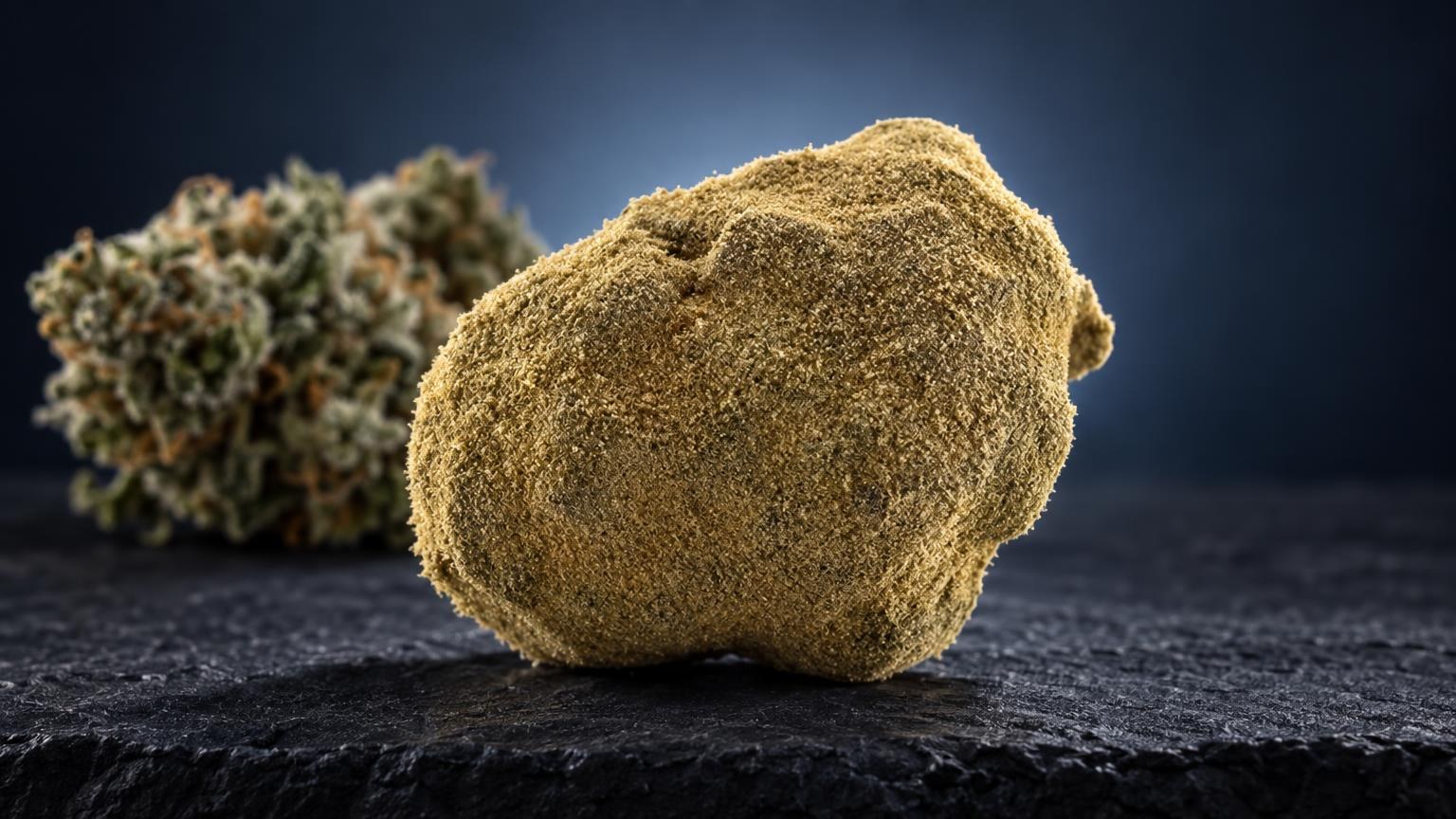
Two references carry the range. Moon Rock THCX is the sticky, hand-breakable one you do not put in a grinder, and the Magic Vape THCX is the pocket format for people who would rather not roll anything. The lab analysis of each batch is available on request from customer service, which is precisely the documentation step the HHC era skipped.
What It Costs in Europe: THCX Prices, September 2026
Chemistry sets the frame; numbers close the argument. So here is our own price sheet, recorded on spliffstore.eu on 07/09/2026, regular prices only, promotions excluded.
| THCX product | Regular price (07/09/2026) |
|---|---|
| Moon Rock THCX | 29,70 € |
| Magic Vape THCX | 49,90 € |
| THCX flowers | 23,70 € (Charlotte Angel) to 38,00 € (Trim Premium, Minibud Cali USA) |
| THCX hash | from 32,70 € (Afghan Hash, Maroccan Hash) |
The Magic Vape THCX sits at the top of that list for a structural reason: a sealed device and a stated fill volume. You know the fill volume instead of inferring it.
The Moon Rock plays a different game. Dense, sticky, coated, it is the format people keep coming back for.
Sourcing moves, and prices move with it, so read the figures above as a dated snapshot rather than a permanent tariff.
That gap matters if you are a potential buyer researching hhc vs thc on a budget. For a sense of scale, our Moon Rock CBN, a different cannabinoid altogether, sits at 21,30 € regular price on the same date. The pharmacological properties of HHC are documented in peer-reviewed research[4], so the molecule itself is known.
What is missing is the commercial side: reliable, current retail pricing for a thc hhc comparison is far harder to pin down than the science.
How to Read a Cannabinoid Listing After the HHC Era
The HHC episode leaves you with something more durable than a date: a method individuals can use to read the next listing before it reads you, whatever benefits the seller lists. Three checks, in order.
- Check 1, is the cannabinoid named, and is it controlled where you live? A trade name is not a molecular structure. HHC itself now sits under the 1971 Convention whatever a label calls it[2], and several EU countries had banned it nationally before that.
- Check 2, does the lab certificate assay more than THC and CBD? That is the blind spot described in the products section; ask what else the method quantifies before you accept the word “compliant”.
- Check 3, is the seller shipping from inside the EU, at a stable regular price? Fixed pricing and an EU dispatch point are boring signals. Boring signals age well.
Run those three on any compound marketed as similar to THC and you filter out most of the noise, whichever molecule turns up after this one, in hemp or in what US sources call marijuana. None of this concerns what a substance does in your body: that question belongs to clinicians, not to product pages.
The Loophole Is Closed: Where That Leaves You
Strip the chemistry back to one sentence and hhc vs thc reads like this: a psychoactive cannabinoid that binds the same receptor target as THC, marketed on the same euphoria, while sitting outside the legal texts that named THC by structure. That was the whole trick. A regulatory gap engineered in a reaction vessel, not a botanical discovery.
Renaming a molecule on a label does not reopen a legal definition. If you’d rather assess the evidence yourself than take a shop’s word for it, the peer-reviewed literature on hexahydrocannabinol is indexed on PubMed[4], and it’s considerably thinner than the marketing of that era implied.
So where does that leave you as a buyer? My position is simple: I’d treat any product whose selling point is a legal definition rather than a documented composition with real caution.
Conclusion
What actually survives all this is a habit, not a headline. The sales pages of that era leaned hard on psychoactive properties, relaxation, euphoria and a list of supposed benefits, none of it drawn from controlled human research on its effects[3]. The peer-reviewed literature is open to anyone, and it reads far more cautiously than any product description ever did[4].
So the practical lesson of hhc vs thc is short: read the molecule, not the marketing. Whether the label says CBD, a hemp-derived cannabinoid or a trade name you have never seen, the same three checks apply before you spend anything.
The three checks above do more work than any claim on the front of a pouch; verify our own figures the same way.
See the full THCX range and judge it on the same criteria you would apply to anyone else.
Frequently asked questions
What is HHC vs THC?
HHC is hexahydrocannabinol, a hydrogenated form of delta-9-THC produced from hemp-derived CBD. Both bind cannabinoid receptors, CB1 first, but HHC is a semi-synthetic lab product, not a plant-derived cannabinoid.
What's the difference between HHC and THC?
The gap is one saturated double bond, but that small change creates two epimers with different receptor behaviour, so an “HHC” label alone does not tell you what a batch will do, unlike THC, which is a single defined molecule.
What are HHC vs THC effects?
HHC produces effects similar to THC because it targets the same CB1 receptor, though generally with lower and less predictable intensity than THC. Potency depends on the 9R/9S epimer mix rather than the dose printed on packaging, so two products labeled identically can feel quite different.
Is HHC legal in Europe?
See “Why HHC Vanished From European Shelves”: HHC moved from a regulatory gray zone in 2022 to Schedule II control under the 1971 Convention, and several EU countries had already banned it nationally before the international decision took effect[2].
Where can I verify information about HHC?
Peer-reviewed studies on hexahydrocannabinol are indexed on PubMed[3], offering a far more cautious picture than marketing from the 2022 hemp-derived cannabinoids boom suggested.
Sources
- Critical review report: Hexahydrocannabinol — WHO Expert Committee on Drug Dependence, 47th meeting (October 2024) — cdn.who.int
- CND decision on international control of hexahydrocannabinol (HHC) and carisoprodol enters into force — UNODC, December 2025 — www.unodc.org
- Ujváry I. Hexahydrocannabinol and closely related semi-synthetic cannabinoids: A comprehensive review — Drug Testing and Analysis, 2024 — pubmed.ncbi.nlm.nih.gov
- Graziano S. et al. Hexahydrocannabinol Pharmacology, Toxicology, and Analysis: The First Evidence for a Recent New Psychoactive Substance — Current Neuropharmacology, 2023 — pmc.ncbi.nlm.nih.gov
- Durydivka O. et al. Hexahydrocannabinol (HHC) and Δ9-tetrahydrocannabinol (Δ9-THC) driven activation of cannabinoid receptor 1 — Scientific Reports, 2024 — pmc.ncbi.nlm.nih.gov
- Casati S. et al. Hexahydrocannabinol on the Light Cannabis Market: The Latest "New" Entry — Cannabis and Cannabinoid Research, 2024 — pubmed.ncbi.nlm.nih.gov