 Written by Sophie Clarke
Contents7 sections
The essentials in 30 seconds
Cannabis long term effects describe patterns linked to frequent, sustained marijuana use over months and years, not to a single session. The long-term benefits and risks remain unclear, yet heavy long-term use can impact midlife cognition, and the more often someone used, the greater the impairment[5][5]. Multiple studies report detrimental effects, while others do not[4].
- Human performance on complex machinery can stay impaired for 24 hours after smoking as little as 20 mg of THC[2].
- Smoked whole-plant THC content has risen from 1% to 4% in the 1970s to 15% to 30% in today’s dispensaries[5].
- A King’s College London survey of 3389 former and current users linked reasons for first use with paranoia[6].
Cannabis long term effects refers to the changes researchers associate with frequent, sustained marijuana use over months and years. That’s different from the short term effects of THC, which belong to a single session and fade once it ends.
Think of the factors below as the settings on a mixing desk: change one and the whole track sounds different.
- Frequency: how often you use, and for how long.
- Potency: how strong the THC is.
- Age of onset: how early in life drug use started.
- Route: smoked, vaped or eaten.
Most data on the health effects of cannabis are observational, and much of it comes from the United States. National agencies such as the National Institute on Drug Abuse and the Food and Drug Administration shape the vocabulary you’ll meet in most summaries, from “use” to “abuse”. Keep one rule in mind throughout: an association is not proof of cause.
What are the short and long term effects of cannabis?
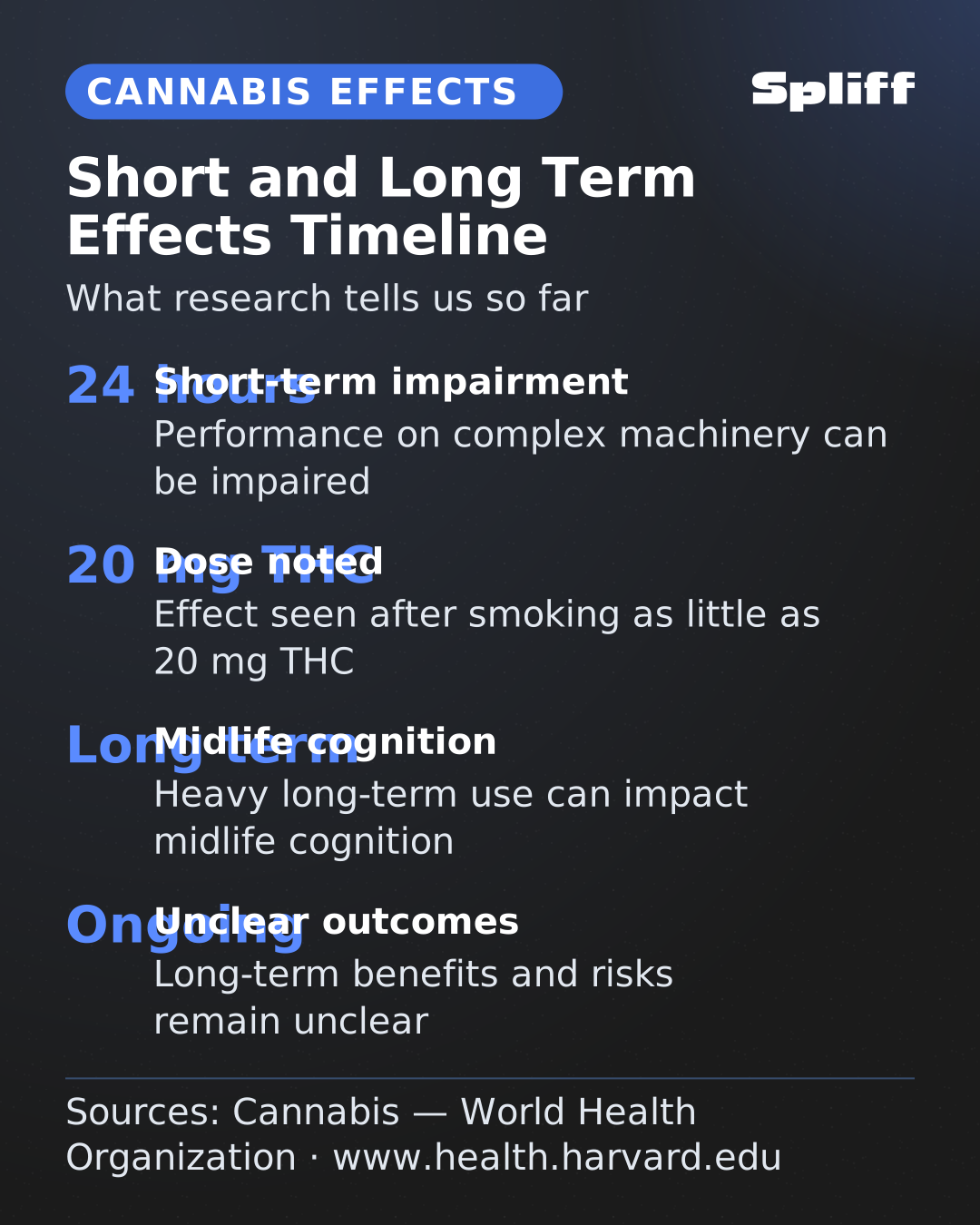
Short term effects of cannabis are the acute THC effects of one session, and they fade as it wears off. Long term effects are the patterns research links to long term use of marijuana, shaped by how often you use, how strong the THC is and how early you started.[5]
The border between the two is blurrier than “one session” suggests. The World Health Organization notes that performance on complex machinery can stay impaired for as long as 24 hours after smoking as little as 20 mg of THC[2].
According to the World Health Organization, cannabis is a generic term for several psychoactive preparations of the plant Cannabis sativa, with delta-9 tetrahydrocannabinol (THC) as the major psychoactive constituent[2].
On the long side, Harvard Health is candid: the long term benefits and risks of cannabis use remain unclear, yet heavy long term cannabis use can impact midlife cognition[5].
So when a review lists outcomes of term cannabis use, read every effect of marijuana use associated with heavy exposure as a pattern seen in observational data. The sections that follow take those patterns one by one, brain and mental health first.
What is considered long-term cannabis use?
There’s no single official threshold for long-term cannabis use. Research describes a pattern rather than a session count: how often you use multiplied by how long that lasts.[5] Most cannabis long term effects in the literature come from people at the frequent, sustained end of that scale.
Daily, weekly or occasional: where do studies draw the line?
Occasional users rarely make the headline. When researchers look at how cannabinoids affect the brain over time, the people they focus on sit further along the frequency scale.
The bands matter because the gradient matters. In the midlife study covered by Harvard Health, the more often people used, the greater their cognitive impairment, suggesting a potential causative link[5].
Potency shifts the picture too, because the main psychoactive cannabinoid now shows up in far bigger amounts. The average THC content of smoked whole-plant cannabis rose from 1% to 4% in the 1970s to 15% to 30% in today’s dispensaries[5]. Daily use of a Cannabis sativa plant product in older cohorts and daily use now are different exposures, like comparing filter coffee to a double ristretto.
Can cannabis cause long-term damage?
Cannabis can be linked to lasting harm, but the evidence is uneven from one area to the next. Researchers at King’s College London connect rising potency with more dependence and cannabis-induced psychosis[6], and the reasons people start using cannabis with paranoia[6]. Most of this data is observational: it shows associations, not proof that cannabis alone caused the damage.
Once you know who counts as a long-term user, the next step is reading each risk area on its own terms. Some findings rest on large samples, while others mostly show how hard it is to isolate cannabis from everything else in a person’s life.
Mental health is where the newest psychiatry data sits. The King’s College team surveyed 3389 former and current cannabis users[6]. People who first chose to use cannabis to self-medicate an illness, whether pain, anxiety, depression or minor psychotic symptoms, scored higher for paranoia than those who started out of fun or curiosity[6].
Keep the limits in view. A survey captures a link between motive and paranoia, not a mechanism, and it can’t tell you which came first. The same researchers note that use and potency are climbing worldwide, with dependence and psychosis rising as a result, especially in North America[6].
Treat it as a strong signal for European users, not a direct measurement of your own market.
For the brain, the midlife cognition gradient from the earlier sections stays the clearest frequency signal on the table.
When it comes to physical harm, the risk of lung cancer needs the sharpest reading.
- Check whether participants’ drug and alcohol habits, including any illicit drug use, were measured.
- If they weren’t, read any cancer headline as unfinished.
Motor vehicle accidents pull the long-term picture back to the single session, because of the impairment window covered in “What are the short and long term effects of cannabis?”.
Does the format or THC strength change the picture?
Potency and route are the two variables a label speaks to directly, and both shape how you should think about cannabis long term effects. A pod at the far end of the potency scale is a very different input from a lightly loaded joint, whatever the format, so expect a much stronger effect.
Most health data behind cannabis long term effects comes from the United States, where about 12% of people aged 12 or older reported past-year marijuana use[4], a headline number that puts young people and older adults in the same bucket. Surveys of people who use illicit drugs seldom separate smoked flower from vapes or edibles, or record how much delta-9 THC each session delivered. Vaping takes combustion out of the equation, not THC.
Live rosin vs standard pods: what’s the difference?
The difference starts at extraction, not at the battery. In cannabis culture, live rosin is a solventless concentrate pressed with heat and pressure and prized for keeping more of the original terpene profile. A standard pod usually runs on distillate, a refined oil that gives up some aroma in exchange for uniformity, much like cold-pressed olive oil next to refined sunflower oil.
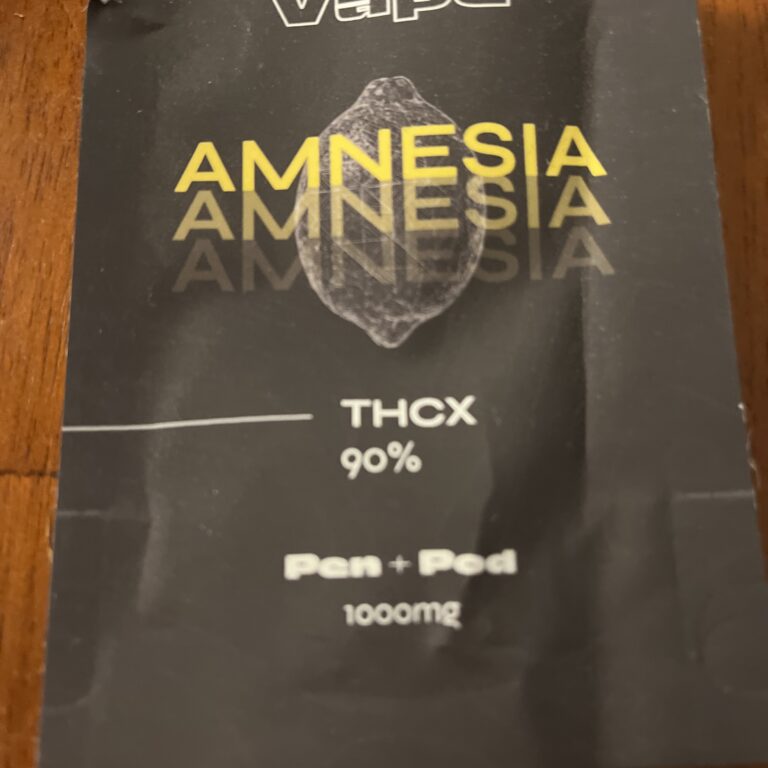
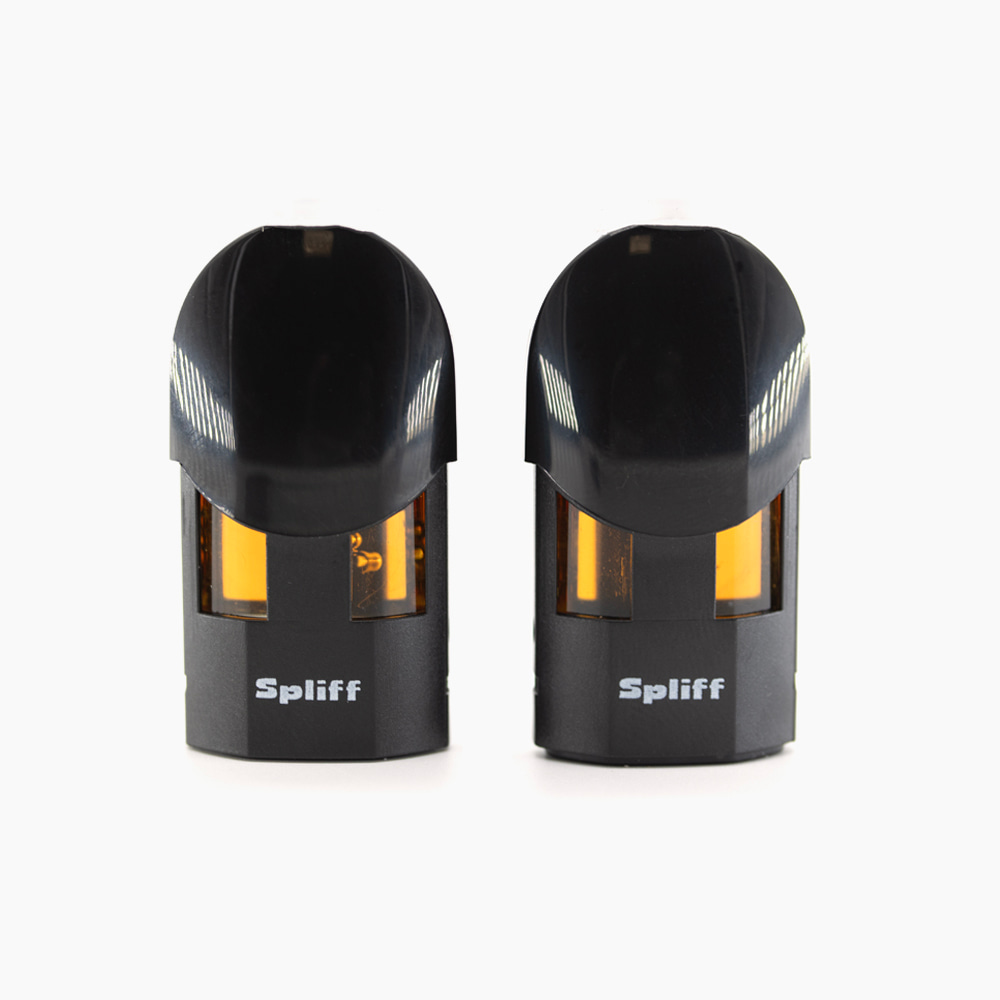
Neither label promises a gentler ride. Our Magic Pod Live Rosin x2 and Magic Pod x2 (THCX Vape Pods 90%) are both high-potency pods for the Magic Vape battery, and the 90% on the THCX pod puts it at the strong end of the scale. THCX is a trade name, not a molecule: every batch is lab-tested for classified molecules and none are detected.
Making an informed choice as an adult
Turning all of that into a decision comes down to the parts you control. Research won’t hand you a verdict: multiple studies have reported detrimental effects of marijuana, others haven’t, and whether it’s harmful remains debated, according to a PMC review built largely on U.S. data[4].
No single study, and no systematic review either, can predict how your own pattern will play out. The cannabis long term effects covered in this article, and across the literature, are averages across groups. Your job is to know which side of each variable you sit on.
- Frequency: how often you’ll realistically use. This is the lever you fully own.
- Strength: the potency on the label, chosen on purpose rather than by default.
- Format: smoked, vaped or eaten, since the route of consumption changes what reaches your body.
If you pick a pod, read its label for what it is. The Magic Pod Live Rosin x2 sits firmly at the high-potency end, and its product page shows today’s price.
For a lower-THC route, the CBD flower collection is the gentler starting point.
Conclusion
Put those pieces together and cannabis long term effects look less like a verdict and more like a pattern you shape: how often (occasional or regular), how strong, how early (adolescent or adult), which route. Only a clinician can apply DSM criteria to your own use.
When the next headline lands, check how it was built. A DOI, a PMID and a PMC record tell you a paper exists, not that it settled the question, whether the team works in London or in the United States. Read the design before the conclusion, and ask whether the effect held up beyond a single sample.
Spliff, created in 2023 in Montpellier, ships to Austria, Belgium, Germany and the Netherlands. If you’d rather keep THC on the low side, start with the CBD flower collection.
Frequently asked questions
What is the most common mental health issue linked to cannabis?
The King’s College London survey points to paranoia as a key issue, with people who first used cannabis to self-medicate pain, anxiety, depression or minor psychotic symptoms scoring higher for paranoia than those who started out of fun or curiosity[6].
Sources
- Cannabis — World Health Organization — www.who.int
- Adverse Health Effects of Marijuana Use – PMC — pmc.ncbi.nlm.nih.gov
- www.health.harvard.edu — www.health.harvard.edu
- Largest ever study into cannabis use investigates risk of paranoia and poor mental health in the general population | King''s College London — www.kcl.ac.uk