 Written by Sophie Clarke
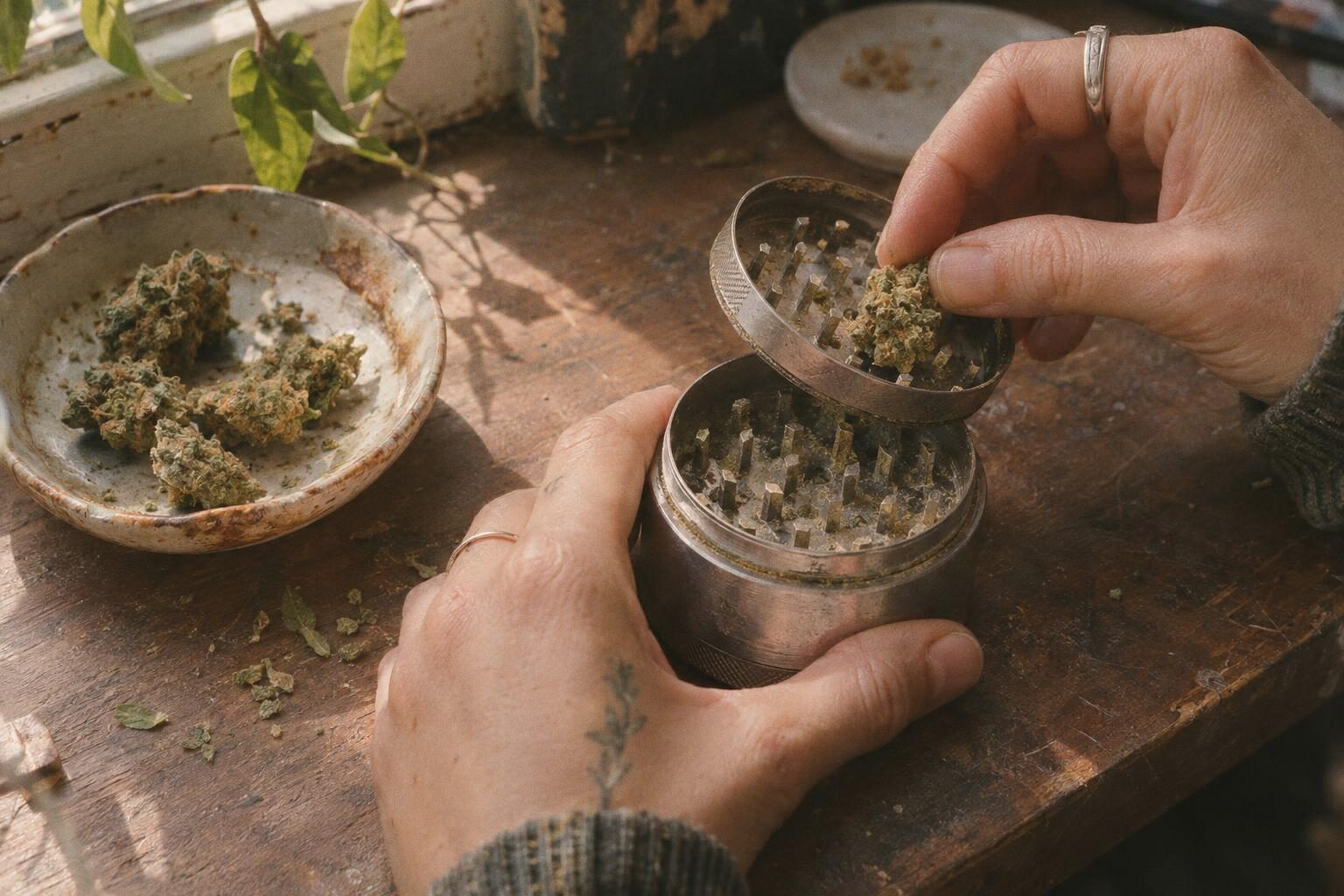
Contents7 sections
The essentials in 30 seconds
A grinder is a small handheld tool that shreds cannabis flowers or dried herbs into an even, airy grind for rolling, packing or vaporising. The guide explains how to use one well, which texture suits a joint, a vaporiser or edibles, and what to do with a kitchen grinder or none at all.
- Cutting and grinding with sharp teeth gives an even texture, so stop before the herb turns to dust.
- An angle grinder, a machine used for cutting and grinding metal, is a different tool from the herb grinder.
- Without a grinder, scissors in a shot glass give the most control, and a knife on a board comes next.
A grinder is a small handheld tool that shreds cannabis flowers or dried herbs between sharp teeth or blades, turning dense buds into an even, airy grind ready to roll, pack or vaporise. This guide shows you how to use one well, which texture suits a joint, a vaporiser or edibles, and how to cope with a kitchen grinder or no grinder at all.
The word covers a lot of hardware. An angle grinder is a power tool with a spinning disc and a disc guard, built for cutting, grinding and polishing metal, and a meat or coffee grinder lives in the kitchen. In cannabis slang, “grinder” means the herb tool itself, sometimes shorthand for the grind it produces.
Picture a pepper mill. Interlocking teeth shear the bud as you twist, while blade models chop it, and both leave pieces of similar size. That regular texture gives you steady airflow and an even burn in a joint, plus consistent heat contact in a vaporiser.
Tearing buds apart with your fingers leaves a mix of chunks and dust, so the joint runs or clogs and the sticky resin ends up on your fingertips. If your grinder already sticks or jams, the fix is in our guide on how to clean a weed grinder.
What is a grinder, and what does it actually do?
A grinder is a hand tool that sets the particle size of your herb. Its real job is making heat behave: every piece catches the flame or the vaporiser’s warmth at the same pace, so nothing scorches while the rest stays raw.
Big chunks and powder heat at different speeds. That gap is why a vaporiser chamber toasts some pieces and barely warms others.
Herb grinder, angle grinder or meat grinder: which one did you mean?
On this page, a grinder is the small hand tool for cannabis and dried herbs, not the electric or kitchen machines sharing the name. For an angle grinder, try a hardware store; a meat grinder is built for soft, moist food. In workshops, the word also covers industrial grinding machines used in machining to refine the surface of materials[4].
The grinder used for weed is pocket-sized: a twist-by-hand cylinder in aluminium or plastic, no battery, built for one job repeated daily and nothing heavier.
How do you use a grinder the right way?
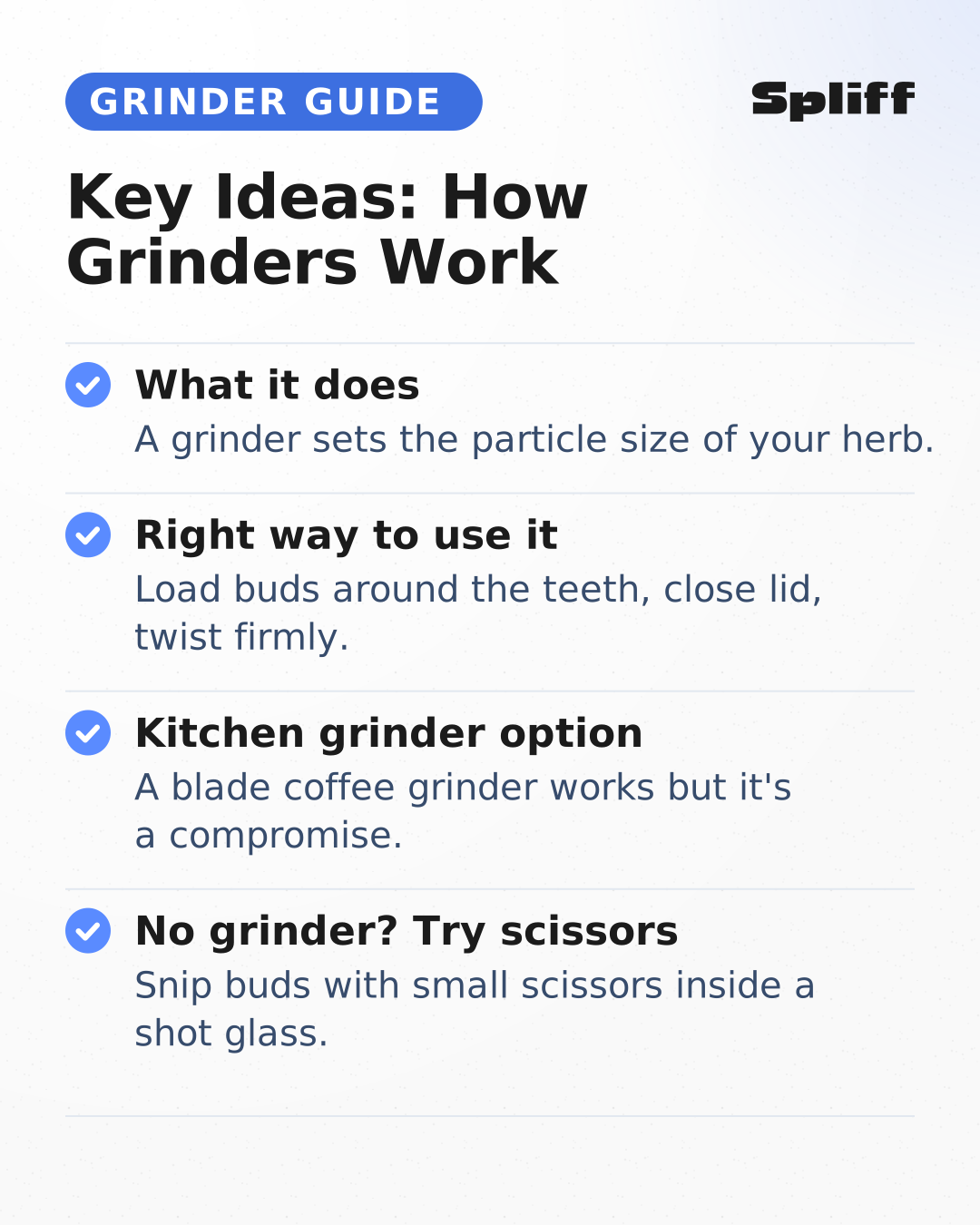
Load broken-up buds around the teeth, not in the centre, close the lid and give it a handful of firm twists. Tap the grinder so the material drops through to the chamber. Stop well before it turns to dust: a fluffy, even grind is the target for almost every format.
Once you know why the teeth beat your fingers, the technique takes about a minute to learn:
- Break large buds into smaller pieces by hand, so they sit flat between the teeth.
- Spread them around the outer teeth, away from the centre pin, so the lid closes without jamming.
- Close the lid and twist a few times, until the resistance fades.
- Tap the grinder on the table, so the grind falls into the collection chamber.
The number of twists is your volume knob: fewer turns leave a loose texture, more turns tighten it, and none of the right textures is powder.
Treat your herb grinder as a herb tool, not an all-materials grinder. Hash and resin crumble by hand or with gentle warmth, and even the WHO treats resin as its own category: its Expert Committee on Drug Dependence (ECDD, 2015), at its thirty-seventh meeting, asked the Secretariat to start collecting data for a future review of cannabis, cannabis resin and extracts and tinctures of cannabis[1].
How fine should you grind for joints, vapes and edibles?
Medium for a joint, fine and even for a vaporiser, consistent for infusions. Think coffee: a joint wants a filter-coffee grind, loose enough to let air through and burn steadily instead of clogging.
A vaporiser behaves more like an espresso machine: hot air flows through the chamber, so a fine, regular grind gives it more surface to work on and less room for uneven patches.
For butter or oil infusions, consistency matters more than fineness. Sharp-toothed grinders hold that uniform size better than a blade, sparing you green dust in the batch afterwards.
Can you use a kitchen or coffee grinder instead?
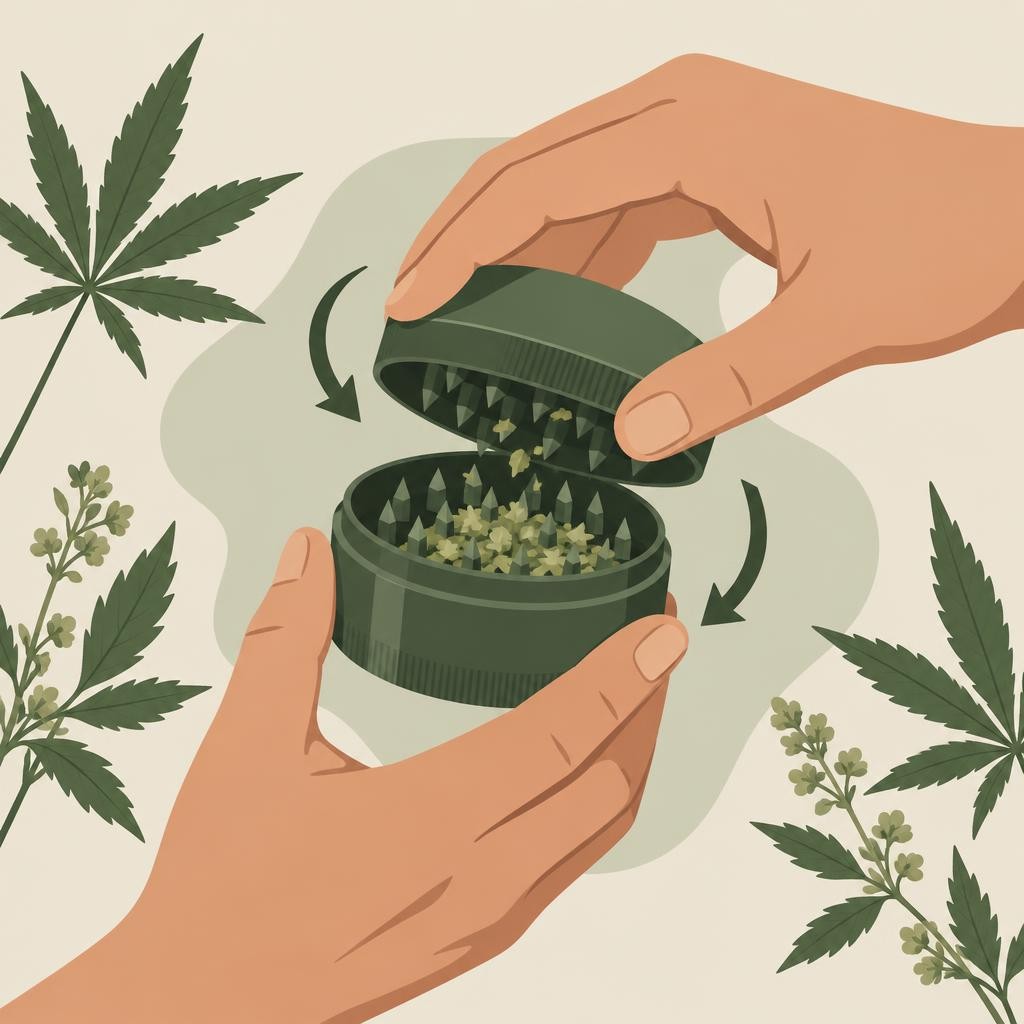
Yes, a blade coffee or spice grinder will break down cannabis flowers, but it’s a compromise. Spinning blades chop at high speed, so the size of the pieces is hard to control and buds turn to dust fast. Coffee and spice aromas also cling to the bowl and mix with terpenes. Pulse briefly and keep that machine dedicated.
A herb grinder shears buds between fixed teeth at the pace of your wrist. A coffee grinder whips its steel blades around so quickly that “fluffy” becomes “powder” with a single extra press.
If you want grinder-style control from a blade machine, use short pulses and shake between each one. Think pesto in a food processor: great for a paste, frustrating when you’re after neat, even pieces.
| Tool | How it cuts | Control over texture | Worth it? |
|---|---|---|---|
| Manual herb grinder | Teeth shear the buds | High, twist by twist | The reference |
| Coffee or spice grinder | Blades chop at speed | Low, dust comes fast | Backup only |
| Electric herb grinders | Motor turns the mechanism | Medium, less feel than your hand | Convenient, less precise |
| Meat grinder | Pushes moist food through a plate | None, sticky flowers clog it | Wrong tool |
Keep the blade grinder as a backup and leave the meat grinder in the kitchen.
How do you crush weed without a grinder?
The best way to crush weed without a grinder is a pair of small scissors snipping buds inside a shot glass: clean, quick and easy to control. A sharp kitchen knife on a board comes next for dry flowers. Breaking buds by hand, a coin in a pill bottle or a card grater all work, but the grind is rougher and less even.
When neither a herb grinder nor a spare coffee mill is around, choose the right method for the texture you’re after. Ranked from best to worst result:
- Scissors in a small glass. Drop the buds into a shot glass and snip with short scissors, turning the glass as you go. You control the size of the pieces and lose almost no resin.
- Knife on a board. Chop the buds like fresh parsley. Works well on dry flowers, but sticky buds cling to the blade and go mushy.
- By hand. Fastest option, but pieces come out uneven and trichomes stay on your fingertips instead of your joint.
- Coin in a pill bottle, or a card grater. A coin shaken with dry buds only knocks them into rough chunks. A homemade grater is slow and yields little, so use these only as a last resort.
The same logic applies to coffee: seal beans in a freezer bag and press with a rolling pin or a heavy pan. You’ll get a coarse, uneven grind that suits a French press better than an espresso machine.
What makes a grinder worth buying?
A grinder is worth buying when it cuts cleanly and keeps working that way: sharp teeth that shear rather than squash, a tough material such as aluminium, a size that suits where you grind, a strong magnet, a fine pollen screen and smooth threads. For home use, a table-sized metal grinder with a screen is the safest pick.
Material decides how the whole thing ages, much like cookware does.
Aluminium is the cast-iron pan of the category: light, tough, and its teeth hold their edge. Zinc feels heavier in the hand, but cheaper builds can chip and shed flakes over time. Wood looks warm but soaks up resin, while acrylic is light and affordable but blunts quickly.
Size comes down to where the work happens. A pocket diameter travels well but takes small loads, while a table model gives your hand more grip, so grinding feels like turning a pepper mill rather than cranking an organ grinder. Check the teeth too: sharp, pointed edges cut evenly, rounded ones just press.
- Strong magnet: the lid stays shut in a bag.
- Fine screen: pollen drops through, plant matter stays above.
- Smooth threads: chambers open without jamming, even when sticky.
- Grinder accessories: a small scraper makes emptying the kief chamber far easier.
Whether two, three or four pieces suit you is covered in our herb grinder guide.
To see this checklist on a real object, look at Grinder Max for home grinding, or Grinder Mini when it has to fit a pocket. Across both, 19 customer reviews give an average rating of 5/5.
Conclusion
Scissors, knife or coffee mill will get you through a night, but none of them match a proper herb grinder for an even, fluffy result. It’s the most low-tech tool you’ll own: no cordless motor, no soft start, no safety guard to fiddle with. Just sharp teeth that cut buds cleanly, and clean cuts that give you a texture you can tune by counting twists.
Match the grind to your format, and the tool does the rest. When you’re ready to upgrade, browse the grinder collection to compare sizes and finishes. Shipping details for Austria, Belgium, Germany and the Netherlands are on the delivery policy page.
Frequently asked questions
What is the definition of a grinder?
In this context, a grinder is a hand tool used to break down cannabis flowers or dried herbs into an even texture. It sets particle size so material heats evenly when smoked or vaporised, unlike kitchen or industrial grinding machines, which serve entirely different purposes.
Sources
- Cannabidiol (CBD) critical review report — WHO Expert Committee on Drug Dependence — www.who.int
- Grinder – Wikipedia — en.wikipedia.org