 Written by Sophie Clarke

Contents7 sections
- What is a lemongrass plant and why does it smell like lemon?
- How do you look after a lemongrass plant?
- Where can you buy a lemongrass plant, and what should you check?
- Which cannabis terpenes share the lemongrass aroma?
- Lemongrass plant or citrus-profile vape: which suits you?
- Conclusion
- Frequently asked questions
The essentials in 30 seconds
The lemongrass plant (Cymbopogon citratus) is a tropical grass with a sweet, lemony scent, commonly cultivated as a culinary and medicinal herb[4]. Fresh lemongrass or lemongrass paste keeps in the fridge for about a week[4]. For a ready-made format, Spliff’s vape and CBD range is lab-tested, with THC below 0.3% and 0% in vapes and pods.
- A tropical grass with a sweet, lemony scent, lemongrass is associated with Thai and South East Asian cooking[4].
- Cymbopogon citratus is commonly cultivated as a culinary and medicinal herb because its scent resembles that of lemons.
- Every Spliff product is lab-tested: THC content below 0.3% (0% for vapes and pods).
The lemongrass plant (Cymbopogon citratus) is a tropical perennial grass that grows in dense clumps of bulbous stems and long, arching leaves. It’s grown mainly for the kitchen, where its bright citrus scent does the heavy lifting.
Chop the pale lower stem finely and it slips into a curry or a broth somewhere between lemon zest and fresh ginger: sharp, clean, a little peppery. That lemon note has nothing to do with lemons, though. It comes mostly from citral, which carries the citrus top note, while myrcene adds a greener, slightly earthy base, much like two notes built into one accord in perfumery.
In a pot, a mature clump makes a full, grassy feature on a balcony or terrace. Here’s the catch that shapes everything else: lemongrass isn’t hardy. Even light frost damages the leaves, so given the growing conditions in Germany, Austria, the Netherlands or Belgium, your care routine starts with a container you can bring indoors.
What is a lemongrass plant and why does it smell like lemon?
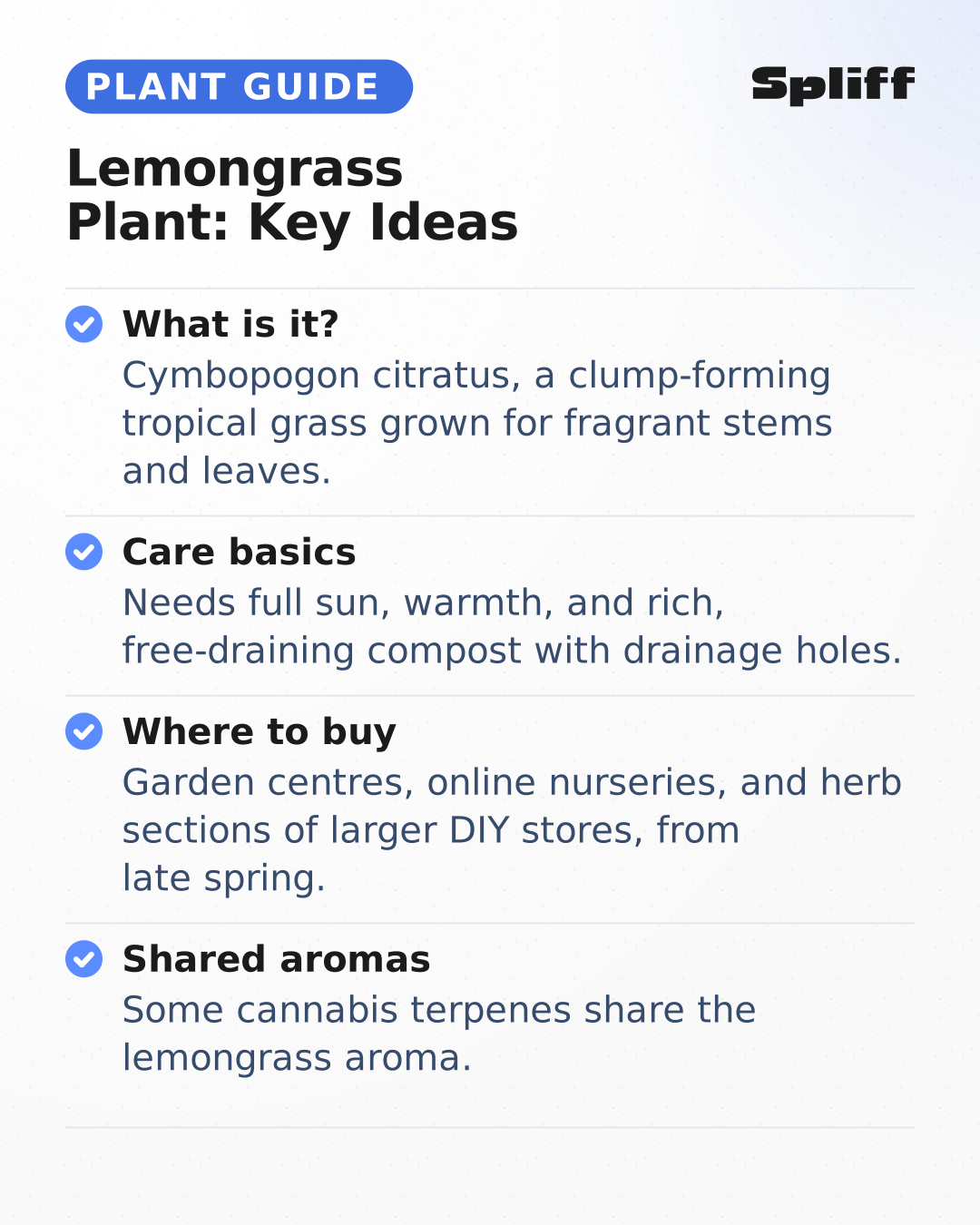
A lemongrass plant is Cymbopogon citratus, a clump-forming tropical grass belonging to the Poaceae (grass) family, grown for its fragrant stems and leaves. It smells of lemon without being related to citrus: the scent is generally described as coming mainly from citral, with greener notes from myrcene, the accord set out just above.
Within that family, it sits inside the genus Cymbopogon, which holds several scented species. Citratus is the one you’ll find at a garden centre, on a greenhouse bench or in the herb section of a supermarket. It’s commonly cultivated as a culinary herb because its scent resembles that of lemons.
That’s the twist people miss. The plant produces a lemon aroma note through a completely different instrument. Picture a cover version that hits the same melody on a different guitar.
Whether you plant lemongrass from a pot picked up in store or from a delivery plant, the fragrance isn’t spread evenly across its height, which matters once you start harvesting:
- Leaves: thin and papery, they release a sharp, zesty hit the moment you crush or tear them.
- Lower stems: the pale, dense and juicy base of each stem holds the rounder, deeper aroma that cooks are after.
- Outer sheaths: tougher and more fibrous, best for infusing a broth and fishing out afterwards.
How do you look after a lemongrass plant?
Look after a lemongrass plant by giving it full sun, warmth and a rich but free-draining compost in a container with drainage holes. Water regularly so the compost stays moist but never soggy, feed it through the summer growth spurt, and bring it indoors before the first frost to rest somewhere cool, bright and fairly dry.
BBC Food describes lemongrass as a tropical grass with a sweet, lemony scent, associated with Thai and South East Asian cooking[4], so good care comes down to faking a warm summer as long as you can. Whether you picked up a Thompson Morgan plant or a YouGarden plant, lemongrass from either one wants your sunniest spot and a container with proper drainage holes. Step up your lemongrass plant’s litre pot size as growth fills it, rather than jumping straight into a huge tub where the compost stays wet for days.
From late spring to early autumn, water when the top of the compost feels dry and feed with a balanced liquid fertiliser every couple of weeks. Yellowing, limp leaves and a sour smell mean too much water: let it drain and ease off. Once your lemongrass live plant crowds the edges of its pot, split it in spring or move it up one size.
How do you overwinter lemongrass indoors?
You overwinter lemongrass by moving it inside before the first frost and letting it idle in a cool, bright room until spring:
- Bring the pot indoors before night temperatures drop below freezing.
- Cut the leaves back to about a hand’s width above the stems, so the clump loses less water.
- Place it somewhere cool and bright, like an unheated stairwell or frost-free conservatory, so growth slows down.
- Water sparingly, just enough to stop the compost drying out completely.
- Move it back outside after the last frosts and restart feeding.

Where can you buy a lemongrass plant, and what should you check?
You can buy a lemongrass plant at garden centres, online nurseries and the herb section of larger DIY stores, mostly from late spring onwards. Before you pay, compare the plant size with its litre pot, check that the stems are firm with no rot at the base, and look at price, availability and delivery dates so the plant lands after the last frosts.
Out of season, when online stock and delivery of a plant both dry up, a market stall or an Asian grocer is your backup. Stand fresh stalks in water on a warm windowsill and pot them up once roots appear. Fresh lemongrass will keep in the fridge for about a week, per BBC Food[4].
- Compare the plant size with the container: judge the litre pot price against the number of stems you actually get.
- Inspect the stems: pale, firm bases and green leaves, never soft or brown.
- Read the price, availability and stock details: “available to order” in early spring often means dispatch weeks later.
- Book delivery for after the frosts. A shop that shows its delivery timing clearly makes this easy, so the plant doesn’t sit in a cold van and arrives ready for a sunny spot.
Which cannabis terpenes share the lemongrass aroma?
Two cannabis terpenes overlap with the aroma of the lemongrass plant. Myrcene carries the herbal, earthy base in many cannabis strains. Limonene is usually credited with most of the citrus brightness in cannabis, with citral seen as a minor player there. The sources cited in this article don’t cover cannabis terpene profiles, so treat that split as common industry description rather than established data.
Whether it’s a lemongrass Thompson & Morgan seedling, a lemongrass Crocus pot or a YouGarden starter plant, once it’s growing on a windowsill at home, your nose has a reference point for any terpene description: lemon on the nose, herbal on the finish.
When a strain sheet pairs limonene with myrcene, expect something in the lemongrass neighbourhood rather than a carbon copy of it.
Why isn’t citral the main lemon note in cannabis?
Because the two plants are generally described as building their lemon scent from different molecules. Cannabis is usually said to get its citrus edge mostly from limonene, with citral only a minor player.
That’s why a strain sold as “lemony” won’t smell like a lemongrass stalk crushed between your fingers. Picture two lemon desserts: one built on lemon verbena, the other on candied peel. Same family, different accent.
Lemongrass sits sharper and more sherbet-like. Cannabis lemon notes come across rounder and more resinous, with myrcene’s earthiness underneath.
Lemongrass plant or citrus-profile vape: which suits you?
Pick a live lemongrass plant if you cook and garden: it gives you fresh stems all summer, but it needs sun, steady watering and a frost-free spot every winter, because a hard frost will finish off any lemongrass plant left outdoors. If you’re an adult who simply wants that citrus-herbal flavour on demand, a ready-made vape format is the smarter choice.
A plug plant or a small live plant needs months of the right growing conditions and care before harvest, then rests for the cold season. Before you buy one, check the pot size, price and availability at your garden centre, since stock is seasonal. A pod works year-round, clipping onto the reusable Magic Vape battery like a capsule fits a coffee machine, so you keep the device and change flavour whenever you like.
THCX is a trade name, not a molecule: every batch is lab-tested for classified molecules and none are detected.
Live rosin or standard pod for a fresh citrus note?
For the freshest citrus note, choose live rosin. The Magic Pod Live Rosin x2 feels bright and close to fresh, like cold-pressed juice versus juice from a carton.
The standard Magic Pod has a rounder, more classic taste for everyday use. Want crisp lemon top notes? Go live rosin. Want an easy all-rounder? The standard pod does the job, and each product page shows the price of the day plus the formats currently available.
Apart from the CBD-based medicine Epidyolex, assessed and authorised by the European Medicines Agency[3], consumer CBD is not a medicine and is not a substitute for medical advice. If in doubt, consult a healthcare professional.
Conclusion
Whichever side of that choice you land on, the lemongrass plant rewards a simple routine: a roomy pot, the sunniest summer spot you’ve got and a watering habit that never leaves water pooling at the base. It’s a tender grass, so whether you started from seed or a nursery plug, bring it indoors before the cold arrives and keep those warm, bright conditions steady. Get that right and your windowsill doubles as a crash course in citrus aroma: few plants or kitchen herbs train your nose this well for the next terpene description you read.
If you’d rather keep that lemon-and-herb profile in a ready-made format, the vape collection is there whenever you want it. At Spliff, every order leaves shortly after payment, and we ship notably to these 4 countries: Austria, Belgium, Germany and the Netherlands.
Frequently asked questions
Do lemongrass plants come back every year?
Lemongrass is a tropical perennial grass, but it won’t survive outdoor winters in a cold climate. Grown in a pot, it can regrow year after year if you cut it back, bring it indoors before frost, keep it cool, bright and sparingly watered, then move it back outside once frosts have passed.
Should lemongrass be planted in pots or in the ground?
A container is the safer choice, since it lets you move the plant indoors before the first frost rather than leaving it exposed in open ground. Choose a pot with drainage holes, size it up as the clump fills it, and place it in the sunniest spot available.
What is the disadvantage of a lemongrass plant?
Its main drawback is that it’s tropical and frost-sensitive: it needs full sun, steady watering without waterlogging, regular feeding through summer, and a cool, dry indoor spot over winter. Without that care routine, yellowing leaves, a sour smell, or stem damage from freezing temperatures can follow.
Sources
- Epidyolex (cannabidiol) — European Medicines Agency, EPAR — www.ema.europa.eu
- Lemongrass recipes – BBC Food — www.bbc.co.uk