 Written by Sophie Clarke
Contents8 sections
- What is a ginger plant, and is ginger a root or a rhizome?
- How do you plant ginger root step by step?
- Can ginger be grown in a pot indoors?
- How often should I water a ginger plant?
- Why does ginger smell like some cannabis strains?
- Ginger plant or terpene shelf: making the most of both
- Conclusion
- Frequently asked questions
The essentials in 30 seconds
This guide shows how to grow a ginger plant, Zingiber officinale, from a plump rhizome in a warm, frost-free pot, with watering adjusted to each season. It also follows ginger’s aroma to terpenes, which ginger and cannabis share. Ginger is rich in active constituents, including phenolic and terpene compounds[4].
- Start from a firm organic rhizome with visible eyes, soaked overnight and laid flat in free draining compost.
- Keep the pot warm and frost free indoors or in a heated greenhouse, and check the Royal Horticultural Society hardiness guidance before moving it outdoors.
- Cannabis is defined by THC as its major psychoactive constituent[2], and every Spliff vape is lab-tested with THC at 0%.
The ginger plant is Zingiber officinale, a tropical perennial with lance-shaped, bamboo-like leaves, and the knobbly piece you grate into a stir-fry is a rhizome, a swollen underground stem, not a root. This guide shows you how to grow it in a pot indoors or in a heated greenhouse, covering planting, light, watering and getting through a continental winter. After that, we follow its scent to terpenes, the aroma family that ginger and cannabis both draw on.
Think potato, not carrot. A rhizome carries small buds called “eyes”, and each one can push up a shoot while roots form underneath. That’s why you start a ginger plant from a chunk of culinary ginger rather than from a seed.
Ginger is a warm-climate plant that won’t tolerate frost or long spells of cold. Treat it like basil or chilli: a tender plant that needs a heated room or greenhouse once the temperature drops.
What is a ginger plant, and is ginger a root or a rhizome?
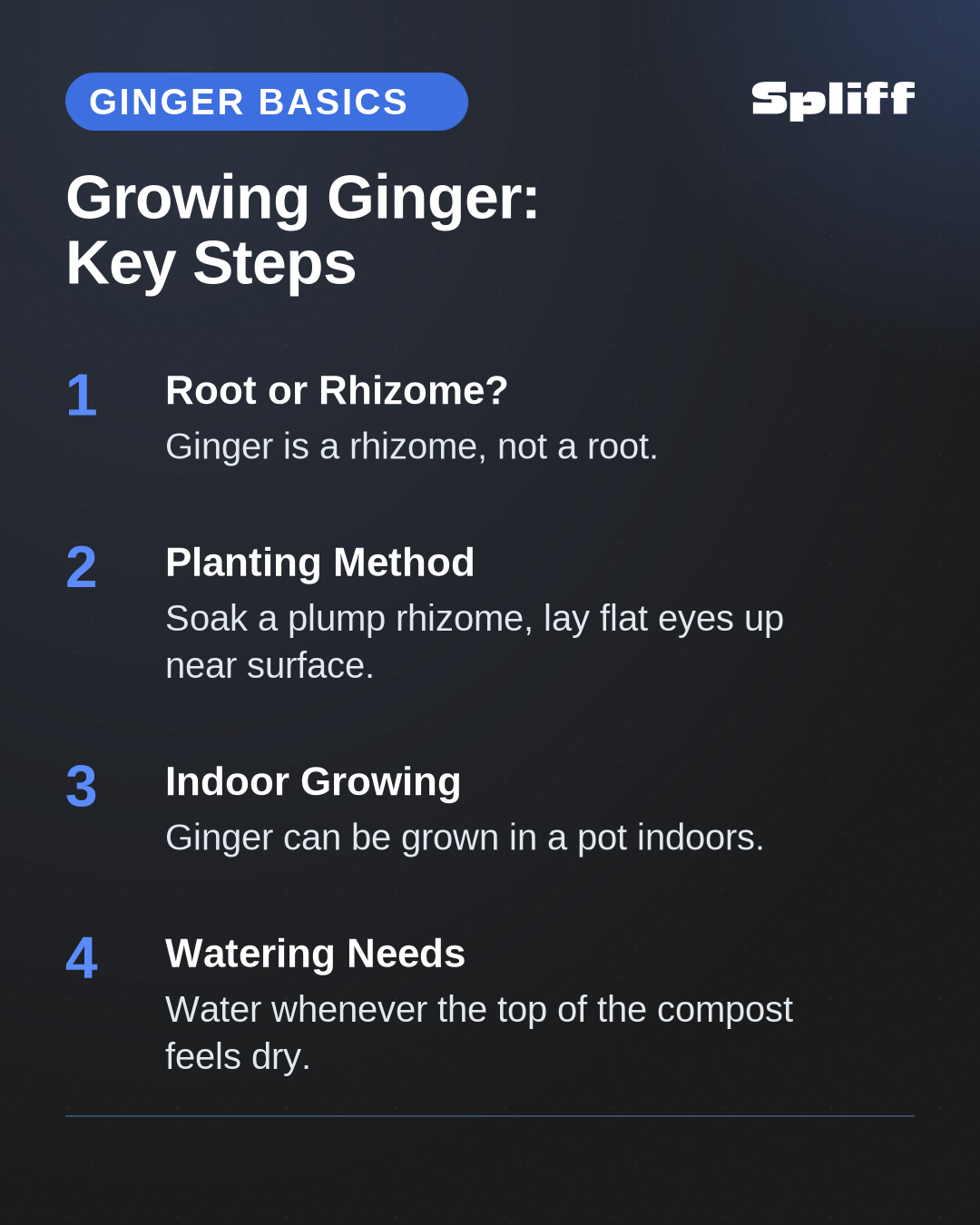
Ginger is a rhizome, not a root. The ginger plant, Zingiber officinale, is a tropical perennial, and the part you cook is a swollen underground stem dotted with buds called eyes. Each eye can push up a new leafy shoot, which is why you start a new plant from a piece of rhizome rather than from a seed.
Cultivated ginger is multiplied almost entirely from rhizome pieces, the same way you’d plant seed potatoes. A plump piece with visible buds already holds everything a new plant needs to get started.
Is a ginger crocus the same thing as edible ginger?
No. A plant ginger crocus sold in garden centres is usually an ornamental relative grown for its flowers or foliage, not the spicy rhizome you grate in the kitchen. Trade names change from shop to shop, and some ornamental gingers look convincingly similar on the shelf.
Common names are slippery in every corner of the plant world. According to the World Health Organization, even “cannabis” is a generic term used to denote several psychoactive preparations of the plant Cannabis sativa, with THC as the major psychoactive constituent[2]. The Latin name remains your only reliable ID.
How do you plant ginger root step by step?
To plant ginger root, pick a plump organic rhizome with visible eyes, soak it overnight, then lay it flat, eyes up, just at the surface of free draining potting compost in a wide pot. Keep it warm and barely moist, and green shoots follow once the rhizome wakes up.
Once you’ve found those eyes, the job itself is short:
- Choose a firm, fat organic piece with several eyes. You start with a rhizome that’s ready to sprout.
- Soak it overnight in lukewarm water. The skin rehydrates and the buds wake up.
- Fill a wide, shallow pot with free draining potting compost. Excess water drains straight through.
- Lay the rhizome flat, eyes facing up. Shoots get the shortest route to light.
- Move the pot somewhere warm, away from cold windowsills. The ginger settles in and starts growing.
Want leaves without the wait? A live ginger plant from a nursery like Thompson & Morgan saves you the sprouting stage. Availability and delivery follow the season, so delivery is available for only part of the year, and the plant price sits well above a rhizome’s price.
How deep should the rhizome sit in the compost?
Barely at all: the top of the rhizome should sit level with the surface or a fingertip below it, never buried deep. Ginger rots far more often than it dies of thirst, and a piece sunk under heavy, wet compost is the classic early failure.
Think of it like toasting bread, not baking a loaf. The eyes need warmth and air on top, while the underside stays in contact with damp compost. Flat, shallow and eyes up is the rule that keeps rot away.
Can ginger be grown in a pot indoors?
Yes. In Germany, Austria, the Netherlands or Belgium, a pot is the smartest way to grow a ginger plant. It wants steady warmth and must stay frost free all year, so a container on a warm windowsill, in a conservatory or in a heated greenhouse beats any garden bed.
Once your rhizome sits in its wide pot of free draining compost, that pot becomes portable climate control. Rank the spots like this: a warm room indoors, heated greenhouse next, and an unheated greenhouse only between late spring and early autumn.
For the formal rating, check the RHS hardiness guidance. If you browse BBC Gardeners’ World Magazine for ideas, read any outdoor tip as summer-only on the continent. Bonus: those bamboo-like leaves work as a design piece in a living room, harvest or not.
Does ginger need full sun or shade?
Neither: ginger wants bright indirect light, closer to dappled forest-floor brightness than a sunbed. An east or west window, or a south-facing one behind a sheer curtain, hits that sweet spot.
- Too much sun: bleached patches and crispy brown leaf edges.
- Too little light: pale, floppy stems stretching toward the glass.
Spot either sign and move the plant closer to or further from the window.
How often should I water a ginger plant?
Water a ginger plant whenever the top of the compost feels dry. Go sparingly while a freshly planted rhizome wakes up and again in winter, then water generously during summer’s active growth. Never leave the pot standing in a full saucer: soggy compost rots the rhizome.
From there, your watering simply follows the seasons:
- Spring start: give a light splash once the top dries, for the first shoots.
- Summer: keep the compost evenly moist, and mist the leaves when the air turns dry.
- Autumn: cut back watering as the days shorten, so the plant can rest.
- Winter: give barely any water and keep the pot frost free, away from cold draughts.
Yellowing leaves in autumn mean your ginger plants are heading into dormancy, not that they’re sick. Cold, wet compost is the real danger at this stage.
Why does ginger smell like some cannabis strains?
Ginger and cannabis both owe their scent to terpenes, a broad family of aromatic compounds. That shared family is why some cannabis flowers and extracts get described as spicy, peppery or zesty, close to the rhizome of a freshly dug ginger plant. The overlap is about aroma only, nothing more.
What does a spicy terpene profile actually smell like?
A spicy profile smells like the spice rack, not the flower bed: cracked black pepper, clove and the sharp bite of freshly grated ginger. Gardening titles such as BBC Gardeners’ World Magazine treat the ginger plant as a crop, but for your nose it works best as a reference point.
- Spicy: pepper and clove, with a warmth you feel at the back of the nose.
- Zesty: lemon peel and lime, bright and sharp.
- Earthy: damp compost, forest floor and fresh-cut wood.
The format you choose decides how much of that profile survives. Live rosin is a solventless extract made with heat and pressure alone. Skipping solvents and distillation, it’s generally aimed at keeping more of the plant’s original aromatic character than a distillate.
If aroma comes first for you, Magic Pod Live Rosin x2 is built around that live rosin format. The standard Magic Pod stays the simpler everyday option. Both are for adults only (18+).
Ginger plant or terpene shelf: making the most of both
Once the scent has made its point, the decision is simple. A ginger plant pays off if you have a warm, bright room through winter and the patience for a slow crop that takes the better part of a year.
- A plump organic rhizome with visible eyes
- A wide ginger plant pot with free draining compost
- Steady warmth and bright indirect light
- A frost free spot from autumn to spring
If every room runs cool and dim in January, skip it, or keep your pot ginger plant as leafy decor and harvest whatever comes. The rhizome is rich in active constituents, including phenolic and terpene compounds[4].
For adults (18+) who’d rather explore the terpene shelf than the windowsill, Magic Vape is the device from our THCX range that takes the pods mentioned above. THCX is a trade name, not a molecule: every batch is lab-tested for classified molecules and none are detected.
Conclusion
Whichever route you take, a ginger plant comes down to the same basics: a wide pot, a warm room and patience through the slow months. For a second opinion on hardiness or seasonal care, a good general gardening guide is worth bookmarking.
If the spicy, zesty side of terpenes is what stuck with you, our vape range is where that aroma story continues.
At Spliff, orders placed in Germany ship quickly on average between payment and dispatch. We ship notably in these 4 countries: AT, BE, DE and NL.
Frequently asked questions
Can you eat ginger straight from the garden?
The guide doesn’t frame homegrown ginger as a food topic, only as a crop to grow for its leaves, rhizome development and aroma. For culinary use, the common approach described here is starting new plants from a plump organic rhizome piece with visible eyes, the same way you’d plant seed potatoes.
Does ginger grow back every year?
Ginger is described as a tropical perennial, meaning the plant can persist across years rather than completing its life in one season. It goes dormant in autumn and winter, shown by yellowing leaves, and relies on a frost-free, warm spot to survive until it resumes growth in spring.
Sources
- Cannabis — World Health Organization — www.who.int
- Bioactive Compounds and Bioactivities of Ginger (Zingiber … — pmc.ncbi.nlm.nih.gov