 Written by Sophie Clarke
Contents6 sections
The essentials in 30 seconds
The comfrey plant, a perennial of the genus Symphytum in the borage family, grows best in moist soil and sun. Some species are used in gardening and herbal medicine[5], yet internal or long-term use is discouraged due to strong liver toxicity potential[4]. Spliff’s range covers CBD and THCX vapes.
The comfrey plant is a hardy perennial of the genus Symphytum and a member of the borage family. Gardeners grow it as a living fertiliser source for liquid feed, mulch and compost activator, and also as ground cover and pollinator food.
This guide reads comfrey the way a plant shop reads a variety sheet: species, textures and formats of use. Here’s the plan:
- Identify it by touch and shape before you cut anything.
- Choose the right type for your plot.
- Turn it into feed for your plants.
- Compare it with hemp, its hairy cousin in spirit.
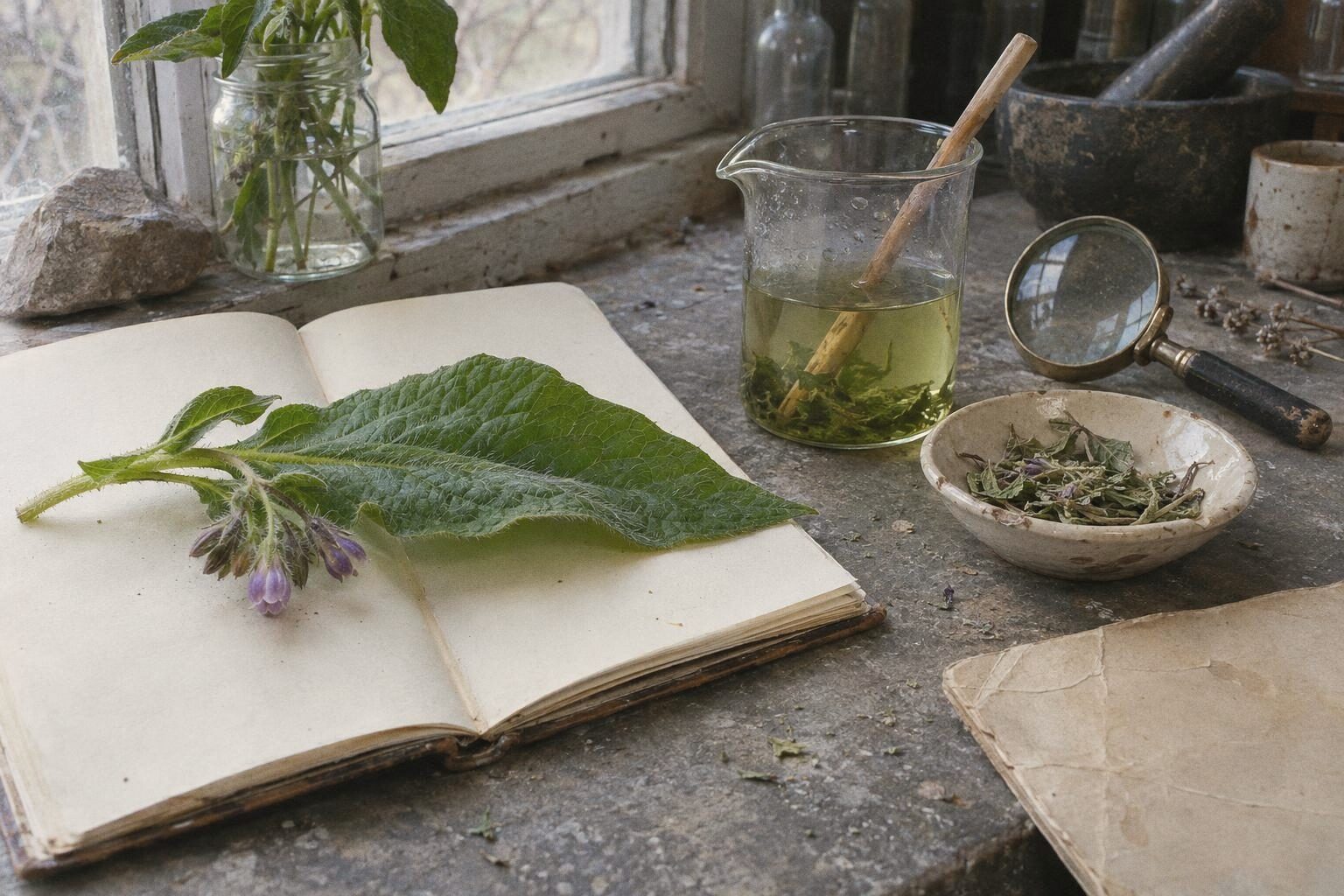
Start with touch. A leaf feels like fine sandpaper, and the stems are winged, with leaf tissue running down their sides. The flowers dangle in curved sprays, cream to violet, from spring into summer.
What is the comfrey plant and how do you identify it?
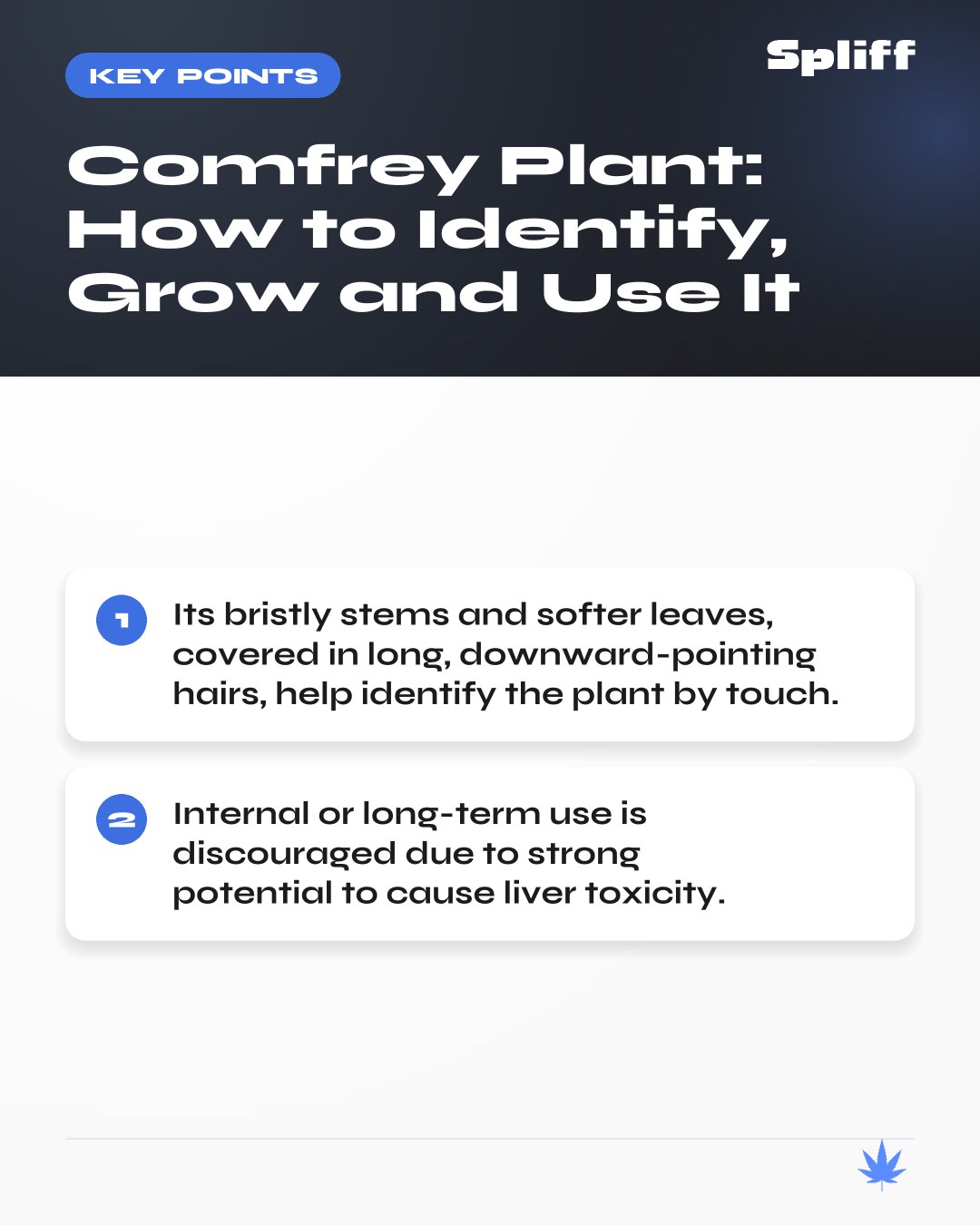
Common comfrey, Symphytum officinale, is a perennial flowering plant in the family Boraginaceae[4]. Beyond the leaf and flower shape covered above, the comfrey plant gives itself away by touch: long, downward-pointing hairs that feel bristly on the stems and softer on the leaves[4]. Here it’s a garden plant, not food or a remedy. If in doubt, consult a healthcare professional.
Common, Russian or tuberous: which comfrey is which?
Once your fingers have confirmed the rough leaf, the flower colour and the plant’s height tell you which species you’re looking at. The flowers common comfrey produces run from cream to dull purple. The flowers Russian comfrey carries lean bluer and come on a bushier, more vigorous hybrid.
| Species | Size | Flower | Best spot | Garden role |
|---|---|---|---|---|
| Comfrey Symphytum officinale (common) | 0.3–1.5 m[4] | Cream to purple | Moist, heavy soil | Feed and compost |
| Russian comfrey (Symphytum × uplandicum) | Tallest, bushiest | Blue-violet to pink | Most soils | Biggest leaf harvest |
| Symphytum tuberosum, tuberous comfrey | Low | Pale cream-yellow | Shade | Ground cover |
| Symphytum grandiflorum | Low, creeping | Cream, red-tipped buds | Shade | Ground cover |
Are comfrey and borage the same plant?
No: they’re related, not identical. Comfrey is a member of the borage family, and that shared family explains the confusion, since both are hairy plants with nodding blooms. Borage belongs to a different genus, Borago, while comfrey sits in Symphytum.
The quickest tell is the flower, long before any fruit sets. A comfrey flower is a bell shaped tube, while borage opens into a flat, bright blue star with a dark cone at its centre.
Life cycle seals it. Borage is an annual that grows from seed each year, whereas comfrey, with its deep perennial root, sits out the winter and returns from the same crown every spring.
Should you plant comfrey in your garden?
Yes, for most gardens, as long as you choose a sterile cultivar and give it a permanent spot. A comfrey plant pulls nutrients up from deep soil into its leaves, feeds bees and other wildlife, and can be cut several times a season. Symphytum uplandicum Bocking is a hybrid commonly grown in gardens.[5]
Once you can tell the species apart, the deciding factor is behaviour. For a vegetable patch or small garden, Symphytum uplandicum Bocking is our clear choice, because the line Lawrence D. Hills kept doesn’t seed itself around the beds.
Common comfrey flowers from May to June[4], so either type gives pollinators an early boost. The catch is permanence: any root fragment left in the soil regrows, so the bed stays comfrey’s for good. For dry shade, skip the tall hybrid and use a low ground-cover symphytum instead.
How far apart should you plant comfrey?
Space each crown roughly its own mature height from the next, so neighbouring clumps never quite touch. Comfrey leaves spread wide and smother anything planted too close, and a crowded bed makes every harvest slower.
Choose full sun or light shade on moist, fertile soil, with clay included. Keep the patch away from paths and your main garden beds, ideally beside the compost corner where you’ll use the cuttings anyway. Leave a mown strip around it to catch any stray shoots early.
How do you make comfrey feed for your plants?
Put on gloves, cut comfrey leaves a few centimetres above the ground, pack them into a bucket and cover them with water. Leave it lidded for several weeks until the leaves rot down into a dark liquid, then dilute it before watering tomatoes, flowers and vegetables. That’s the whole comfrey feed method.
With your patch in place, every cut turns into free fertiliser. Wear gloves: cut comfrey stems are bristly enough to irritate bare skin, and the comfrey plant regrows fast enough to harvest from spring to autumn.
Some species and hybrids, especially S. officinale, Symphytum grandiflorum and S. × uplandicum, are used in gardening and herbal medicine[5]. This section covers the gardening half, for reasons the planting section already spelled out.
Short on water or space? Pack leaves into a tube with a weight on top and collect the thick drip at the base. It works like a reduction in cooking: less volume, more punch, so dilute the concentrate more than the bucket brew.
Liquid feed, mulch or compost: which use fits your garden?
Choose by three things: the time you can give it, the smell you’ll put up with and what your plants need.
| Format | Effort | Smell | Best for |
|---|---|---|---|
| Liquid feed | Weeks of steeping, then regular watering | Strong, pond-like | Hungry fruiting crops: tomatoes, peppers, potted flowers |
| Mulch | Cut and drop, a few minutes | Barely noticeable | Established crops, berry bushes, wildflower strips |
| Compost activator | Thin layers between other material | Stays inside the heap | Slow, dry or stalled compost heaps |
If you want a visible boost this season, feed comfrey as a liquid to your tomatoes, whether they grow in a bed or in a pot on the balcony. If the smell is a dealbreaker or time is tight, mulch: lay the wilted leaves around plants and let them break down where they fall.
Comfrey vs hemp: two hairy plants, two very different jobs
That dark bucket brew sums up what comfrey is for, and it sets up a comparison few gardeners think to make. Comfrey and hemp are both hairy plants, yet their hairs do opposite jobs.
| Trait | Comfrey | Hemp |
|---|---|---|
| Leaf hairs | Bristly, non-glandular, purely protective | Glandular trichomes that make resin, cannabinoids and terpenes |
| Where the value sits | Below ground, with a taproot reaching up to 1.8 m deep[4] | In the flower, where the resin is the harvest |
| Typical use | Feed, mulch, ground cover, wildlife plant | Flowers, hash, oils and vapes for adults |
A comfrey plant never leaves the bed. Comfrey plants settle into moderately fertile moist soil in sun or partial shade, take a top-up of peat free compost and give you leaves to cut several times a year. Hemp is the plant that leaves the field and comes back to you as finished articles.
On the Spliff side, that resin ends up in compact formats shipped to adults in Europe. Our THCX range covers the Magic Pod x2 refill pods and the ready-to-use Magic Vape, alongside the Magic Pod Live Rosin x2 pack. THCX is a trade name, not a molecule: every batch is lab-tested for classified molecules and none are detected.
For adults only (18+). CBD is not a medicine and is not a substitute for medical advice or treatment. If in doubt, consult a healthcare professional.
Conclusion
So the hairs settle it: one plant feeds your compost heap, the other belongs on a product shelf. Sterile cultivar, moist soil, sun or light shade, a permanent corner: that’s the whole recipe for years of leafy harvests.
A local garden centre or regional horticultural society is a solid next stop for advice suited to your own climate.
Came for the hemp side too? Our THCX vapes and CBD range are waiting whenever you’re ready.
Frequently asked questions
Does comfrey actually heal bones?
Comfrey is traditionally linked to folk remedies, but internal or long-term topical use is discouraged due to its strong potential to cause liver toxicity[4]. In this guide comfrey is treated purely as a garden plant for feed and compost, not a remedy. Consult a healthcare professional for any health-related use.
Sources
- Symphytum officinale – Wikipedia — en.wikipedia.org
- Symphytum – Wikipedia — en.wikipedia.org