 Written by Sophie Clarke

Contents8 sections
- What is a canna plant?
- Do cannas need full sun?
- How deep should you plant canna lily rhizomes?
- Should you lift canna rhizomes for winter?
- Canna plant vs cannabis plant: why the names get mixed up
- Came here looking for the cannabis plant instead?
- The bottom line on the canna plant
- Frequently asked questions
The essentials in 30 seconds
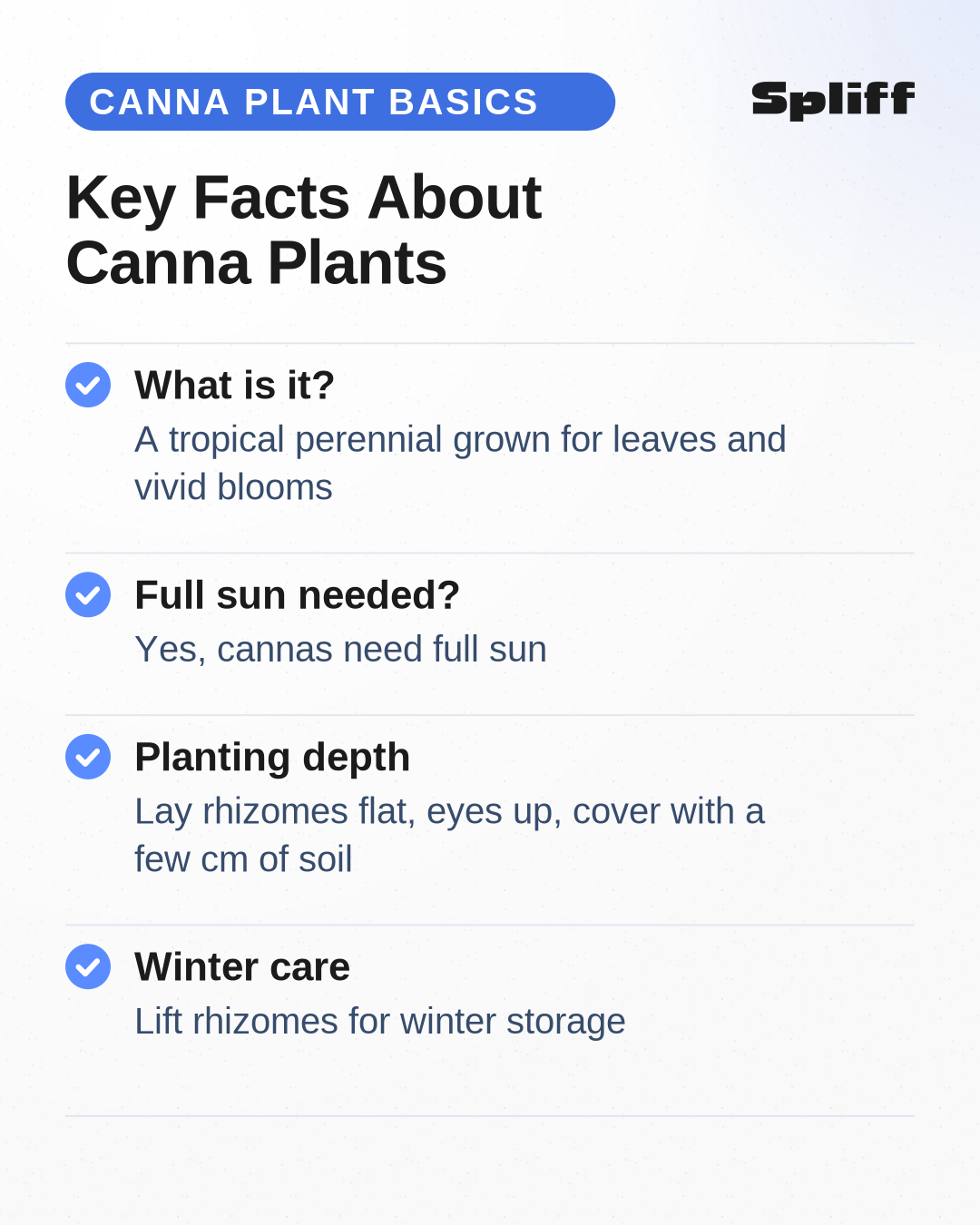
A canna plant is a frost-tender tropical perennial from the Americas, grown from fleshy rhizomes for bold foliage and bright flowers in red, orange, yellow and pink. It needs full sun and warmth, and it can be planted shallow with the eyes facing up once the risk of frost has passed. Where winters bite, lift and store rhizomes before frost. It is not related to cannabis.
- Sun and warmth: full sun gives the most flowers, while partial shade gives lush leaves but far fewer blooms.
- Winter care: in cold areas, cut back the stems after the first frost, lift the rhizomes, and store them dry in a cool, frost-free place until spring.
A canna plant (or canna lily) is a frost-tender tropical perennial of the genus Canna, family Cannaceae, native to the Americas and grown from fleshy rhizomes for its bold foliage and bright flowers. Despite the name, it’s neither a true lily nor any relative of cannabis.
Below you’ll find the practical side of canna lily planting: how much sun it wants, how deep to set canna lily rhizomes, and how to lift and store them before frost hits a garden in Germany, Austria or the Benelux. We’ll also settle the canna vs cannabis name mix-up with a proper botanical comparison, something most related gardening guides skip.
First, the plant details that tell you what you’re looking at:
- Foliage: broad, paddle-shaped leaves that look like a small banana plant, often veined, striped or deep bronze.
- Plant height: differs a lot between varieties, from compact dwarf types for pots to tall cultivars that tower over a border.
- Flowers: blooms in red, orange, yellow, pink and striped orange, as saturated as a pop-art poster.
Canna ‘Tropicanna’ is the classic example, with orange flowers above leaves striped like a sunset. Before you buy, check the cultivar name on the label: that’s what tells you the final height and flower colour.

What is a canna plant?
A canna plant is a rhizome-forming tropical perennial in the genus Canna, family Cannaceae, grown for broad paddle leaves and vivid blooms in fiery red, orange, yellow, pink and striped mixes. Garden centres usually shelve its rhizomes next to the summer bulbs under the name canna lily, a label we’ve already debunked above. Think of it as a banana-leaved cousin of ginger with showy flowers.
Why is it called a canna lily if it isn’t a lily?
The “lily” is pure marketing shorthand. Nurseries borrowed the word because the flared blooms vaguely recall a lily, so you’ll find cannas shelved in lily-related displays at garden centres.
Botanically, the two plants aren’t close. A true lily belongs to Liliaceae and opens a tidy, symmetrical star of petals. A canna sits in Cannaceae, alongside ginger and banana, and its flower is lopsided by design: most of the colourful “petals” are modified stamens, frilled and irregular.
Whether you’re looking at soft yellow blooms, candy-pink ones or orange flowers striped with red, that asymmetry gives the game away. The genus name itself comes from an old word for reed, a nod to its upright, cane-like stems, which still look striking when you grow one in a big patio pot.
Read also: THCX
Do cannas need full sun?
Yes. A canna plant needs full sun and warmth to flower well, so give it the brightest, hottest spot you have, with direct light for most of the day. In partial shade it still grows lush leaves, but you’ll get far fewer flowers, arriving late.
Think bright, steamy tropical warmth rather than a cool woodland corner. Tall cannas also want a sheltered spot out of the wind, since those big paddle leaves catch gusts and tear easily.
A hot summer in the Rhineland or Austria pushes out red flowers quickly, while cooler coastal summers in the Netherlands or Belgium usually mean a later start.
Quick name check, since canna and cannabis get mixed up all the time: they’re unrelated plants. Cannabis is a generic term used to denote the several psychoactive preparations of the plant Cannabis sativa, with THC as the major psychoactive constituent.[2] Your canna is a tropical ornamental grown for its leaves and blooms, and these basics keep it flowering:
- Soil: rich, full of humus, moisture-holding yet well drained so rhizomes never sit in water.
- Watering: generous once growth takes off. Keep soil evenly moist and a canna flowers summer to first frost.
- Feeding: a regular high-potash liquid feed from early summer keeps new buds coming.
- Pots: pick a large, deep container with drainage holes. Pots dry out fast, so water and feed more often than in the border.
How deep should you plant canna lily rhizomes?
Plant canna lily rhizomes shallow: lay them flat with the eyes (the pointed pink or green buds) facing up, then cover them with just a few centimetres of soil.
With your sunny, well-fed spot ready, getting a canna plant into the ground is quick work: shallow, warm and never waterlogged.
- Start early under cover. Pot the rhizomes in spring on a bright windowsill or in a cool greenhouse. Keeping the rhizomes frost-free indoors gets you shoots and flowers weeks sooner.
- Wait until the risk of frost has passed for good. In Germany and Austria that usually means after the Ice Saints in mid-May, with the Benelux often similar, so young shoots escape a late canna lily frost.
- Lay each rhizome flat, eyes up. With the frost risk passed, set each one in its hole. A lily canna planted on its side still grows, just slower.
- Cover lightly and space by height. Canna varieties range from compact patio types to towering giants, so match your spacing to the final height canna plants reach and give the tall ones more room to fill out without crowding each other.
Should you lift canna rhizomes for winter?
Yes. Once your canna plant has given you a summer of flowers, lift it in most of Germany, Austria and the Benelux. Canna lilies can’t survive frozen soil, so wait until the first frost blackens the foliage, cut the stems back, dig up the rhizomes and keep them in a cool, frost free place until spring.
Can you leave cannas in the ground over winter?
Only in a few situations, and it’s always a gamble. In sheltered city gardens or the coastal Benelux, a thick mulch over the bed can carry rhizomes through a soft winter. One hard cold snap that reaches the roots still ends it.
Pots are the easy exception: move the container into a frost free garage or cellar and leave the rhizomes dormant in dry compost. Anywhere with long, hard frosts, don’t push your luck. Lift and store rhizomes instead:
- Cut the blackened stems to short stubs a few days after the first frost; the clump is ready to dig.
- Lift each clump with a fork, shake off loose soil and leave it somewhere airy until the skin firms up.
- Pack the rhizomes in boxes of dry compost, peat-free potting mix or newspaper, in a cool shed or cellar where they stay dormant and protected from frost.
- Check them monthly, discard any soft or mouldy pieces, and only firm, plump rhizomes will remain for spring.
Canna plant vs cannabis plant: why the names get mixed up
The mix-up is mostly about sound: shops and slang often shorten cannabis to “canna”, and the cultivar names don’t help. Canna ‘Durban’ is a striped, bronze-leaved bedding plant, while Durban Poison is a well-known cannabis strain. Same city, two very different plants.
| Trait | Canna plant | Cannabis plant |
|---|---|---|
| Family | Cannaceae | Cannabaceae |
| Life cycle | Perennial, grows from fleshy rhizomes | Annual, no rhizome to lift |
| Leaves | Broad, smooth paddles | Palmate, serrated leaflets |
| Flowers | Showy, made to be looked at | Resinous buds covered in trichomes |
| Main use | Ornamental | Flowers, hash, oils |
Resinous trichomes packed with cannabinoids are a hallmark of cannabis, and a canna plant doesn’t produce them. Terpenes show up in plenty of plants, but the sticky, cannabinoid-rich resin is cannabis territory. So there’s nothing in a canna for a cannabis fan: grow it for your garden, not for your grinder.
Our take is simple. If you want a bold plant for the back of a summer border, cannas are unbeatable. If you’re after aroma and terpene profiles, browse our CBD flowers and compare the strain notes and each product’s customer rating, or look at a ready-to-use pod format like the Magic Pod Live Rosin x2.
Came here looking for the cannabis plant instead?
Then you’ve landed on the wrong plant, and that’s an easy fix. If you want something made from cannabis itself, drop the canna plant search and look at formats instead of plants: pre-filled pods, a matching vape device, or CBD flowers.
One label trap first: a garden-centre tag reading “plants canna indica” means Indian shot, a canna species, not Cannabis indica. Whatever the plant price on that tag, you’re buying an ornamental for spring planting in a sunny border, nothing more.
On our side, the Magic Pod x2 is a pre-filled pod from our THCX range. THCX is a trade name, not a molecule: every batch is lab-tested for classified molecules and none are detected. The Magic Vape is the device side of the same line (check current availability on its page), and the live rosin pod suits you if solventless texture is your thing.
CBD from a shop isn’t a medicine. Epidyolex, the CBD medicine you may have heard of, is an authorised medicinal product assessed by the European Medicines Agency, a different category from flowers or pods.[3]
The bottom line on the canna plant
A canna plant is one of the easiest ways to bring a bold, tropical look to a European garden: big paddle leaves, bright flower spikes, and a little planting effort each year that’s well worth it. If cannabis was what you were really after, skip the flowerbed and browse our CBD flower range or cannabis seeds, where each product page shows its current price and availability.
Frequently asked questions
What is Canna indica used for?
Canna indica, also called Indian shot, is grown purely as an ornamental garden plant for its foliage and flowers. A garden-centre tag reading “plants canna indica” refers to this species, not to cannabis, so it holds no cannabinoid content or use.
Are canna lilies perennials or annuals?
A canna plant is a tropical perennial in the genus Canna, family Cannaceae. It is frost-tender, so in Germany, Austria and the Benelux the rhizomes are usually lifted before winter and stored, then replanted the following spring to keep the same clump going year after year.
Do canna lilies do better in pots or in the ground?
Both work, but each has different care needs. In the ground, canna wants rich, moisture-holding yet well-drained soil. In pots, a large deep container with drainage is best, though pots dry out faster and need more frequent watering and feeding than border-grown clumps.
Sources
- Cannabis — World Health Organization — www.who.int
- Epidyolex (cannabidiol) — European Medicines Agency, EPAR — www.ema.europa.eu