 Written by Sophie Clarke
THCX at Spliff · from €5.30/g · ★ 4.9/5 (1,363 reviews)
72 h delivery in Europe · Free delivery from €99
Contents6 sections
The molecule THC is tetrahydrocannabinol, a single organic compound and the main psychoactive one among the many cannabinoids that cannabis produces. It’s not a blend, not a brand, not a vague family name: one precise structure, distinct even from its close sibling cannabidiol (CBD). Picture it as a design blueprint in three parts:
- A phenol ring, the polar “head” carrying an OH group.
- A pyran ring, the oxygen-containing link in the middle.
- A long pentyl tail, an oily carbon chain that hates water and loves fat.
That fatty tail is the thread running through this whole article. The “delta” in delta tetrahydrocannabinol THC marks where a double bond sits in the carbon ring. Shift it one position and you get a close cousin, which is why “THC delta” names multiply.
In the raw plant, most of it sits as THCA, which only becomes THC when heat strips off carbon dioxide (decarboxylation). So when you see THC on a label, think of that specific plant cannabinoid, not a loose catch-all for anything cannabis-like.
From here, we follow that tail step by step. You’ll see why concentrations of delta tetrahydrocannabinol settle into butter and chocolate rather than water, what your body makes of them, and how that shapes the way you use edibles.
The essentials in 30 seconds
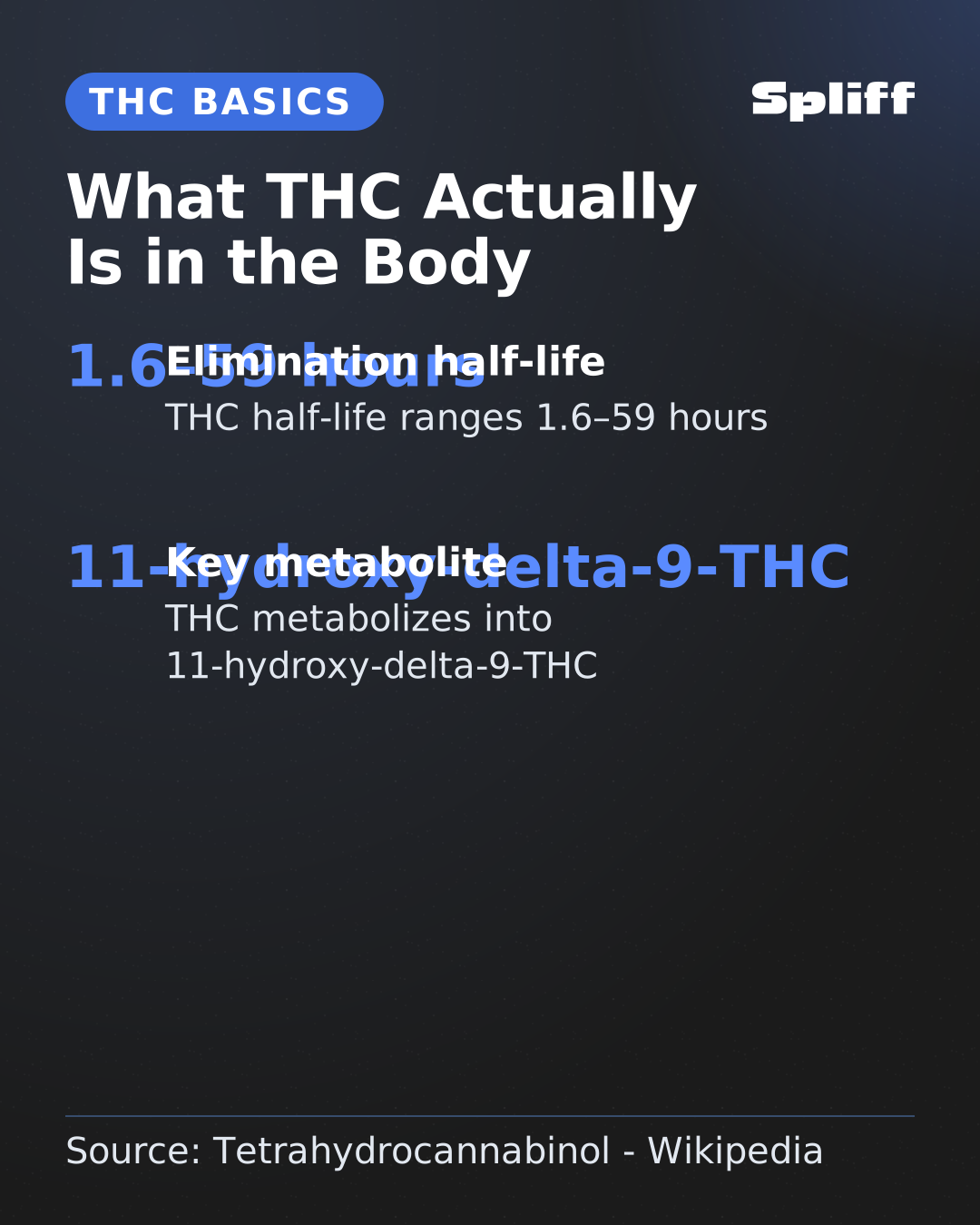
THC, or delta-9-tetrahydrocannabinol, is the single psychoactive molecule driving cannabis effects, acting on cannabinoid receptors in the brain[4] and showing an elimination half-life of 1.6–59 hours[5]. Its fat-loving structure explains absorption, metabolism and therapeutic interest, including in chemotherapy induced nausea[2].
- THC is metabolized hepatically into 11-hydroxy-delta-9-THC and other metabolites[5], with 97–99% protein binding shaping its pharmacokinetics pharmacodynamics cannabinoids profile[5].
- Cannabis, a generic term for psychoactive Cannabis sativa preparations, delivers the same THC whatever the form consumed[2].
- Spliff ships to 4 countries, and every product is lab-tested with THC content below 0.3% (0% for vapes and pods); THCX is a trade name, not a molecule: every batch is lab-tested for classified molecules and none are detected.
Is THC a molecule? What delta-9-tetrahydrocannabinol actually is
Yes. THC, short for delta-9-tetrahydrocannabinol, is one single organic molecule: a terpenophenolic cannabinoid with fixed atoms and a fixed shape. It’s the compound behind the high in recreational use of cannabis, and its oily tail makes it strongly fat-loving. That one trait shapes how it’s infused, absorbed and stored.
The molecule THC behaves the way it does because of that shape. Its rigid ring frame docks onto cannabinoid receptors in your brain, while its oily pentyl tail drags it towards fat instead of water.
Delta-9, delta-8 and THCA: what actually changes in the molecule?
A single edit to the blueprint gives you a different compound. “Delta-9” points to where the carbon-carbon double bond sits in the ring. In delta-8 THC, that bond moves one position over, with every other atom staying the same.
So “delta THC” names close cousins, not strength grades: concentrations of delta-9-tetrahydrocannabinol on a lab report tell you how much, while the delta number tells you which molecule. A label listing tetrahydrocannabinol, cannabidiol and cannabinol names three distinct molecules.
| Name | What differs from delta-9 THC | Fat-loving tail |
|---|---|---|
| Delta-9 THC | Reference molecule | Yes |
| Delta-8 THC | Double bond in another ring position | Yes |
| THCA | Extra carboxyl group, lost with heat | Yes |
THCA is generally described as the raw-plant form of THC, carrying that extra carboxyl group until heat turns it into the THC you know. Synthetic cannabinoids are lab-built and can hit the same cannabinoid receptor, but their skeletons are unrelated to delta-9-tetrahydrocannabinol, cannabidiol or any other plant cannabinoid. When a label says “THC”, it means the plant molecule.
Whatever the cousin, the pentyl tail stays put. THC breaks down into hydroxylated metabolites, and its elimination half-life is long and highly variable from one person to the next[5].
How does THC bind to fat molecules?
The THC molecule doesn’t form a chemical bond with fat. It has high lipid solubility and barely dissolves in water, so its nonpolar tail mixes into fats and oils through hydrophobic interactions: like dissolves like. It slips between fat molecules the way chili heat or vanilla carries in cream but falls flat in plain water.
Water molecules cling to each other and push nonpolar shapes out. Fat molecules are long, greasy chains themselves, so the molecule THC simply settles in among them.
Nothing locks into place, and no new compound forms. Fat isn’t a glue for THC. It’s a solvent. The same rule applies to its cousins cannabidiol (CBD), CBN and CBG, which explains why CBD oil always comes in a carrier oil rather than a water base.
This is why infusions lean on fat. In chocolate, cocoa butter holds the THC and spreads it through the bar; in a brownie, butter or oil does that job. Sugar alone can’t carry it, so candies need an added fat base to hold the cannabinoid at all.
Whichever fat carries it, the molecule inside stays the same: the primary psychoactive constituent of cannabis, producing a wide range of pharmacological effects in humans and animals[4].
What happens to the THC molecule once it's in your body?
Once absorbed, the THC molecule travels in the blood and reaches cannabinoid receptors in the brain, acting mainly via CB1 receptors, which play a big part in its psychoactive effects. The liver then breaks it down into metabolites: first 11-hydroxy-THC, then THC-COOH, generally described as inactive. The share parked in fat tissue seeps back out slowly, which is why elimination drags on.
Cannabis is a generic term for several psychoactive preparations of the Cannabis sativa plant.[2] Its fat-loving nature shows again in the bloodstream, where most of it travels bound to proteins instead of floating free in watery plasma[5].
That’s human cannabinoid pharmacokinetics in a nutshell: what the body does to the drug. Pharmacodynamics is the other half: what the drug does once it reaches its receptors.
11-hydroxy-THC: why eating THC isn’t the same as inhaling it
Swallowed THC is absorbed through the gut and sent to the liver before reaching the rest of the body. On that first pass, a large share converts into 11-hydroxy-THC, still an active metabolite.
Inhaled THC skips that step, going from lungs into blood and on to the brain. The route of administration changes the chemistry, not just the timing. That’s why an edible kicks in later and can feel different from the same plant smoked.
THC-COOH and other metabolites: what lingers after the molecule is gone
THC-COOH is what remains after the active molecule has done its work: a carboxylic-acid metabolite without psychoactive effect, generally reported as the marker drug tests look for. Among THC metabolites, it’s thought to hang around the longest.
The fat reservoir explains that persistence. THC stored in fatty tissue drips back into the blood slowly, so the liver keeps producing THC-COOH long after the effect has faded.
It’s also why the elimination half-life range quoted earlier is so wide: a single half-life figure can’t capture how differently bodies store THC. Someone who uses regularly builds a much bigger fat reservoir than someone who tried one edible, so their traces outlast the experience by a long way.
Choosing a THC edible: what the molecule tells you about format
Because fat carries the molecule, picking an edible really means picking a carrier. Chocolate and brownie bring their own fat, so THC spreads naturally through the piece. Sweets are mostly sugar, which can’t hold THC alone, so they rely on a fat or oil base worked into the recipe.
The carrier doesn’t change the effects per milligram, only how evenly the dose sits in the product. That’s why the labelled THC amount is the number to read before anything else.
| Format | Fat carrier | Labelled THC | Best for |
|---|---|---|---|
| Magic Candy – Sweets | Fat or oil base inside a sugar matrix | See pack label | First tries, small portions |
| Magic Brownie – Space Cake | Butter or oil baked in | See pack label | Fans of a classic baked format |
| Family Packs (candy or chocolate) | Oil base or cocoa butter | See pack label | Adults who already know their portion |
New to edibles? Start with Magic Candy: lowest total, easy to split into small portions. The brownie makes sense once you know how your body handles the short-term effects. Leave the family packs until your usual portion is a known number, not a guess.
These are THC edibles, not medical cannabis, and holding a medical cannabis card doesn’t change how you should handle them. Bring the same care you’d bring to any other cannabis use. The slow elimination covered in “What happens to the THC molecule once it’s in your body?” can also matter if you face a urine test.
CBD is not a medicine and is not a substitute for medical advice or treatment. If in doubt, consult a healthcare professional. For storage tins and other extras, browse the accessories collection.
Conclusion
Put the chain together and the molecule THC stops being an abstract formula. One oily tail explains why it rides in fat, why the liver reshapes it and why cocoa butter or butter makes the logical carrier. Even its acid form, THCA, only joins that story once heat has done its job.
The practical takeaway: read the mg per unit, respect the slower edible onset and judge a format by how well its fat holds the dose. Short-term or long-term, any physical or mental health question about THC belongs with a professional, not a product page.
When you’re ready to choose, delivery covers several countries, including these 4: AT, BE, DE and NL.
Frequently asked questions
What is the boiling point of THC?
The provided data does not include a boiling point figure for the THC molecule. What’s documented is its pharmacology: THC is the primary psychoactive constituent of cannabis, producing pharmacological effects in humans and animals[4], with a fat-loving structure that governs absorption rather than any thermal property.
Is THC worse for the liver than alcohol?
The data provided doesn’t compare THC to alcohol. What’s known is that THC undergoes hepatic metabolism, mostly via CYP2C[5], with an elimination half-life of 1.6–59 hours depending on use pattern[5], producing metabolites like 11-hydroxy-delta-9-THC[5]. Any liver-related health comparison should be discussed with a medical professional.
How many microns is a THC molecule?
No micron measurement for the THC molecule appears in the available data. What is established is its molecular behavior: THC is strongly protein-bound in plasma, at 97–99%[5], and its oily pentyl tail drives it toward fat tissue rather than water, which explains its pharmacokinetics more than any particle-size figure.
Sources
- Cannabis — World Health Organization — www.who.int
- Chemistry, Metabolism, and Toxicology of Cannabis: Clinical Implications – PMC — pmc.ncbi.nlm.nih.gov
- Tetrahydrocannabinol – Wikipedia — en.wikipedia.org