 Written by Sophie Clarke
Contents5 sections
The essentials in 30 seconds
Lagerstroemia indica, commonly known as crape myrtle, belongs to the Lythraceae family and is often a multi-stemmed deciduous tree[5][5]. Its flowers come in white, pink, mauve, purple or carmine[5], and its leaves turn yellow, orange and red in autumn[5]. Traditional Chinese medicine has used its leaves, flowers, roots and bark, while the ornamental industry values its flower colour[4].
Lagerstroemia indica, commonly known as crape myrtle (crepe myrtle), is an ornamental, multi-stemmed deciduous shrub or small tree of the genus Lagerstroemia, a member of the family Lythraceae native to China, Korea and Southeast Asia. Despite the “indica” in its name, it isn’t a cannabis plant.
Here’s the short description most reference sheets give: a deciduous tree that typically flowers in summer and generally drops its leaves in autumn, so it isn’t an evergreen. Its best known crape detail is the bloom itself. The ruffled petals look like crumpled crepe paper, or the frilly sugar work on a pastry chef’s cake.
The silhouette is easy to spot even without flowers. Several trunks usually rise from the base, and the smooth bark peels away in patches, which gives the tree real visual interest in winter.
This guide helps you identify the tree quickly, then explains why “indica” shows up in two very different botanical names. It also covers what the indica label actually tells you on a cannabis product.
What is Lagerstroemia indica, the crape myrtle?
Wikipedia’s species entry describes Lagerstroemia indica, commonly known as crape myrtle or crepe myrtle, as a species of flowering plant in the genus Lagerstroemia of the family Lythraceae[5]. Beyond that garden-tree identity, it earns its fame mainly through its blooms, plus a long history outside the flower bed.
The flowers carry most of its reputation. Researchers note that rich flower colour is a valuable attribute for the ornamental industry built around Lagerstroemia indica[4]. Think of it as the tree’s selling point, the way a label’s artwork sells a record before you hear a note.
The plant also has a story beyond the garden. In traditional Chinese medicine, its leaves, flowers, roots and bark have traditionally been used, which documents a custom, not a proven effect.
That’s a historical note about the tree, not a health claim.
Is crape myrtle evergreen or deciduous?
Crape myrtle is deciduous, not evergreen. As the intro flagged, it won’t give you the year-round green screen a laurel hedge would.
Once the leaves are gone, every stem stands bare through the colder months. Fresh leaves usually come back in early spring, and the summer flowers follow later.
When do crape myrtle flowers appear, and in which colours?
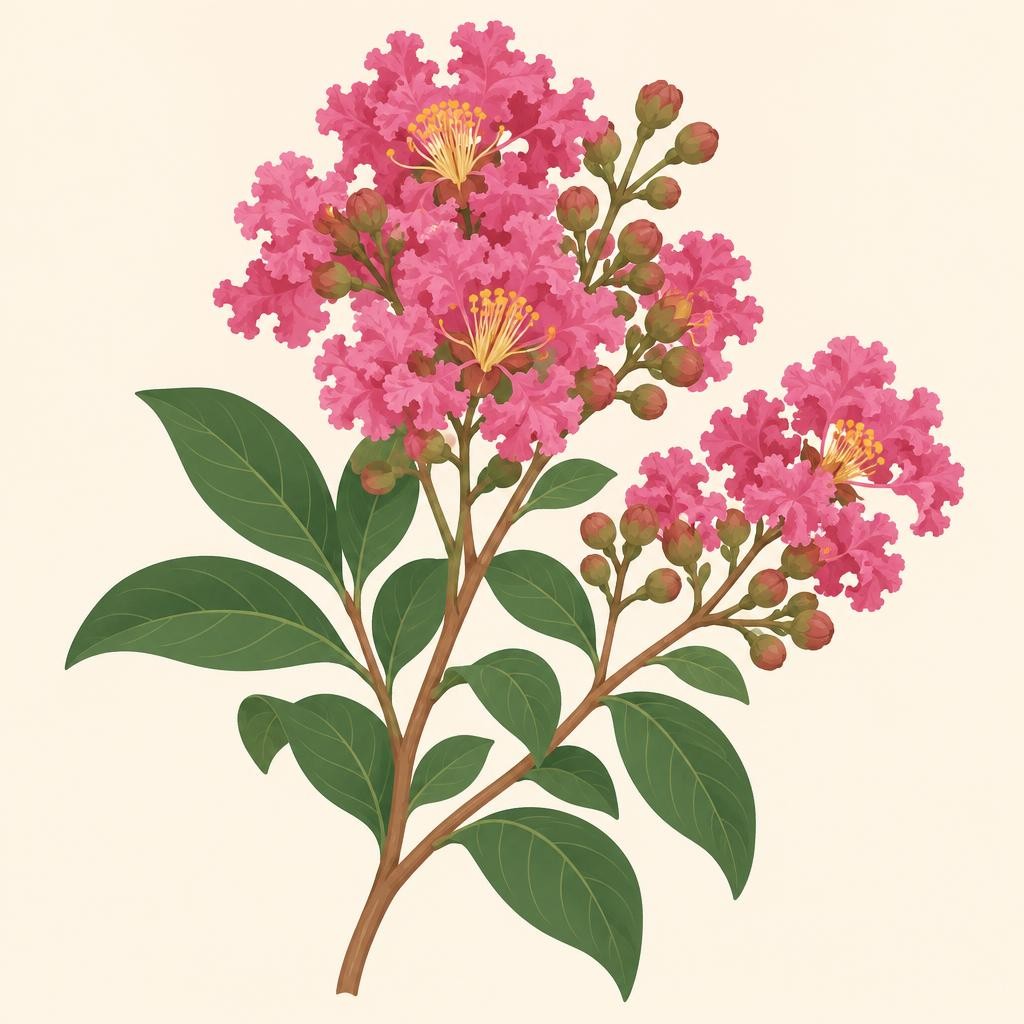
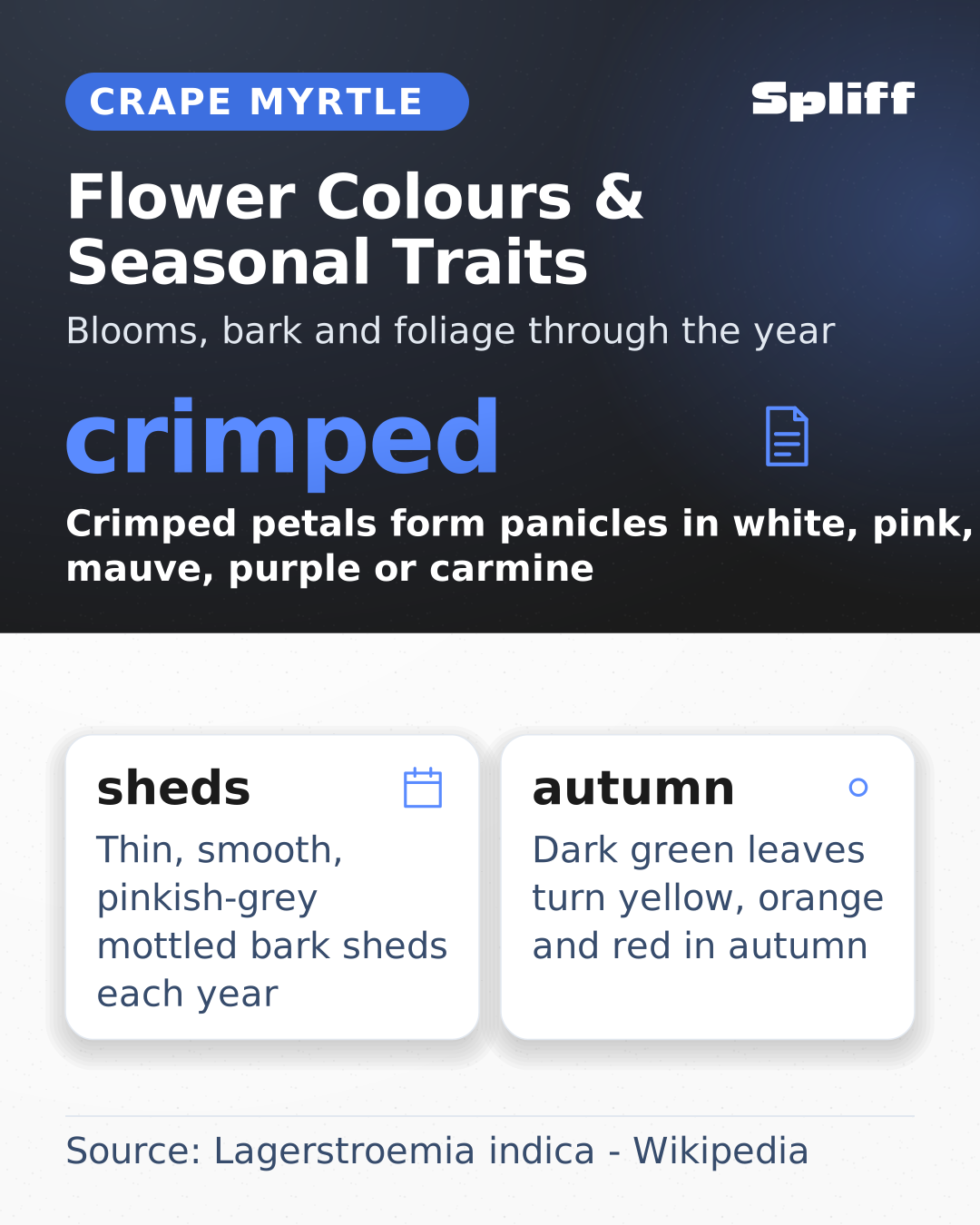
Crape myrtle flowers appear in summer, typically in dense clusters at the tips of the season’s new shoots, and they stay on show longer than the blooms of most flowering trees. Depending on the tree, the flowers are white, pink, mauve, purple or carmine, grouped in panicles[5].
The bark and silhouette are the first clues. The bloom calendar confirms the ID. Each tree sticks to its own shade, so a row of crape myrtles reads like a paint swatch card: white flowers beside pink-red ones, then lavender and deeper purples[5].
Compact cultivars such as Berry Dazzle bring the same palette to smaller plants. Like other crape myrtles, it’s generally described as a sun lover, and reference sheets typically report noticeably fewer flowers in shade.
That sun preference is the main climate clue. Lagerstroemia indica is generally associated with hot, sunny summers. Plant finders and the RHS use USDA zones as a hardiness guide, so check the zone listed for your exact cultivar instead of assuming one rating covers every crape.
Here’s how the plant changes through the year:
- Summer: the flowering peak, with the white, pink, mauve and red shades the tree is known for.
- Autumn: dark green leaves turn yellow, orange and red[5].
- Winter: bare branches show thin, smooth, pinkish-grey mottled bark that sheds each year[5].
- Early spring: fresh leaves return before the next flower season.
Lagerstroemia indica vs cannabis indica: what does 'indica' really mean?
“Indica” is simply botanical Latin for “of India”, an epithet attached to dozens of unrelated species. In Lagerstroemia indica it signals nothing about cannabis. In Cannabis indica it historically marked a lineage of stocky, broad-leaved plants, and on a product label today it mostly points to an aromatic profile (earthy, spicy or fruity), not a guaranteed effect.
So the shared word is a naming coincidence, not a family tie. Botanists gave the same epithet to species as different as the mango and the tamarind, while the genus Lagerstroemia itself honours a Swedish naturalist. Whether the indica lagerstroemia you spot is a tree large enough to shade a street in Texas or a dwarf in European gardens, those lagerstroemia indica plants have no botanical link to the cannabis plant.
Cannabis indica took a different path. The label first described a short, bushy plant with wide leaves, but countless crossbreeding events have blurred those lineages. Read “indica” on a cannabis product the way you’d read “dark roast” on coffee: a flavour cue, not a promise.
That’s why format matters when aroma is your priority. The Magic Pod Live Rosin x2 uses live rosin, which keeps a terpene profile close to the flower.
For the THCX range, there’s the Magic Pod x2 THCX Vape Pods 90% and the Magic Vape. THCX is a trade name, not a molecule. THCX is a trade name, not a molecule: every batch is lab-tested for classified molecules and none are detected. For adults only (18+).
Conclusion
So one word, two very different plants. If you came for the tree, the identification tips above are your cheat sheet, whether you met it in a garden in Japan or in a park down your street.
For gardening questions, from choosing a spot to what to do in early spring, a local garden centre, a reliable plant database or your national horticultural society will serve you far better than a cannabis shop.
If you came for the indica, the cannabis kind, you’re in the right place. Think of it like a menu: you pick by format, aroma and intensity, not by a botanical family tree.
Frequently asked questions
Is Lagerstroemia indica evergreen?
No, Lagerstroemia indica is deciduous, not evergreen[5]. Its dark green leaves turn yellow, orange and red in autumn before shedding each winter[5][5], leaving bare stems with thin, smooth, pinkish-grey mottled bark that also sheds yearly[5], with fresh foliage returning in early spring.
Sources
- Multi-omics analysis uncovers novel gene regulatory networks of … — www.sciencedirect.com
- Lagerstroemia indica – Wikipedia — en.wikipedia.org