 Written by Sophie Clarke

Spain’s cannabis rules separate personal use from public consumption, and each point needs its own dated text. Public consumption can bring administrative fines of 601 to 30,000 euros under the citizen-security law[4]. Cannabis clubs rest on case law: the Tribunal Supremo’s Sentence 484/2015 of 7 September 2015 is the reference[5].
Contents7 sections
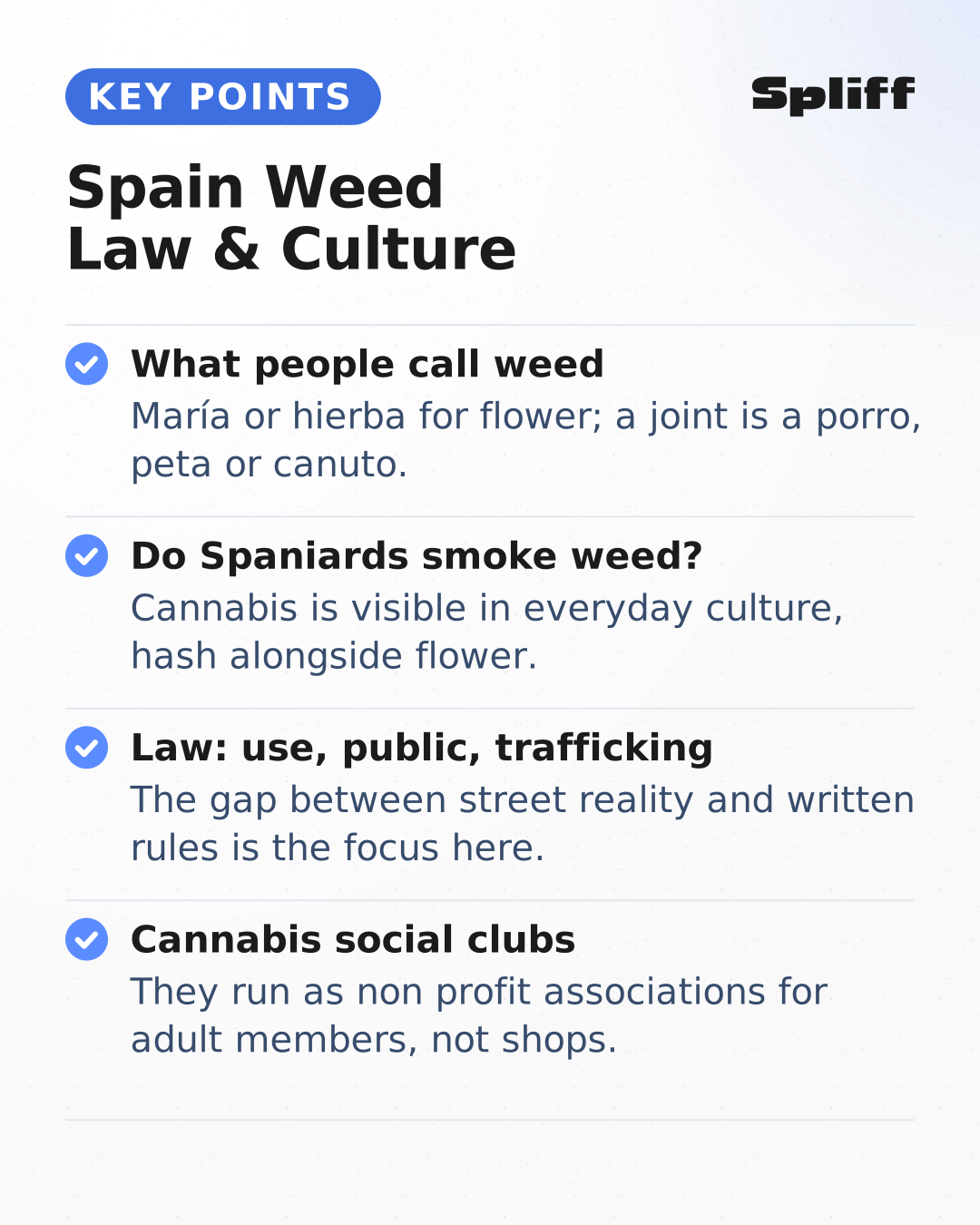
Spain laws on weed refers to the Spanish legal texts and court decisions that frame cannabis. On the ground, though, you’ll meet the vocabulary first: maría or hierba for flower, porro, peta or canuto for a joint, and costo, chocolate or hachís for hash.
This guide is intended as a quick reference, and it starts with those words. It then lays out what the legal framework does and doesn’t say as dated, sourced facts, kept separate from any interpretation, and explains how cannabis social clubs work as non-profit associations.
Before getting to private or public consumption, home growing and the number of plants, cannabis clubs or case law, here’s what a few everyday words mean:
- María, hierba: the dried flowers of cannabis plants, what most of Europe simply calls weed.
- Porro, peta, canuto: a rolled joint, whatever ends up inside it.
- Costo, chocolate, hachís: hash, the pressed resin.
Think of flower as fresh basil and hash as pesto: same plant, pressed and concentrated into something denser. The aroma carries over, but texture and intensity change completely.
Slang also shifts by region, so what you hear in Madrid may not match what you hear in Tenerife. Some words only sound natural in specific settings too, among friends rather than over a counter.
What do people call weed in Spain?
In Spain, weed is mostly called maría or hierba when people mean the flower, while a rolled joint is a porro, a peta or a canuto. Hash goes by costo, chocolate or hachís. The first group names the plant material, the second names the format, and the third names the pressed resin.
María, porro, peta: the everyday words for flower and joints
The quick rule: maría and hierba name the material, while porro, peta and canuto name what it’s been rolled into. Think coffee beans versus an espresso. One is the ingredient, the other is the finished cup, and Spanish keeps the two apart in conversation.
Hash sits in its own lane. If flower is fresh basil, costo and chocolate are the pesto: resin pressed from the same plants, darker and denser in texture and aroma. The exact mix of words shifts between regions and even between cities, so use this list as a starting point, not a dictionary.
You’ll also run into a more formal vocabulary in court cases and news reports, with terms like cannabis personal use or private cultivation. Neither register changes what Spain laws on weed say. The Ley Orgánica 4/2015 of 30 March 2015 on citizen security sets administrative fines of €601 to €30,000 for illicit drug consumption or possession in public places[4].
Do Spanish people smoke weed?
Cannabis is a visible part of everyday culture in Spain, and hash sits right next to flower in the way people talk about it. The best-known expression of that culture is the cannabis social club: a private, non-profit association of adult members rather than a shop. Those cultural signs, though, tell you nothing about spain laws on weed or what Spanish law actually permits.
Why the Basque Country and Catalonia keep coming up
These two regions are where cannabis social clubs became a public conversation, so San Sebastián and Barcelona are the names you’ll hear first. Think of the model as a food cooperative rather than a restaurant. Members join a club, the association runs as a non-profit, and members use private spaces rather than anything that looks like a storefront.
That associative logic is what defines the Spanish club as a cultural idea, whether people discuss it in the Basque Country, in Catalonia or further south in Alicante. It’s a membership culture, not a retail one.
None of that settles anything about spain laws on weed. How Spanish law and the courts handle these social clubs, and what can count as an offence, is a separate matter, and the legal section covers it as dated, sourced facts.
Spanish law on weed: personal use, public consumption and trafficking
That gap between what you see on the street and what the written rules say is exactly where this part sits. The clearest way to read spain laws on weed is to ask three separate questions: where the consumption happens, how much is involved, and whether anything is passed on to someone else.
Public consumption, meaning any place with public access, is the zone already pinned to a dated act above, through the citizen-security law and its fine bands. The other zones deserve the same discipline: a named text, a date, an article number, or nothing at all. Think of it like a recipe: a vague list of ingredients without quantities isn’t a recipe you can rely on.
| Situation | What the line depends on | What to verify in the text |
|---|---|---|
| Personal use in a private space | The setting and the amount, read together | Which act, if any, addresses personal consumption at home or cultivation in a private space |
| Public consumption | The place rather than the person | The fines set out in the citizen-security law cited above |
| Trafficking or large-scale supply | Passing cannabis on, or quantities beyond personal use | Whether the provision sits in the criminal code, where a criminal offence is defined |
| Cannabis social clubs | How each association is actually organised | How case law handles the specific facts: which court, which date, which ruling |
Be wary of any guide claiming that personal use in private is never treated as a criminal offence without naming the act behind that claim. The same goes for the opposite shortcut: supply on a large scale and a few grams at home aren’t the same file, and a serious source tells you which text draws that line.
Spanish case law is the reason for all this caution. Case law treats each situation on its own facts, so a ruling about one association doesn’t become a rule for every club. If your own situation is unclear, the right move is advice from a qualified Spanish lawyer, not a forum thread.
How do cannabis social clubs in Spain operate?
Cannabis clubs in Spain run as non profit associations reserved for adult members, not as shops. That associative status comes from how the courts have interpreted the law, chiefly Sentence 484/2015 of the Tribunal Supremo, Spain’s Supreme Court, not from an explicit legal framework that recognises clubs[5]. Members join, pay a fee and share what the association organises among themselves, with no sale to outsiders and no retail licence under spain laws on weed (see “Spanish law on weed: personal use, public consumption and trafficking”).
Why clubs are set up as associations, not shops
A cannabis club is built around a closed circle of members, while a shop serves anyone who walks in. Think of a private supper club next to a restaurant: the kitchen may look the same, but only one takes bookings from the street.
That’s how clubs operate as a model: membership first, a contribution to the costs associated with running the group, and cannabis consumption kept among adults inside it, for members’ own personal use. There’s no public access, and open sale sits outside the model entirely. On the court side of spain laws on weed, the reference decision on cannabis clubs is plenary Sentence 484/2015 of 7 September 2015, issued by the Second Chamber of the Tribunal Supremo[5].
What's the Amnesia profile, and how do you order it in the EU?
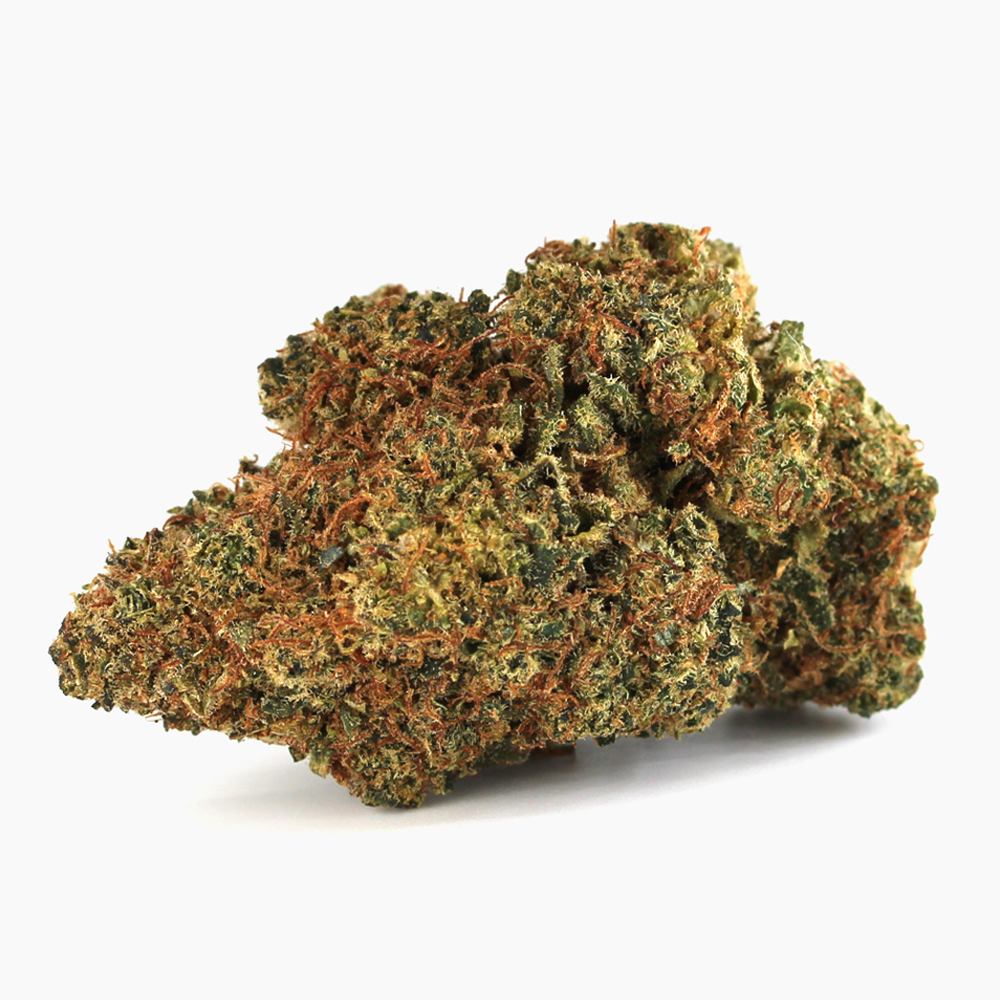
Amnesia is a haze-style flower whose product page describes citrus and earthy notes. You order it from the Amnesia product page, which shows the day’s price, the formats on offer and the review rating, with shipping to AT, BE, DE and NL, where your local rules, not Spain laws on weed, apply.
Amnesia’s aroma in plain words
Picture lemon zest grated over dark toasted bread. The citrus note hits first and stays bright, while an earthy base keeps the whole thing grounded instead of sugary.
The haze side sits between the two, a small, slightly sharp herbal lift that’s closer to a sourdough tang than to a dessert. How loud each note reads comes down to your individual nose. If you’ve picked up the Spanish habit of talking about flower by smell first, this is the profile to describe.
The lab analysis of each batch is available on request from customer service.
Conclusion
Once the aroma and the format are sorted, the bigger picture on spain laws on weed comes down to one habit: read the dated text before you trust the street. The vocabulary tells you what people call marijuana, the acts tell you what the law actually says, and the clubs show how case law shaped a membership model rather than a market.
Details like the number of plants an association grows, or how its members organise shared use, sit in each club’s own rules and in the court rulings associated with them, never in hearsay. Any piece of information that skips the act and the date belongs in a closed tab, no matter how high it ranks in your search results.
At Spliff, flower ships in 3 g, 5 g, 10 g, 20 g, 50 g and 100 g formats, notably in these 4 countries: AT, BE, DE and NL.
Frequently asked questions
Is weed legal in San Sebastián?
No single act declares weed simply “legal” there. Public consumption or possession can draw administrative fines of 601 to 30,000 euros under the Ley Orgánica 4/2015 of 30 March 2015[4]. Cannabis social clubs operate as private, non-profit membership associations, a model shaped by Tribunal Supremo Sentence 484/2015 of 7 September 2015[5], not by an explicit legal permission.