News

An international team led by Swiss researcher Gino Caspari reports Scythian cannabis in Siberia: a tomb at Tunnug 1, in Tuva, held over 1,500 seeds and hair carrying THC traces. Published on 12 November 2026, the find is dated to the 8th century BCE.
Key points
- A Scythian burial mound at Tunnug 1 (Tuva, Russia) held over 1,500 cannabis seeds.
- Hair samples contained cannabinol and a small amount of THC, according to mass spectrometry.
- The authors call it the oldest evidence of cannabis consumption, but key questions remain open.
CBD Hash at Spliff · from €3.50/g · ★ 4.9/5 (428 reviews)
72 h delivery in Europe · Free delivery from €99
The burial mound, known as a kurgan, sits at the Tunnug 1 site in the Republic of Tuva, in south-eastern Siberia. According to Sciences et Avenir, it contained more than 1,500 cannabis seeds, whole or fragmented, along with hair remains bearing traces of cannabinol and THC.
For background on the discovery, see our guide to the 2,800-year-old Siberian tomb.
What the tomb contained
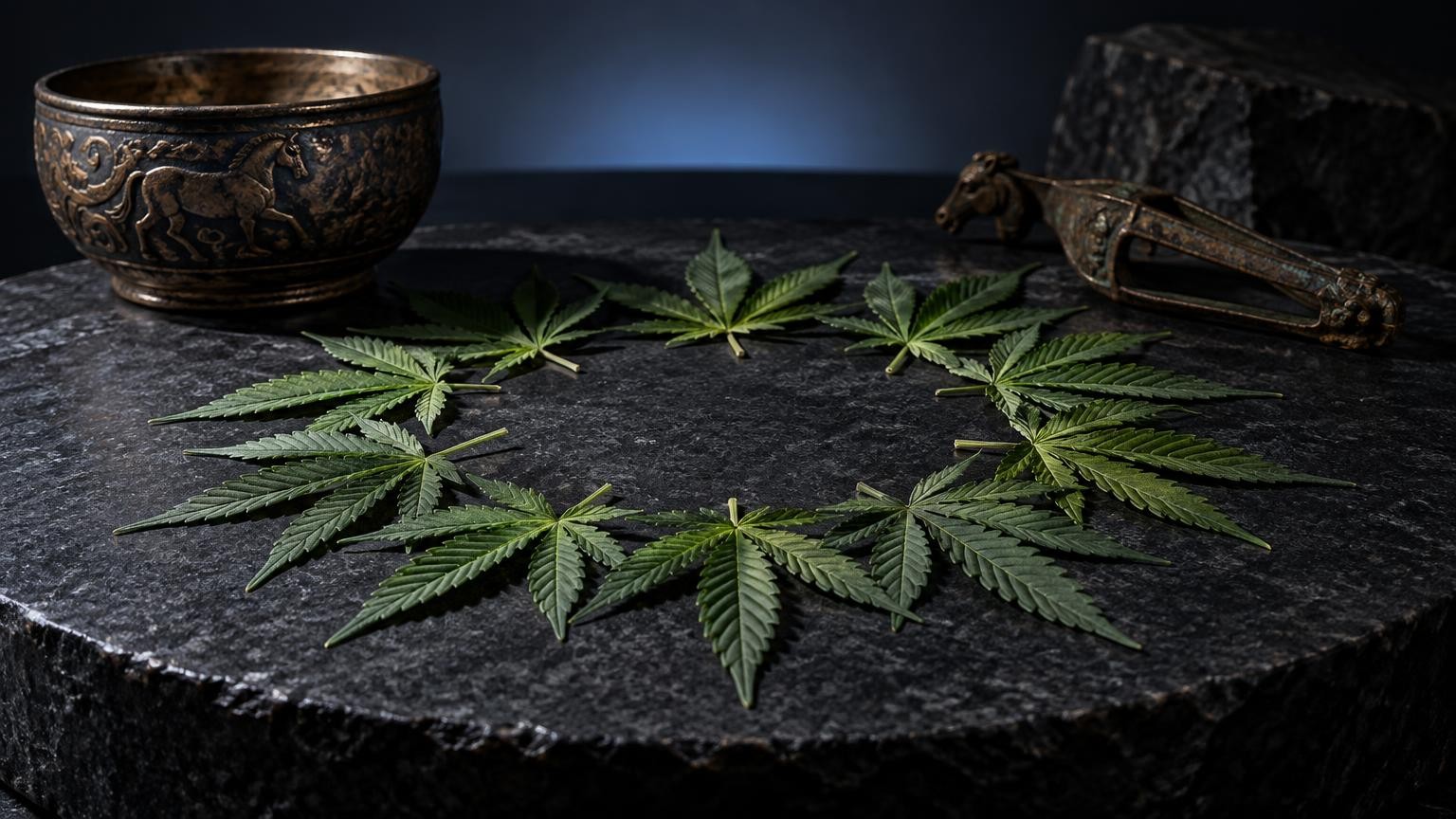
The monumental tomb has four chambers built from wooden logs, holding the dead, and was covered with blocks of dark stone. Horse sacrifices were identified above the mound, and human sacrifices are considered likely.
Six of the seeds were sent for radiocarbon dating. They place the deposit in the first decade of the 8th century BCE, which gives about 2,800 years of documented cannabis use.
Seeds point to a wild species
The seeds are smaller and more irregular than cultivated forms. On that basis, they are attributed to the wild type, Cannabis sativa spp. sativa var. spontanea.
It is not known whether this wild plant was selected or grown for high levels of active compounds. The THC content of Scythian plants remains unknown.
Hair analysis reveals cannabinoid traces
Mass spectrometry found cannabinol in all hair samples and THC to a lesser degree. The authors say the two types of evidence together make up the oldest proof of cannabis consumption.
They add that intent cannot be proven in a prehistoric setting, yet the evidence strongly supports deliberate use for psychoactive effects. They also stress that toxicological analyses cannot quantify how much was consumed.
Echoes of Herodotus and Central Asia
In the 5th century BCE, Herodotus described Scythians inhaling the vapour of burnt cannabis in tents during purification rituals. The Tunnug find gives that account a physical counterpart.
Earlier digs in Central Asia, including the Pazyryk culture in the Altai, Jirzankal in China and Jiayi in Xinjiang, uncovered remains of similar rituals.
Questions still open
- Whether the dead used cannabis or were only exposed to it.
- Whether it was ingested or inhaled.
- Why it was placed in the grave: to calm those to be sacrificed, or to mask the smell of decay. The authors consider the first more likely.
Evidence of this kind is rare because plant parts perish quickly. Hemp was also grown in East Asia for oil and fibre, which makes it hard to separate practical use from psychoactive use. Genetic research on domestication is under way.
Ce que ça change pour toi
This is a history story, with no direct effect on rules or products where you live. It may help put the long human relationship with the plant in perspective.
If the language around cannabis interests you, our piece on slang for weed across Europe shows how that history lives on in words. You can also browse the CBD flower collection. Every Spliff product is lab-tested: THC content below 0.3% (0% for vapes and pods).
FAQ
Where was the Scythian cannabis found?
It was found in a kurgan at the Tunnug 1 site in the Republic of Tuva, south-eastern Siberia, Russia. The tomb held over 1,500 seeds.
How old is the evidence of cannabis consumption?
The seeds were radiocarbon dated to the first decade of the 8th century BCE, about 2,800 years ago. Six seeds were tested.
Does the study prove the Scythians got high?
Not fully. The authors say intent cannot be proven, but the evidence strongly supports deliberate psychoactive use. It cannot show how much was consumed.
Sources
- Sciences et Avenir — Une tombe scythe en Sibérie apporte la plus ancienne preuve de consommation du cannabis
- WELT — Sibirien: Rätselhafter Fund – Wofür Menschen vor 2800 Jahren Cannabis nutzten
Image created with AI