 Written by Sophie Clarke
Contents4 sections
The essentials in 30 seconds
Elephant ear plants are tropical perennials grown for their huge heart-shaped leaves, mostly Alocasia and Colocasia[4][4]. Good care for elephant ears means bright indirect light, watering only when the top inches of soil feel dry, and feeding through spring and summer. Their leaves contain calcium oxalate crystals that irritate skin, so cook them before eating[4].
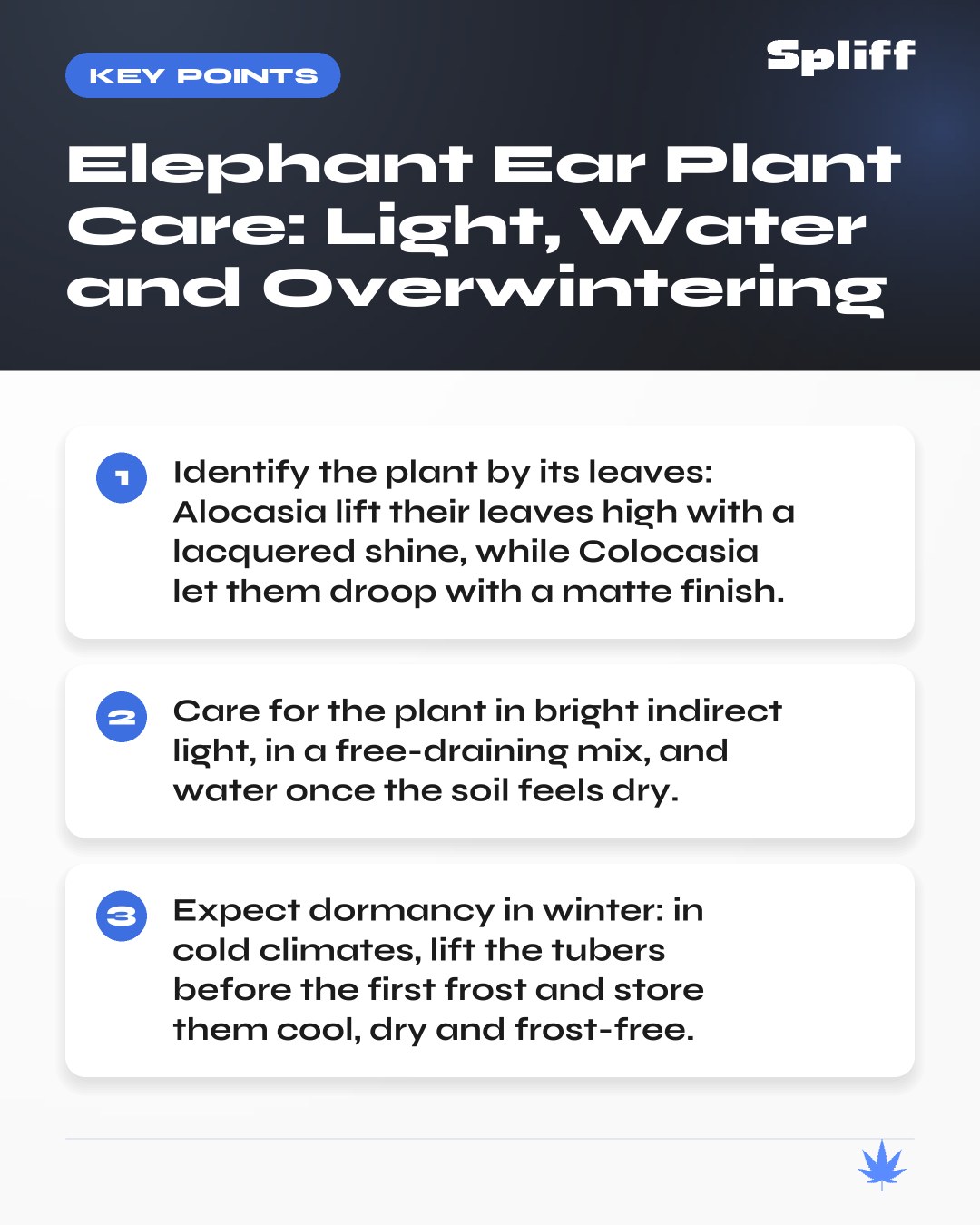
- Identify the plant by its leaves: Alocasia lift their leaves high with a lacquered shine, while Colocasia let them droop with a matte finish.
- Care for the plant in bright indirect light, in a free-draining mix, and water once the soil feels dry.
- Expect dormancy in winter: in cold climates, lift the tubers before the first frost and store them cool, dry and frost-free.
Elephant ear plant refers to several tropical foliage plants, mainly Alocasia and Colocasia (occasionally Xanthosoma), that grow from tubers and are grown for their huge heart- or arrow-shaped leaves. This guide shows you how to tell which one you own, how to keep it healthy indoors, and how to bring it back after a continental European winter.
Start with identification, because the two main genera look alike from across the room but behave differently. An upright elephant ear alocasia holds its leaves high and stiff, with a waxy, almost lacquered surface and veins drawn like a graphic print. Colocasia lets its matte, softer ears tip downward, closer to brushed velvet than to glazed ceramic.
A few varieties you’ll often find as houseplants, and the detail that gives each one away:
- Alocasia amazonica ‘Polly’: dark, glossy arrowheads with bright white veins.
- Alocasia zebrina: plain green blades on stems striped like a zebra.
- Colocasia esculenta: broad, matte hearts with the tip pointing toward the ground.
Getting the genus right decides how you water. Alocasia prefers its soil to dry out partly between waterings, while Colocasia handles consistently moist soil much better. A lot of the trouble people have with these ear plants starts with caring for one as if it were the other.
What is an elephant ear plant, and which one do you have?
Your elephant ear plant is almost certainly an Alocasia or a Colocasia, the two genera most often sold under that name in European garden centres. According to Wikipedia’s Colocasia entry, the name comes from the leaves, which are shaped like a large ear or shield[5]. To tell which one you have, check where the leaf points, where the stalk joins it and whether the surface shines.
Alocasia or Colocasia: how to tell upright elephant ears apart
Leaf posture gives you a first hint, but a solid ID takes three quick checks. Both are tropical aroids, and the Wisconsin Horticulture extension notes that in cooler climates they’re grown for their large leaves[4].
- Look at the tip. Follow the leaf to its point. Raised like an arrowhead means Alocasia. Drooping like a wet umbrella means Colocasia.
- Turn the leaf over. Find where the stalk meets the blade. A stalk joining at the notch of the V points to Alocasia. A stalk attached inside the blade, a little way in from the edge, points to Colocasia.
- Read the surface. A lacquered-ceramic shine says Alocasia. A finish where water beads straight off says Colocasia.
Two matching signs out of three are enough to name your plant. All you need is decent light conditions to see the leaf clearly, and the check beats any pot label.
Once you know the genus, these common houseplant varieties are easy to pin down by one giveaway detail:
- Alocasia amazonica ‘Polly’: dark, glossy arrowheads with bright white veins.
- Alocasia zebrina: plain green blades on stems striped like a zebra.
- Colocasia esculenta: broad hearts with the tip pointing toward the ground.
One thing to know before you start poking around: according to the University of Wisconsin horticulture extension, the leaves and all parts of the plant contain needle-like crystals of calcium oxalate, which are a skin irritant[4].
Read also: THCX
How do you care for an elephant ear plant?
To care for an elephant ear plant, give it bright indirect light, water once the top couple of inches of soil are dry, and pot it in a free-draining mix. Add warmth and humid air, feed from spring to summer, then cut back sharply on water and feeding in autumn.
Your genus still sets the fine-tuning: Alocasia drier, Colocasia steadier. A feeding routine is best started in spring, when fresh leaves begin to unroll.
Do elephant ears like sun or shade?
Bright shade is the answer. Indoors, place the plant a step back from a south or west window, or behind a sheer curtain, so it gets bright indirect light all day. Outdoors in a Central European summer, dappled half-shade under a tree or on an east-facing terrace works best.
Too much sun leaves bleached, crispy patches, like paper left on a car dashboard. Too little light makes the stalks stretch and lean toward the window. Outside the tropics the leaves stay much smaller anyway[4], so a modest leaf size doesn’t automatically mean your light is wrong.
Why are the leaves turning yellow?
One old leaf turning yellow while new ones keep coming is normal, because the plant is recycling it. When several leaves start yellowing at once, the usual cause is overwatering. Match the symptom to its fix:
- Several soft yellow leaves, damp pot: too much water. Only water when the top inches of soil feel dry, and check that the drainage hole isn’t blocked.
- Brown, crispy tips: the air is too dry. A humidifier or a pebble tray gives the plant the humidity it needs.
- Pale, washed-out patches on the window side: sun scorch. Move the pot back into filtered light.
Do elephant ear plants come back every year?
Yes, as long as frost never reaches the tubers. Elephant ears are tender, tropical perennial plants grown for their large, heart-shaped leaves[4]. They return from the tuber every year but won’t survive a German, Austrian, Dutch or Belgian winter in the ground. Bring pots indoors and lift garden tubers before the first frost.
Colocasia belongs to the Araceae family and is native to Southeast Asia and the Indian subcontinent[5], so wintering it is part of the deal. Let lifted tubers dry for a few days, then store them cool, dry and frost-free. Check them now and then for soft, rotting spots.
Elephant ears grown in pots and kept indoors often droop and shed leaves over winter. That’s normal dormancy, not a dying plant, so water sparingly until spring.
When should you start elephant ear tubers indoors?
Tubers are best started indoors in late winter, a few weeks before your area’s last frost, so they’re already in leaf when it warms up outside.
- Pot each tuber in a free-draining mix with the growing tip up, so the shoot has a clear path.
- Place the pot somewhere warm and bright and keep the soil barely damp, until a first leaf unfurls.
- Increase watering as more leaves open, and the plant builds a sturdy crown.
- Move it outdoors once nights stay mild and frost is over, giving it a full season: spring, summer and into autumn.
On a separate note, Spliff’s cannabis range is strictly for adults (18+). Magic Pod Live Rosin x2 and Magic Pod x2 come as pairs of pods, while Magic Vape is the range’s vape format. Every Spliff product is lab-tested: THC content below 0.3% (0% for vapes and pods).
Conclusion
Once your tubers wake up indoors and the nights stay mild, the cycle starts over. Your elephant ear plant playbook fits in three moves: name the genus, let that answer set your routine, and get the tubers under cover before the first frost.
Generous containers, free-draining soil and warm temperatures are what turn a modest pot into a showpiece of large, ear-shaped leaves, whether yours are glossy green or nearly black.
Sources
- Elephant Ears (Colocasia, Alocasia, and Xanthosoma) – Wisconsin Horticulture — hort.extension.wisc.edu
- Colocasia – Wikipedia — en.wikipedia.org