 Written by Sophie Clarke
Contents6 sections
The essentials in 30 seconds
The curry plant is Helichrysum italicum, a silver-leaved Mediterranean herb whose name refers to the fragrance of its leaves, not to curry cooking[4]. It is not related to the curry tree, Murraya koenigii, and is not used as masala[4]. The plant is reportedly used in traditional medicine in several European countries, but no health claim is endorsed here[4].
The curry plant is Helichrysum italicum, a compact, silver-leaved Mediterranean herb named for the warm, curry-like smell of its foliage, not for any role in curry cooking. That one detail is the source of most of the confusion around it.
You’ll also see it called common curry plant, immortelle or everlasting. It belongs to the helichrysum genus. This is a scent plant, not a spice.
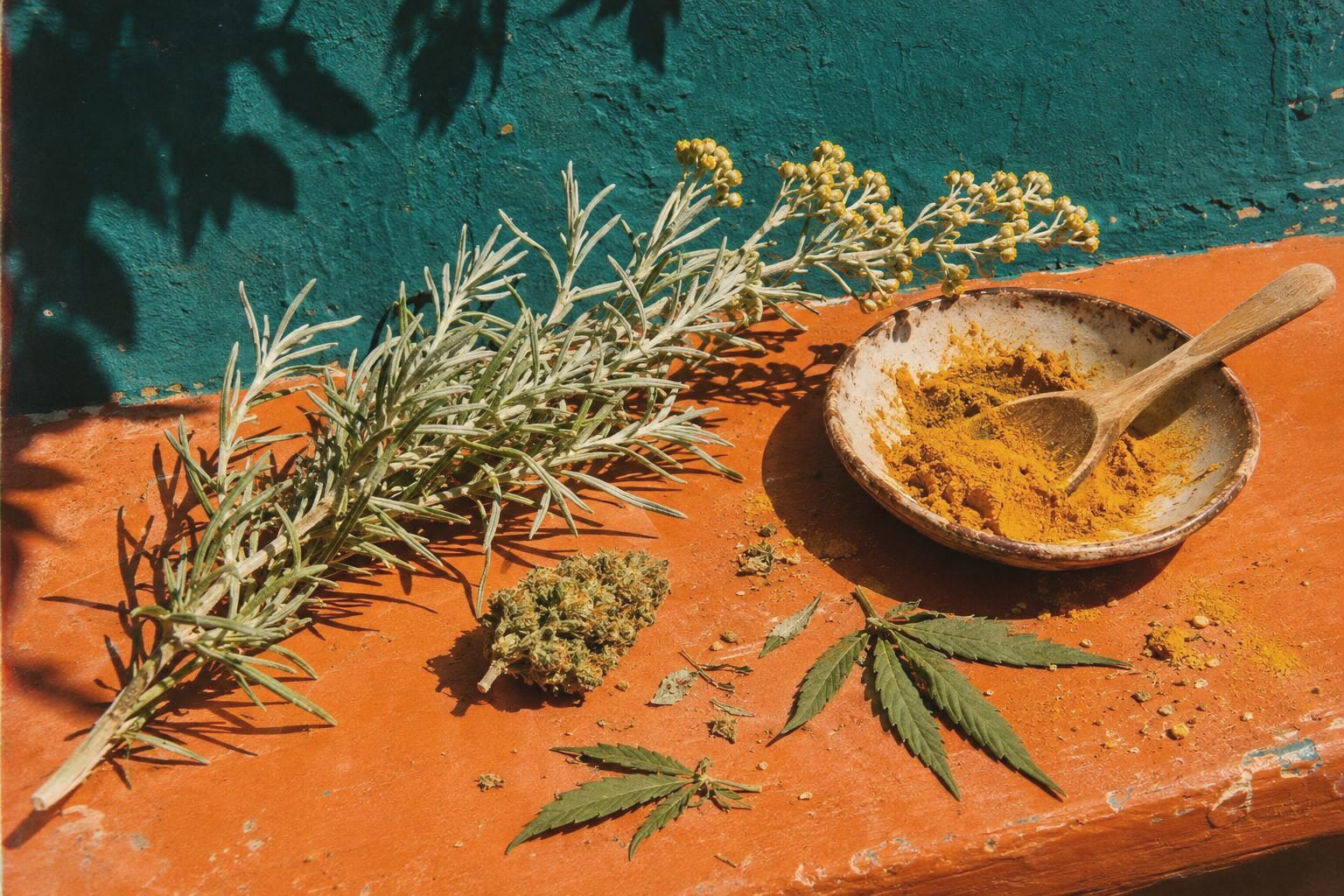
It’s easy to recognise. Look for a small woody shrub with needle-like, silver-grey leaves, topped in summer by tight clusters of yellow flowers.
Below, you’ll learn where that smell comes from and whether the leaves belong in your kitchen. You’ll also get a side-by-side with the real curry leaf tree, the perfume story of immortelle oil, and a look at why herb plants like this one give you a handy vocabulary for reading aroma notes on cannabis products.
What is the curry plant (Helichrysum italicum)?
The curry plant is Helichrysum italicum, a silver-leaved aromatic sub-shrub from the Mediterranean and a member of the daisy family. It gets its common name from the strong fragrance of its leaves[4]. It is an ornamental scent herb, not a spice plant, and has no botanical link to the curry tree, Murraya koenigii[4].
That last point shapes everything that follows. When a recipe asks for curry leaves, it means Murraya koenigii. The silver plant helichrysum italicum on a garden centre shelf is a different species altogether.
Think of the label as a description of the curry plant smell, nothing more. The name tells you what your nose will notice, not what goes in the pan.
Does the curry plant come back every year?
Yes. Helichrysum italicum is described as a tender perennial (USDA Zones 7–10), which can regrow yearly in mild climates[4], pushing out fresh silver growth and new clusters of yellow flowers in summer from the same framework of stems.
That staying power comes from where it evolved: dry, rocky, sandy Mediterranean slopes with hot summers and free draining soil. Its whole build (narrow leaves, a woody base, a silvery coating on the foliage) is designed to cope with sun and drought rather than with rich, damp ground.
The weak spot is cold combined with wet. Long frosts and waterlogged roots during a northern European winter can kill a plant that would live for years on a Mediterranean hillside. In harsher climates it can therefore behave more like a short-lived perennial.
The woody base also explains why gardeners prune curry plant shoots instead of sowing it fresh each spring: the plant is built to persist, and its flowers come back on that permanent structure.
Is the curry plant the same as the curry leaf plant?
No. The curry plant is Helichrysum italicum, while the curry leaf plant is the curry tree, Murraya koenigii. They share a nickname and nothing else botanically: a different genus, a different leaf and a completely different job in the kitchen. Only the curry tree gives you real curry leaves.
Think of it like two bands with the same name on different labels. Here’s how they stack up side by side.
| Feature | Curry plant | Curry tree |
|---|---|---|
| Latin name | Helichrysum italicum | Murraya koenigii |
| Growth form | Tender perennial (USDA Zones 7–10)[4] | A tree |
| Role in cooking | Grown for scent, not for curry dishes | Source of true curry leaves |
If you’re growing one, the curry plant is a tender perennial suited to USDA Zones 7–10, according to Wikipedia[4]. That’s a garden detail, not a cooking one.
Which one actually goes into a curry?
The curry leaf from Murraya koenigii is the culinary ingredient, not the silver herb. When a recipe asks for curry leaves, it means the leaves of the curry tree. That’s your best bet, and the only correct one.
The curry plant can’t replace them, however strong its smell is.
Does the curry plant taste like curry?
Not really. The curry plant smells strongly of curry: warm, savoury, with a slightly sweet edge. On the tongue, though, the leaves are widely described as bitter and resinous rather than spicy. The scent does all the work, which is why this herb belongs in the scent garden and not on the spice rack.
That gap between nose and mouth is the interesting part. Brush the silver leaves or let the sun warm them, and they release volatile aromatic compounds that your nose picks up straight away. Your tongue mostly reads basic tastes like sweet, salty, sour and bitter, so most of that curry impression never turns into flavour.
Compare it with the kitchen herbs you already cook with. Thyme, basil, mint and lemon balm taste roughly like they smell, so what you sniff is what lands on the plate. With this plant, curry is a perfume, not a seasoning.
Can you eat curry plant leaves?
Can you use a curry plant in cooking? Plainly, no: it isn’t a culinary ingredient. It won’t give a dish real curry flavour, and bitterness is what you’d get instead of spice.
Don’t put any garden plant on a plate because of its nickname, and don’t treat its yellow flower clusters like edible flowers either. If you’re still curious, check a reliable botanical reference or the food-safety authority in your country before eating any part of it.
Who should not take curry leaves? That’s a question for a healthcare professional, not a herb guide. If you have any doubt about your health, a medication or an allergy, ask a doctor or pharmacist before adding any herb to your diet.
What is curry plant essential oil used for?
Curry plant essential oil, usually sold as immortelle or helichrysum oil, is an essential oil obtained from Helichrysum italicum. It’s widely reported as a perfumery ingredient, where it adds a warm, rounded note, and as a cosmetic one, though we have no source to cite on either use. Health claims about it are everywhere online, but none of them comes with a source we can point you to.
If the leaves carry the curry smell, the oil carries the commercial value. Perfumers reportedly treat immortelle as a character note: a small touch adds depth and warmth, the way a pinch of smoked salt changes a dessert. Skincare brands add it to face oils and creams too, which we read as a scent and formulation choice, not a promise of results.
The price tag is usually put down to yield. The plant is a modest perennial, woody at the base and reaching about 60 cm or more[4], so it takes a lot of plant material to fill a small bottle of essential oil.
Then there’s the other side of the search results. Type “plant helichrysum” or “curry plant helichrysum” and you’ll find pages on medicinal uses, “anti inflammatory properties” and how the herb was used in traditional medicine. Before you trust any “anti inflammatory” headline, ask:
- Was the essential oil tested, or a different extract?
- Is the page selling the oil it praises?
For contrast, here’s what an actually evaluated medicine looks like on paper: Epidyolex is used alongside clobazam to treat patients from two years of age with Lennox-Gastaut syndrome or Dravet syndrome.[3] That’s a specific product with an official file behind it, and a bottle of immortelle oil simply isn’t in that category.
How does the curry plant's aroma help you read cannabis terpenes?
The curry plant has a resinous, somewhat bitter aroma reminiscent of sage or wormwood.[4] Cannabis product pages use the same herb garden vocabulary (herbal, spicy, citrus, resinous, minty). Read those descriptors as notes for your nose, compare them with plants you already know, and judge taste and potency separately.
Even botanical references don’t settle on one word for the curry plant. Its aroma is described as resinous and somewhat bitter, reminiscent of sage or wormwood[4]. That’s a smell you can place, even if you’ve never seen the shrub.
One plant, several honest descriptors: aroma words are a vocabulary, not a measurement.
Cannabis descriptions use that same vocabulary across Europe, so a product page written in Spain uses the same words as one written in Germany. Your nose reads them differently depending on conditions, so compare notes in the same setting, ideally indoors and away from kitchen smells. Here’s how to read them with your nose, not as a menu:
- Herbal points toward thyme or basil: green, savoury, a little dry.
- Fresh or minty means a cool lift, like crushing a leaf of mint, lemon balm or catnip.
- Resinous or spicy sits closer to the curry plant itself: warm, sticky, slightly bitter.
- No aroma word tells you how strong a product is or how long its effect lasts. Those details sit elsewhere on the product page.
Format also changes how aroma is presented. The Magic Pod Live Rosin x2 carries its extraction method in its name. The Magic Pod x2 THCX vape pods and the Magic Vape each have their own product page, so check the descriptor there rather than guessing it.
THCX is a trade name, not a molecule: every batch is lab-tested for classified molecules and none are detected. For adults only (18+).
Conclusion
That nose-first habit is the real takeaway from the curry plant: trust the scent, then check the Latin name. Whether you spot it on a dry hillside in Italy, the country its species name points to, or potted in sandy loamy soil at a garden centre, it belongs next to sage and fennel in a scent garden, not in your curry pan.
Bring that same reading to the aroma notes in our vape collection. At Spliff, we ship to several markets, including these 4 countries: Austria, Belgium, Germany and the Netherlands.
Sources
- Epidyolex (cannabidiol) — European Medicines Agency, EPAR — www.ema.europa.eu
- Helichrysum italicum – Wikipedia — en.wikipedia.org