 Written by Sophie Clarke

Contents7 sections
The essentials in 30 seconds
Catnip, Nepeta cataria, is a mint-family perennial that grows 30–100 cm tall[5] and is native to southern and eastern Europe[5]. About two-thirds of cats are drawn to its nepetalactone[5], and the plant is widely naturalized in North America[5]. Check the full Latin name before you buy a live plant.
The catnip plant is Nepeta cataria, a perennial herb in the mint family (Lamiaceae), known for its soft grey-green leaves, its square stems and the nepetalactone stored in its foliage.[5]
This guide gives you a clean botanical ID, a firm line on catnip vs catmint, and a straight answer on the “cat weed” mix-up with cannabis. You’ll also get a neutral checklist for reading a pot label before you buy a live plant, from the sunny position it likes to how much water it really needs. Availability shifts with the seasons, and what’s available on the shelf changes with it: a leggy pot in late summer isn’t the same buy as a compact one in spring.
What is a catnip plant?
A catnip plant is Nepeta cataria, an upright, bushy perennial herb from the mint family (Lamiaceae). You recognise it by its soft grey-green toothed leaves, small pale flower spikes and a sharp minty, lemony scent. That scent comes from nepetalactone, the aromatic compound stored in its foliage.
How do you recognise Nepeta cataria catnip at a glance?
Here’s the quick guidance: catnip plant ID starts with the leaves, then your nose. Whether it’s growing in a garden bed of rich compost or in a catnip plant pot on a balcony, true cataria is easy to pin down once you know what to look for:
- Leaves: heart-shaped with toothed edges, grey-green and slightly downy, like a fuzzier spearmint.
- Flowers: small white blooms dotted with purple, packed into spikes at the stem tips.
- Scent: crush a leaf and you get mint, lemon and dry hay all at once.
For height and spread, catnip is a short-lived perennial herb that grows between 30–100 cm (12–39 in) tall[5]. Square stems are another clue, shared by the whole mint family, and they’re worth checking before planting anything sold under the catnip name.
Which compound sits in catnip leaves?
The compound is nepetalactone, an iridoid from the wider terpenoid family. That’s the same broad chemical clan as the terpenes behind cannabis aromas. It’s volatile, so it drifts into the air as soon as you bruise the leaves or flowers, which is why brushed plants smell stronger than ones left alone.
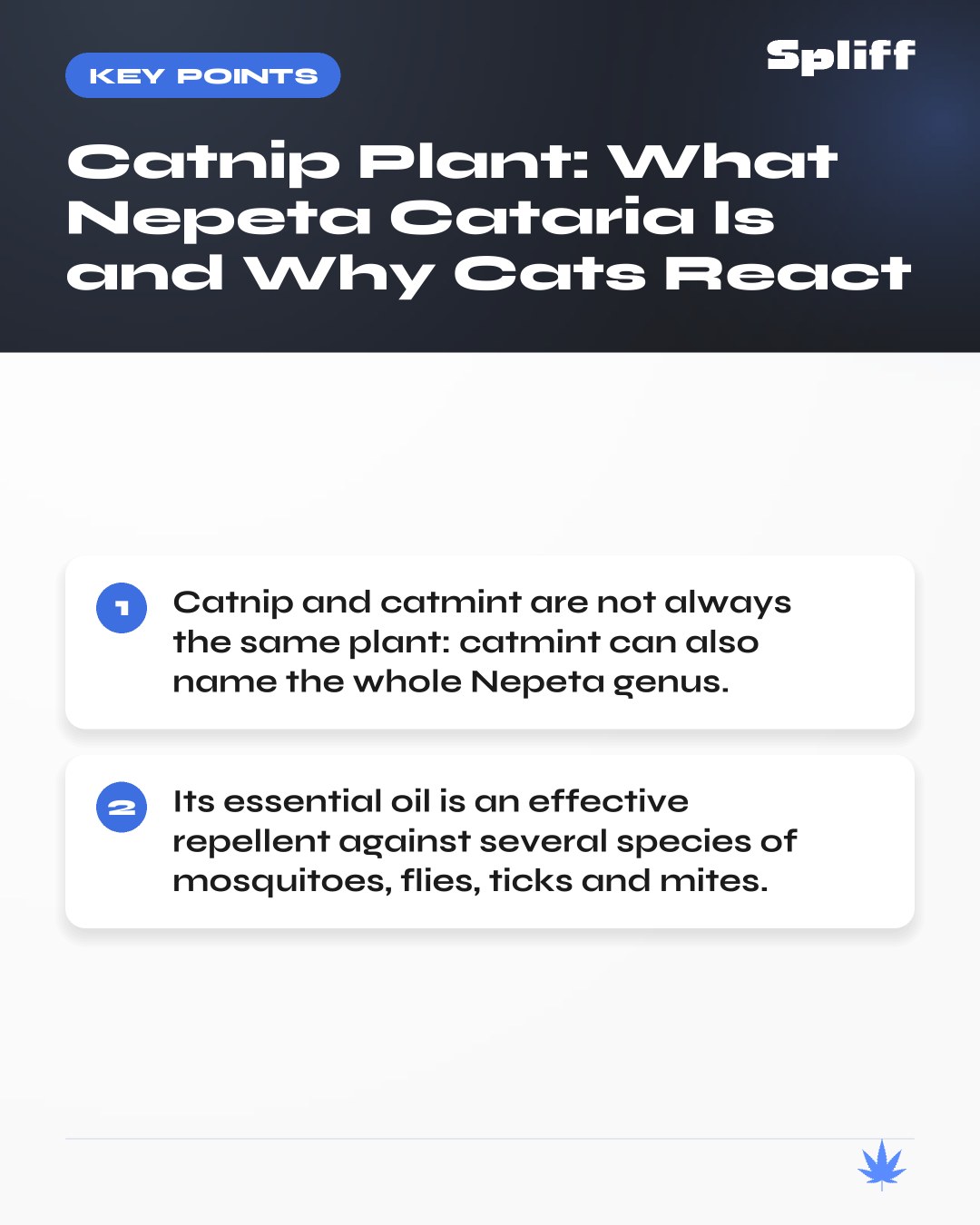
That chemistry also does a job that has nothing to do with cats. Catnip essential oil is an effective repellent against several species of mosquitoes, flies, ticks, mites and other disease vectors[4]. Think of nepetalactone as the plant’s chemical bodyguard. Keep that in mind for the comparison with cannabis.
Read also: THCX
Is catnip the same as catmint?
Not quite. The catnip plant, Nepeta cataria, is commonly known as catnip or catmint[5], but catmint is also the common name for the whole Nepeta genus[5]. Every catnip is a Nepeta, yet a pot labelled catmint may hold an ornamental species bred for its flowers rather than its scented leaves.
Which Nepeta is actually in that garden-centre pot?
Read the second word of the Latin name. If the label says Nepeta cataria, you’re holding the catnip plant. Any other word after Nepeta, such as × faassenii or racemosa, means a different species or hybrid, even when the tag says catmint in big friendly letters.
- Find the botanical name: it’s usually printed in italics below the common name.
- Check the epithet: “cataria” is catnip. Anything else is a different Nepeta, typically bought for the border.
- Spot the “×”: it marks a hybrid, which tells you straight away it isn’t the wild catnip species.
- No Latin name at all: a tag that’s free of any botanical name doesn’t settle it, so treat the plant as unidentified.
A plant pot tagged only “catmint” is a coin toss. Whether it’s a litre pot on the bench or a seed packet, insist on the full name if you want Nepeta cataria for its scented leaves, the ones people dry to stuff a homemade cat toy. When a tag looks vague, cross-check the Latin name in an international botanical database before you pay.
Does catnip come back every year?
Yes. The catnip plant is a short-lived perennial, so one clump usually comes back for a few seasons rather than forever. Its leafy top growth dies back in the cold months, the roots push fresh shoots in spring, and the plant also self-seeds, so new seedlings keep popping up around the original one.
That seasonal rhythm suits a herb native to southern and eastern Europe, northern parts of the Middle East, and Central Asia[5]. On a pot label, a catnip plant Nepeta cataria is usually filed under “Details: perennial”, and that one word explains most of its behaviour.
Self seeding is the trait that lets catnip spread so easily: the spent flower spikes drop seed that sprouts close by. Want to limit self seeding? Snip the faded flower heads before they ripen, and you decide where the next generation grows.
So if the availability of a catnip plant reads “out of stock” in November, you’re looking at the plant’s calendar, not a supply problem. Check price and availability again once spring stock lands, and read the delivery notes on live plants, since a young pot travels better in mild weather than in a frost.
Is catnip safe for cats to eat?
Catnip is one of the most familiar cat herbs, sold fresh, dried and stuffed into a plush toy, yet no single safe amount fits every animal. As a common-sense rule (not veterinary advice), treat the leaves as an occasional extra rather than food and take stock of how your cat responds. For any question about your cat eating a catnip plant, your vet is the one to ask.
Once your clump is back in leaf, its nepetalactone becomes the cat side of the story: about two-thirds of cats are attracted to catnip because of this terpene[5]. So a cat that walks past your pot without a glance isn’t broken. It simply belongs to the group that doesn’t react.
For the cats that do, the reaction mostly starts at the nose, when they sniff, rub or roll on bruised leaves. Chewing and swallowing the leaves is a different behaviour, closer to grazing on any garden greenery, and if you sow where your cat roams, tender seedlings rarely survive that kind of attention. That eating part is the one worth keeping modest.
Catnip vs cannabis: are the two plants related?
No. The catnip plant belongs to the mint family, Lamiaceae, while cannabis sits in Cannabaceae, a separate botanical family.[5] Catnip contains no cannabinoids at all: no THC, no CBD, none of it. The overlap is a nickname, not a family tie.
Why do people call catnip ‘weed for cats’?
The nickname comes from what you can see. A cat rolls, rubs and zones out after a sniff, and the herb is leafy and green, often dried and crumbled like flowers. That’s where the resemblance ends.
So the “weed” label is a visual joke, nothing more. A store-bought soil catnip plant sitting in a container on your windowsill is a scented mint cousin, not a stash. Planting it is about as rebellious as potting up basil.
If cannabis aromas are what you’re after, the Magic Pod Live Rosin x2 is the pod format to look at. It’s for adults only, and the product page shows the day’s price and full details. THCX is a trade name, not a molecule: every batch is lab-tested for classified molecules and none are detected.
CBD is not a medicine and is not a substitute for medical advice or treatment. If in doubt, consult a healthcare professional.
What to check before you buy a catnip plant
Now that you know which plant you’re after, buying the right one comes down to a few checks. Catnip is widely naturalized in northern Europe, North America and New Zealand, so you’re not hunting a rarity.[5] Treat this as a neutral checklist for any nursery or garden centre.
- Label: Nepeta cataria in full. Anything vaguer may be an ornamental catmint.
- Pot size: plug plants are the youngest and cheapest option, a small pot sits in the middle, and a larger pot gives you a more mature clump at a higher price.
- Price, availability, delivery: a good listing, whether it’s a Thompson & Morgan catnip page or a small grower’s, shows all three before checkout. Check that delivery is available to your country and when the next available delivery slot is. Live catnip plant availability peaks in spring and summer, and a seed packet is your off-season alternative.
How does a live catnip plant survive delivery?
It travels well when it’s packed upright, held firmly in its pot and shipped early in the week. Open the box the day it arrives. Feel the soil: catnip plant compost should be slightly moist (if it’s bone dry, give it a small drink of water), and the leaves should still smell sharp and minty.
A few yellow lower leaves after a dark journey are normal. Mushy stems or mould aren’t, and that’s when you contact the seller. After delivery, catnip plant roots need space, so pot it up within a day or two: that’s the real test of a “delivery available” promise.
Conclusion
That covers it: a catnip plant is a scented mint-family herb with zero cannabinoids, so judge it by its leaves and its label, never by its nickname. Choose a young pot that clearly reads Nepeta cataria (or sow your own seeds in light, well-drained soil), find it a sunny spot, and your cat gets the real thing rather than an ornamental lookalike.
If cannabis aromas are more your thing, our THCX vape collection picks up where this guide ends, for adults only.
Sources
- Catnip (Nepeta cataria L.): recent advances in botany, … — scholarship.libraries.rutgers.edu
- Catnip – Wikipedia — en.wikipedia.org